
Anna Helmer
Oh, how I theoretically love the splashy yet pitter-pattery, decidedly non-summery sound of rain falling on snow. It’s actually happening a lot this winter, and I wonder if the bloom comes off the rose with too much repetition. I love it most on especially hot summer days when I have to perform farmwork, that’s for sure.
Just to set the scene more specifically, today’s weather is, as usual, hovering around zero, with heavy, wet snow flakes falling on top of what’s left of a modest accumulation of same, which itself lies on the not-quite-frozen ground. I don’t think a person could walk on a field right now without sinking in the mud and losing their boots in a puddle. The driveway is only marginally better.
Because this is a woo-woo Biodynamic article, I can say that the fields don’t want us there anyways. We need not involve ourselves at this stage of their development. And developing they are: Biodynamically, winter is a very vibrant and important time underground. As soon as I began looking into Biodynamics, I realized that theoretically it mostly has something to do with first recognizing and then managing the flows of energy into and out of the earth. Without getting too specific (I really couldn’t if I tried), I understand we’re talking about forces that course through our solar system taking power and influence from celestial bodies and depositing it in the places to which it is attracted, ideally the soil in our fields.
During a northern, higher latitude winter such as this one, the mud, snow, and puddles serve to seal off the earth. There are no annual plants vectoring energy from the soil to the air, and no new supply of plants to decompose. The energy is still flowing in from behind of course, where the other side of the earth is in full light and bloom, but there’s nowhere for it to go.
The energy is accumulating, and wanging around somewhat aimlessly. We can help it get focussed, which will be more helpful for our growing purposes, with BD 500. It is often suggested to apply it in the winter itself, but surely not in this watery environment. I hope the BD 500 we applied earlier in the fall is doing something. I think it should be helping to organize the chaos, so when the crop grows, it will come up in a pleasingly potato-y way, and the tubers will be tasty. The Biodynamic preparations are the tool we are using to exert influence—however futile it might seem.
I like to think that when we plant potatoes in May, it is into soil that has had a really good Biodynamic winter. In fact, I even think it’s reasonable to think that tubers literally bathing in the soil might absorb some of whatever it is we are talking about.
I’m thinking about this as I begin the annual two-month stint of root house work, sorting seed potatoes. The potatoes in there were dug in August and stored in 1000-pound tote bins stacked three high. The room is stuffed. I’m looking at a bin label right now, all soggy with snow melt—it’s chucking down out there—Sieglinde Fld. 1b Aug 22. It’s a hasty scrawl that conjures up a vivid image of that blazingly hot afternoon almost six months ago.
All that remains of that moment is this disintegrating label and the 1,000 pounds of potatoes in the bin to which it belongs. Or is it? Perhaps the potatoes provide a much more solid connection not only to that summer day, but to the field and the soil itself. I fancy that each potato in the root house might contain some summer-y energy: they were bathing in it, after all.
There are a lot of potatoes around me. That’s a lot of summertime stored in this one room and it explains why I like working in here so much during the winter. I am surrounded with summer energy—but not summer temperatures, which is such a treat. If I think about it, it’s obviously not the sound of rain-on-snow that’s warming my heart, it’s potatoes.
Anna Helmer farms in Pemberton and wonders if it would work for teenagers.
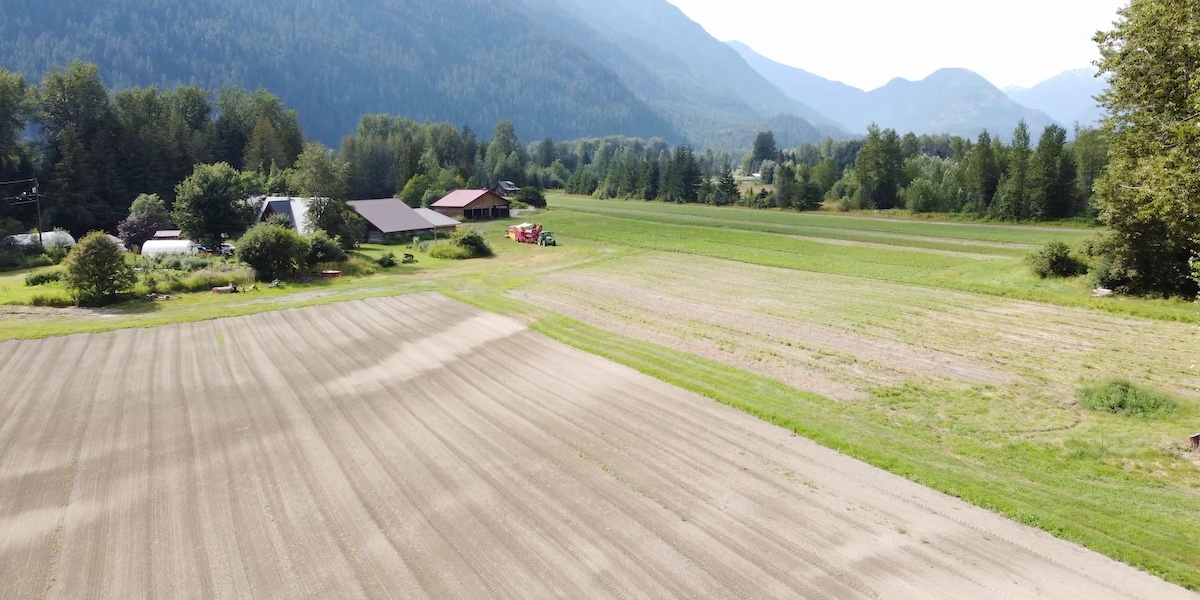
Featured image: Warmer days at Helmers’ Organic Farm. Credit: Organic BC.