
Darcy Smith
At Creekside Dairy, “it’s all about the cows.” For Johannes and Julaine Treur, the long hours, early mornings, and often tight margins are worth it. “When you see your whole herd stampeding out to pasture every morning and they’re so healthy and look so good, I don’t think there’s any other feeling like it,” says Julaine. “The cows are the backbone of our whole farm. Our lives revolve around them, the farm revolves around them.”
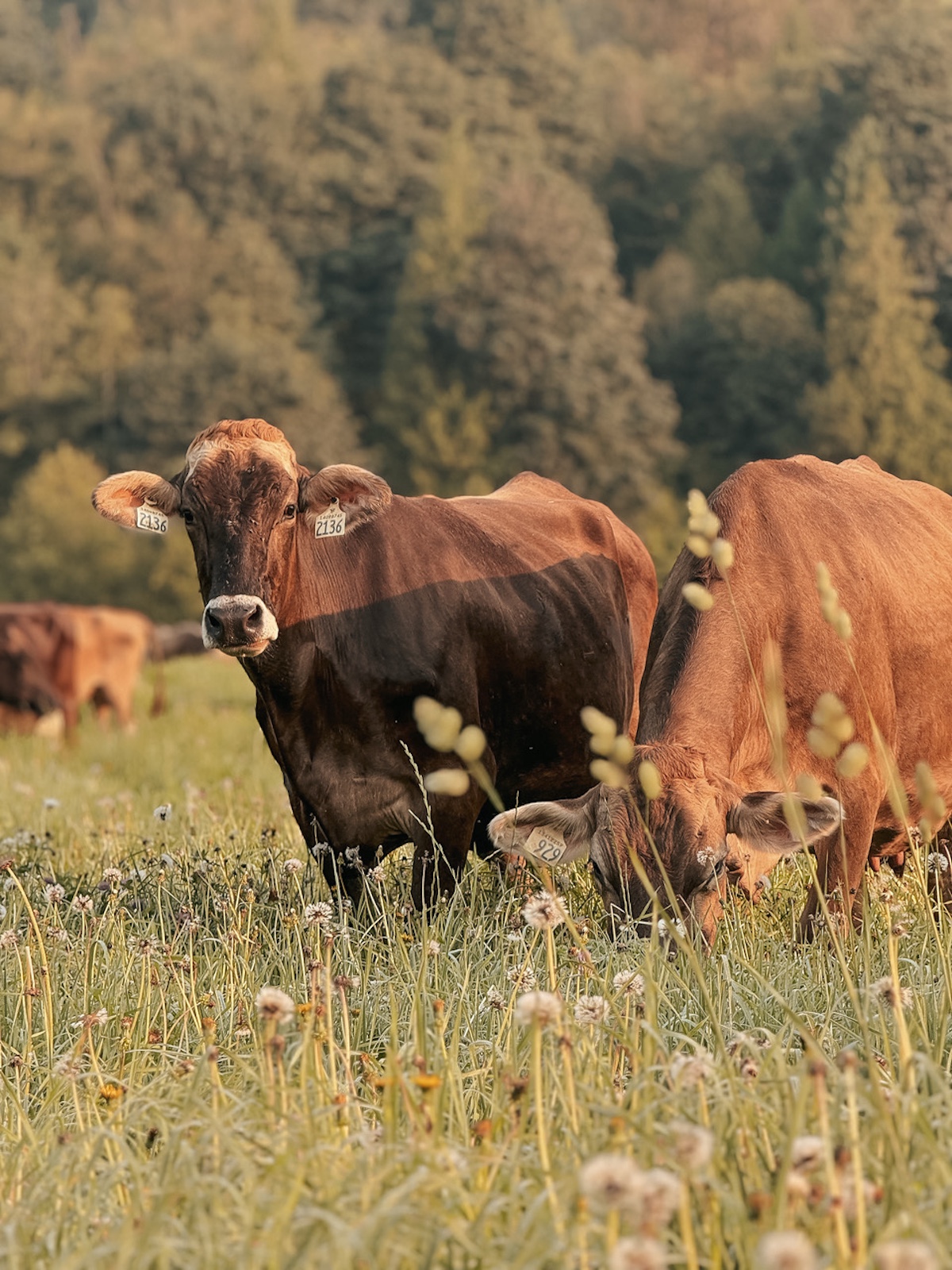
Those cows? 100 head of registered Brown Swiss with “fuzzy ears.” Hearty, inquisitive, friendly—and “definitely smarter than a lot of other dairy breeds,” Julaine laughs. They also make great milk for cheese, due to the percentage of fat and protein, specifically kappa-casein BB, in the milk. And, after the cows themselves, cheese is the star at Creekside.
Johannes comes from a long line of dairy farmers in the Netherlands, Julaine says: “he can trace back six generations.” His family moved to Canada in 2002, after his father sold the family farm and became a pastor—at Julaine’s family church in Chilliwack, which is how the two met. Johannes, along with two of his brothers, also found opportunities to farm in Canada, and purchased a dairy farm together in Rosedale. Julaine and Johannes met six months before they bought that farm, and Julaine remembers “while dating, I spent a lot of time at the farm, milking cows. I fell in love with dairy cows.” Though she didn’t grow up farming and had a career as a pharmacy technician, her maternal grandparents were dairy farmers, and she found that she “really got into it!”
The goal of the family farm venture was always to “get started in the dairy industry together, and when possible, to split up and each farm on our own,” Julaine says.
The Treurs were able to do that in 2011, when they purchased what is now known as Creekside Dairy. Named for the creek that runs alongside the fields, the farm is located in Agassiz, on 72 acres (plus another 50 rented). It was a dairy farm until about 10 years before the Treurs purchased it, and Julaine remembers visiting the property as a child—the farmers there at the time had a meat shop where her family bought beef and pork.
Today, the property also features a new dairy barn and cheese processing facility, and the Treurs have continued the trend of bringing their customers to the farm.
“We farmed regularly for half a year,” remembers Julaine. “Then our feed nutritionist put it into our heads about organic. We were already doing things like feeding pasture and reducing fertilizer use.” When they looked into it more, they found there was demand for organic milk. With the costs and eventual return, “it just made sense.”
Another benefit was that farms that transitioned to organic got extra milk quota, and they wanted to expand the herd. They submitted their certification application in 2012, and put their first load of organic milk on a milk truck in 2015.
“One of the most gratifying parts of transitioning to organic is watching the soil life grow and become what feeds our crops,” says Julaine. When they purchased Creekside, the previous owners had been renting the land to a farmer using it for forage corn, and, in the year before the Treurs took over, Brussels sprouts.
Because the land was being sprayed regularly when it was planted in vegetable crops, “we noticed there was no soil life. You couldn’t see any worms and there was hardly any structure in the soil,” Julaine remembers. They ended up seeding most of it into grass to build up the organic matter and structure of the soil. “It was the best thing we ever did. Some of those original seedings are still going strong.”
Reflecting on the move to organic, Julaine calls the organic system a “beautiful symbiotic process. We transitioned from a conventional mindset of feeding the crops to an organic mindset of feeding the soil, which then feeds your crops—which then feed the cows and then people, with the milk. Then, of course, the cow manure feeds the soil again.” Transitioning to organic has been so rewarding that Julaine is now finding ways to participate more deeply in the organic community, including joining the Organic BC board.
The Treurs fed into the organic milk pool for years before Julaine happened on a new angle. “I noticed, when being on the farm with three kids and interacting with other moms, dairy comes up,” she says. “There are lots of misconceptions about dairy on the internet.” She started a Facebook page for the farm—“a bit of a creative outlet” for the former pharmacy technician who loves writing and communicating with people—and it took off. Soon, “people were asking how they could get milk directly from our farm.”
Julaine starting thinking again about going to the farm’s meat shop as a kid. “It took half a day. It was always on my mind: do we live too far?” But with the evident demand, they decided to take a chance. “We had an extra side of beef from a steer, and we just put it out there. We had line ups,” she says. “That put to rest my fear people wouldn’t want to come out.” They started looking into processing on the farm more seriously, and an opportunity came up to purchase a self-contained processing plant from a cheesemaker in Quesnel who was going out of business.
The day they signed the contract was March 19, 2020, just as the whole world shut down. “We thought we were making the stupidest mistake ever,” she says. But they started pumping milk and making cheese in June of 2021, and when they opened the store in August, “we sold more cheese in the first week than we thought we’d sell in a month. It was wild.” The store has just gotten busier since then.
Creekside produces many varieties of cheese, with a focus on European styles: raclette, gruyère, gouda, camembert, morbier, reblochon. They also do “a bit of cheddar, which is a quintessential Canadian cheese.” (It’s worth noting that their aged cheddar just won Grand Champion at the Canadian Cheese Awards at the Royal Winter Fair in Toronto.) They also do spreadable cheese, yogurt, gelato, “nice and squeaky” cheese curds, and of course, fluid milk through their on-farm milk dispenser. “The milk dispenser keeps people coming back. Once you’ve had our milk, it’s really hard to go back to grocery store milk!”
Julaine calls the milk dispenser “probably our best decision” when it comes to processing on farm, knowing they didn’t want to do a bottling line but rather “be artisanal and hands on.” They “wanted to focus on cheese,” she says. “It condenses the milk and makes it easier to handle. It doesn’t have the short shelf life.” But the dispenser still allows people to get their milk and cheese in the same trip.
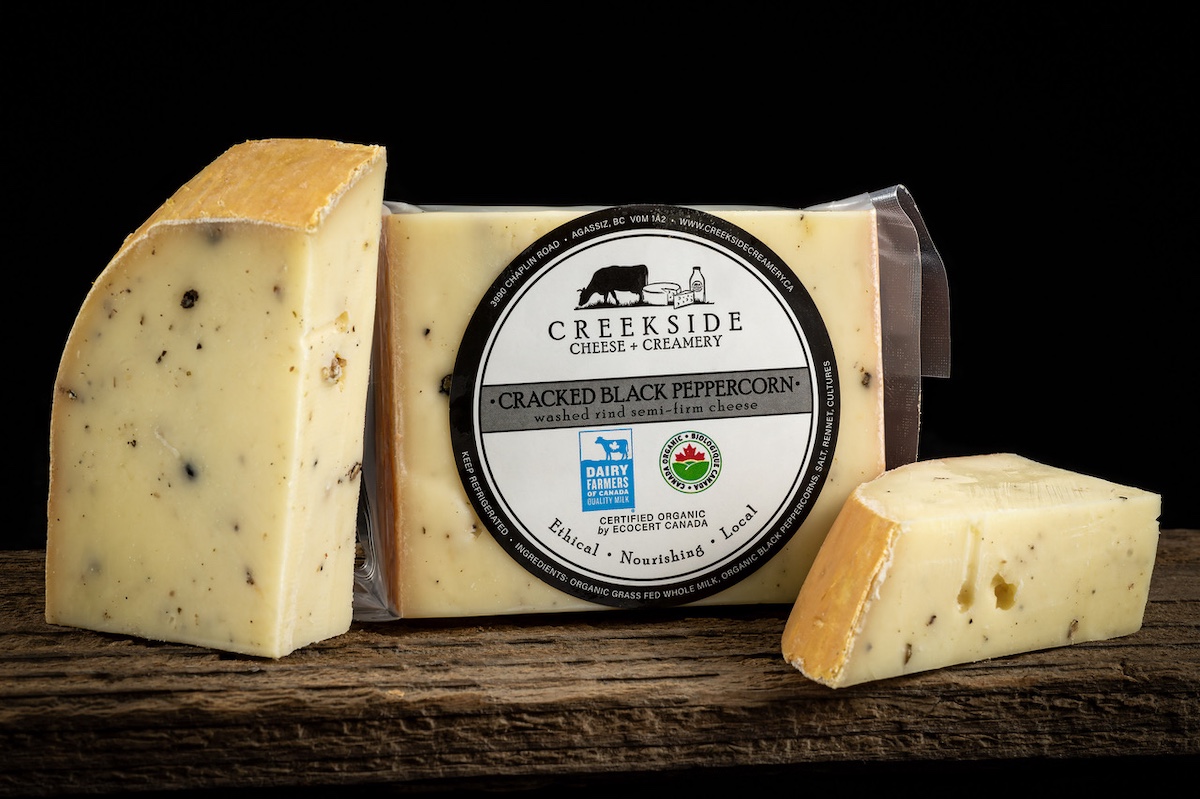
You can also find Creekside at the farmers market, which “have just gone nuts in the last couple years, along with the store,” Julaine says. “With tariff talk, people are starting to look local. It feels great that local food has become important to people. That they’re choosing organic and local is extra lovely.”
To make Creekside’s signature products, milk is pumped over underground from the milk tank to the cheese processing plant. “Then begins the cheese making process,” Julaine explains: the milk is pasteurized, then heated to the right temperature for adding cultures and rennet, which will solidify the milk into curd. This takes about an hour or so. After that, they cut the curd using a cheese harp—”it really looks like a harp”—which is run through the solid mass of curds to separate them. Once the curd is cut, whey, the fluid part of cheese that is a waste product and gets fed back to the cows, seeps out.
Then comes the stirring and heating process, which is unique to each type of cheese. Some need more or less stirring and heating: “For camembert, you basically cut the curds and spoon it into the mold,” Julaine says, while “aged gruyère needs much more to solidify before you can make it into wheels.”
Once in wheels and the whey is drained off, the cheese is put into a mechanical press for almost 24 hours, which presses the curds together. Then the cheese is moved into the brine bath, which is “how cheese is salted, the cheese absorbs salts from brine.”
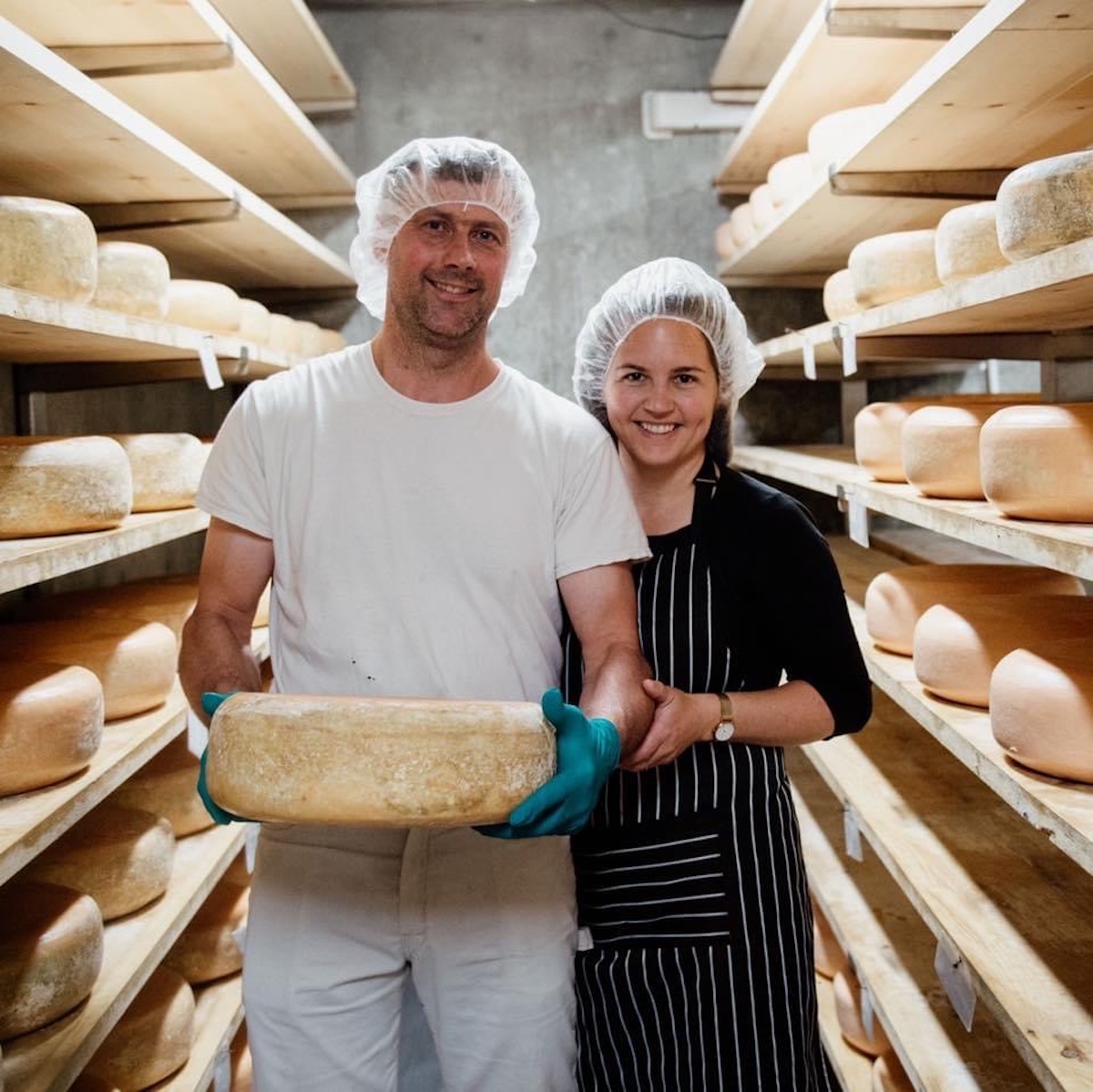
Lastly, the cheese is aged. Depending on the kind of cheese, that can be anywhere from fresh cheese curds ready the same day to gouda ready in a month or six weeks to aged cheese that can take anywhere from a year to two years. This involves “babying the wheels, flipping them, washing them with a brine solution if it’s a washed rind cheese, or natural rind brushing,” Julaine explains. “We are personally handling each cheese hundreds of times before it goes out the door, especially for the aged cheeses.”
The “we” at Creekside is made up, of course, of Julaine and Johannes, along with some very important support. On the creamery side, Julaine is in the office with Johannes in the role of cheesemaker, as well as a second cheesemaker, Jasmine, a full-time employee and four part-time employees. On the dairy side, their oldest son Riley works on the farm, along with two part-time employees who help out with morning milkings. Their four younger kids are also involved in everything from the store to helping out with after school chores.
Julaine sees the farm’s evolution in “three defining parts: the transition to organic, our first beef sales, and getting into processing.” Each came with challenges, as well as exciting opportunities.
“When we got into organic dairy farming, we didn’t quite have a handle on how expensive it would be,” Julaine says. “There’s not a lot of information or resources out there for organic dairy farmers compared to conventional dairy farmers, even just from a feed nutritionist standpoint.”
But they took that steep learning curve in stride, and figured out how to best use the organic products available to them to give their cows the nutrition they needed to be healthy and produce enough milk, while still being cost effective.
As well, organic grain prices are much higher than conventional. “It took us a long time before we found that sweet spot of cows producing enough, and the grain prices being manageable,” Julaine says. “We had to be creative, and we had some tight financial years before the ‘cheese years’.”
Despite the nuances to figuring out the business model of organic dairy, “one thing we have noticed and appreciated,” she says, “is how healthy the cows are. Their feed is excellent quality because of the focus on healthy soil and crops.”
Julaine also praises the organic standard for not allowing too much grain: “Organic cows are on pasture so much longer than the industry standard. The milk quality is so much higher because they are not being pushed to over produce.”
Those first beef sales have continued to be a feature of the farm store. The Treurs raise steers, and sometimes have heifers that they decide not to raise as milk cows. Their beef is now certified organic, since mid-2024.
On the processing side, Julaine shares that “the next milestone will be working on processing more of our milk here on the farm.” They currently process about a quarter of the milk they produce, but demand keeps increasing. “We are actively working on plans and expanding the processing plant,” Julaine says.
They’re outgrowing the self-contained processing facility they purchased in 2020. “We desperately need a bigger cheese vat!” Julaine says that they’re planning to add a new cheese plant with an aging room underneath: “That will be a game changer in how much cheese we can process in one day.”
With all the future planning, the Treurs are always seeking that “sweet spot.” Julaine says, “We’re trying to make the farm profitable and pay off as much as we can so that the next generation can continue on a firm footing if they so choose.”
At least two of their children are interested in careers in dairy farming. “We always farm with that mindset,” Julaine says. “We’re not inheriting the land from our ancestors, we’re borrowing it from our children. We farm with the future in mind for them.”
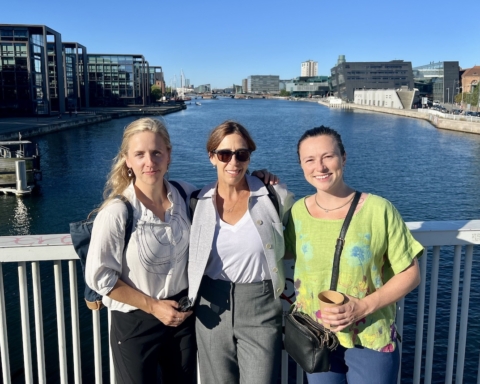
Darcy Smith is the departing editor of the BC Organic Grower, and a huge fan of organic farmers. She is also the Executive Director at Young Agrarians, and excited to be embarking on a new chapter raising her own young agrarian.
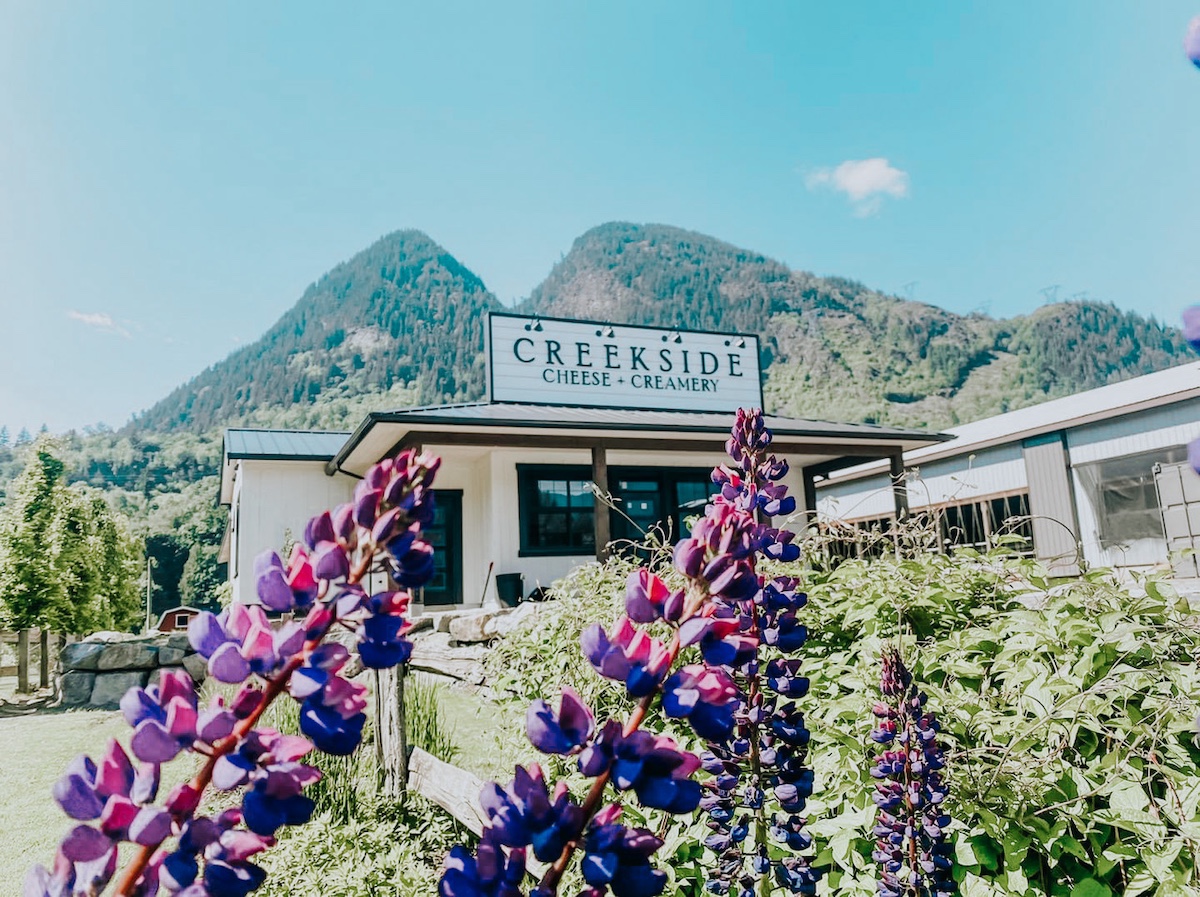
Featured image: Creekside’s bright and welcoming farm store.Credit: Creekside Dairy.