
Emma Holmes
As BC’s organic industry specialist, I have been able to meet many members of our organic community across the province. I also get to collaborate with other experts at the Ministry of Agriculture and Food (AF) and am keen to highlight them and the important work they do, so you can get to know them—and hopefully collaborate with them too! This issue, I interviewed Thom O’Dell, Regional Agrologist for North Vancouver Island.
Emma Holmes (EH): Thom, thanks so much for joining me. When did you join AF, and what is your current role?
Thom O’Dell (TO): Thanks, Emma. I first joined the ministry in 2019 as a one-year parental leave backfill for the provincial agroecologist role. I returned in July 2022 as the Regional Agrologist for North Vancouver Island.
My role is to support farmers in building environmentally and economically sustainable operations, and to help however I can with production, soil, or broader system questions.
EH: Where did you grow up, and how did you first become interested in agriculture?
TO: I grew up in Virginia in the United States, although I’m now a permanent resident of Canada. I didn’t grow up on a farm, but my first paid job was selling produce at a roadside stand my father ran when I was about 10 years old. My father had grown up on a farm in Texas and, although he left that behind, he stayed interested in food and gardening.
EH: How did that early interest develop into a career?
TO: It was a gradual process. I was interested in biology and ecology, and as a student I came across J. Russell Smith’s Tree Crops: A Permanent Agriculture, which really influenced how I thought about sustainability in food systems. I got drawn into organic and sustainable agriculture as a consumer first, and through friendships with people involved in early organic certification efforts like Oregon Tilth.
Graduate school at a land grant university immersed me in agricultural research, even though my formal training was in botany, plant pathology, and microbiology.
EH: Tell us a little about your academic background.
TO: I completed a PhD studying plant–fungal relationships, focusing on lupins and belowground ecology. I was interested in how fungi colonize plant roots and whether they benefit plants that weren’t traditionally thought to be mycorrhizal. Some of my observations helped lay groundwork for later research showing just how complex and important these underground relationships are.
EH: You also spent time working in forests and fungal ecology?
TO: Yes. After my PhD, I held a postdoctoral fellowship at the University of Washington studying fungal diversity in old growth forests in Olympic National Park. Later, I worked on rare fungi surveys associated with old growth conservation work. It was a fascinating and very privileged experience—both scientifically and personally.
EH: How did you transition from research into farming and applied agriculture?
TO: That really started when my partner, Haley Argent, and I launched a nursery specializing in hazelnuts. BC’s hazelnut industry was severely impacted by Eastern Filbert Blight, and because of quarantine restrictions, importing disease resistant varieties required tissue culture propagation.
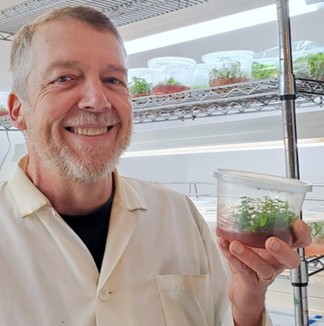
I was able to apply my background in mycology to that work. I converted a construction trailer into a small lab with a homemade sterile bench, shelving, and basic equipment. We were able to propagate tens of thousands of trees and help reestablish the hazelnut industry in BC.
EH: What are some of the key projects you’re currently working on?
TO: I’m involved in a soil biology project aimed at helping farmers critically evaluate soil amendments and avoid unnecessary inputs and expensive testing. While publication is a few months away, it will be shared through the AgriServiceBC e-bulletin and online.
I’m also working with Kwantlen Polytechnic University on a dry farming project, looking at how vegetable crops can be grown using stored soil moisture instead of irrigation.
Previously, I worked on an alternative crops report that explores what we might be able to grow in BC as our climate continues to change:
A few recent publications I’m proud of, but that I did outside of my role with the Ministry are:
Articles from Nature Tech Nursery – Nature Tech Nursery:
Flowering and Yield of Eastern Filbert Blight Resistant Hazelnut Cultivars in Southwest British Columbia:
EH: With all the interest in soil biology right now, what’s your most practical advice to farmers?
TO: The single most important thing you can do is keep living roots in the ground. Maintaining plant cover, whether through cover crops or perennials, is one of the most effective ways to support soil health. Some inputs, like rhizobia seed coatings for legumes, are proven technologies. But many other products offer limited benefit, especially in field settings.
EH: Why do some inoculants work while others don’t?
TO: Success really depends on the biology and the context. Legumes, for example, depend heavily on their nitrogen fixing bacteria, so that relationship works very well when properly applied. In contrast, trying to add organisms to a tilled field without living roots is very challenging and expensive.
Soil is a highly competitive environment—you have to give introduced organisms every possible advantage.
EH: What is your favourite part of your role?
TO: I genuinely love this work. Food systems are fundamental, and agriculture faces real challenges around climate, water, and economics. If I can contribute in even a small way toward making our agricultural systems more resilient, that’s work worth doing.
If you want to reach out to a regional agrologist or industry specialist, you can do so at AgriServiceBC: agriservicebc@gov.bc.ca or 1-888-221-7141.
Emma Holmes is the Organics Industry Specialist with the BC Ministry of Agriculture and Food. She studied Sustainable Agriculture and Soil Science at UBC, and then farmed on Salt Spring and worked on a permaculture homestead on Orcas Island. She now lives in Vernon and loves spending time in the garden. She can be reached at: Emma.Holmes@gov.bc.ca
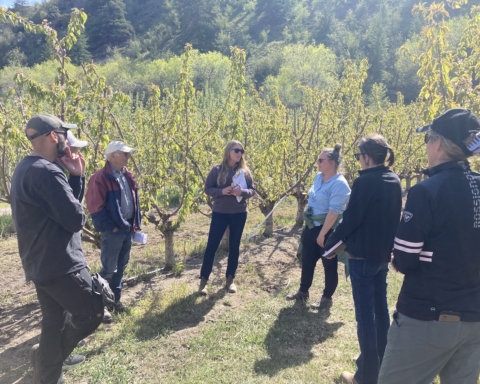
Featured image: Thom O’Dell, Regional Agrologist. Credit: Thom O’Dell.