Author

Darcy Smith - page 3

Darcy Smith has 283 articles published.

Cover Cropping for Swath Grazing
in 2024/Crop Production/Fall 2024/Grow Organic/Livestock/Tools & Techniques

Healthier Soil and a More Resilient Operation

Stacey Santos

At Jackknife Creek Land & Cattle in Alberta’s Peace River Country, the Noble family is implementing innovative cover cropping practices on their farm, specifically swath grazing in their cattle operation. This practice not only ensures their cows are well fed during the winter, but it also simultaneously aligns with organic principles, enhancing soil health and bolstering the overall resilience of their land, livestock, and entire operation.

In a recent episode of Organic BC’s Innovative Cover Cropping Tour of BC series, we had an inside look at Jackknife Creek’s swath grazing techniques and the many benefits of this management practice.

But First, What is Swath Grazing?

Swath grazing (also known as windrow grazing) is the practice of seeding a cover crop mix, typically comprising annual forages and cereals, from mid-May to early June. The cover crop is then cut down and formed into swaths from late August to mid-September, just before the arrival of killing frosts.

These swaths are then left in the field during the winter to extend the grazing season, even beneath the snow. This practice not only captures the nutrients from the manure and urine on the fields, improving soil health, but it also reduces the labour associated with hauling manure or moving bales around.
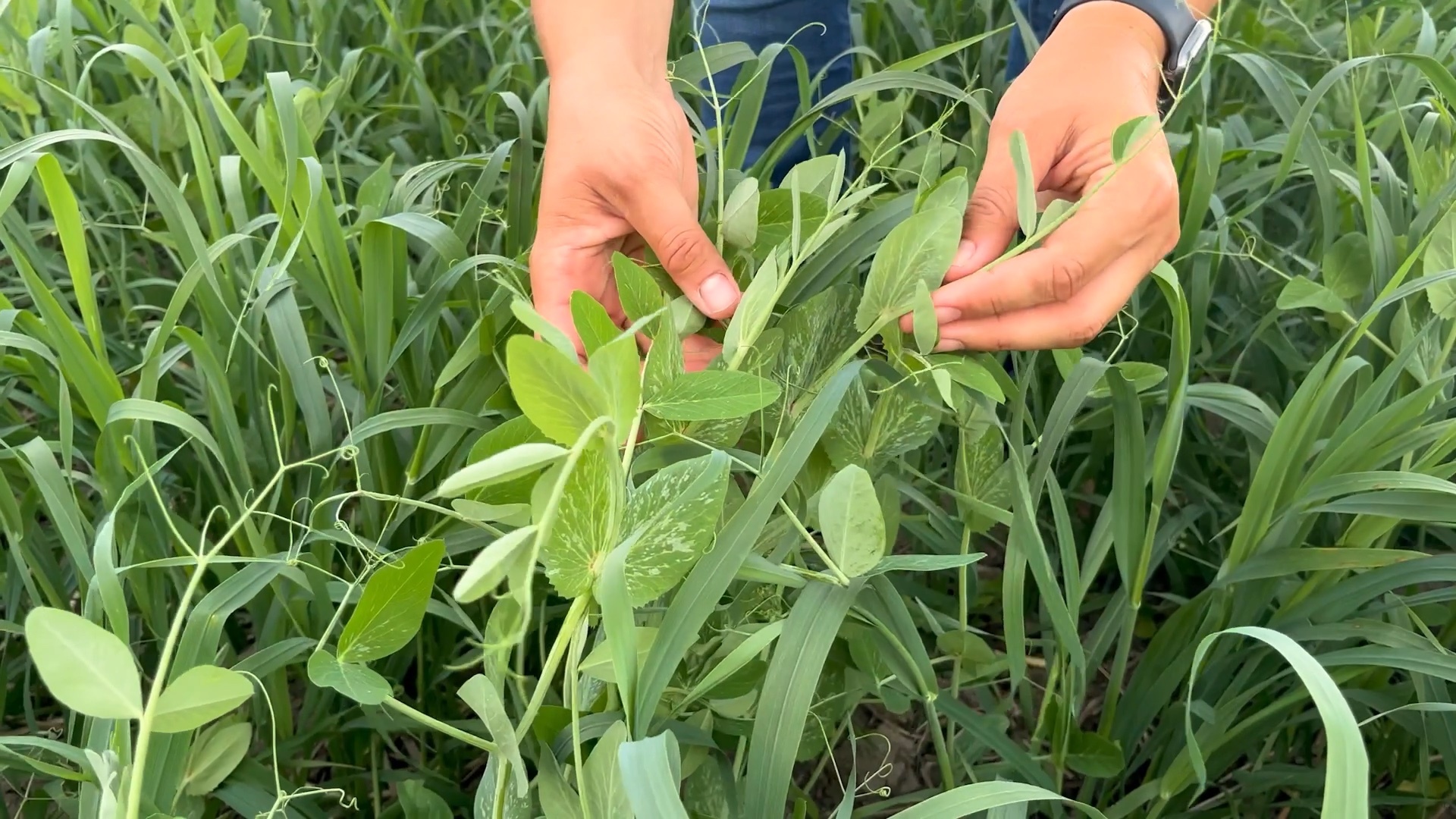
Forage peas, part of Jackknife Creek’s custom nine-way cover crop mix. Credit: Organic BC.

Generations of Innovation

Jackknife Creek Land & Cattle is a multi-generational farm run by Bob Noble and Nora Paulovich, along with their adult children Jolene, Cara, and Lee. It’s a mixed operation with cattle, grass seed, and grain cash crops and a dedication to innovation, from value-added products and marketing right down to evolving farm practices that promote soil health and reduce their reliance on inputs.

The family’s passion for soil health began during Nora’s years as manager of the North Peace Applied Research Association (NPARA). Jackknife Creek transitioned to swath grazing after being inspired by the practices of soil health proponent Gabe Brown from North Dakota, who they heard speak at an NPARA event.

“We seed nine different species at the end of May or June and swath that in late August or September,” said Nora. “It’s become a major feed source for us. We’re leaving our calves on longer now into February, and weaning them after that, and find they’re doing remarkably well. We’ve been doing feed testing and [have seen] very high planing nutrition on those cover crop swaths.”

From Grass to Swath

Jackknife Creek calves out on pasture in the spring. The pasture is primarily grass for May and the start of June, with smooth brome sod holding their cows up well in the wet months leading up to calving. As the higher legume perennial pastures become ready for grazing, the cows are trailed out to the fields that have the most stockpile.

“We typically do daily moves in the summer,” said Jolene. “All of our cows are in one herd, so we can do that. We’re not moving three different herds every day, or every three days, or whatnot. It’s more intensive.”

Depending on the year, the cows are on the perennial pasture into September and October. When the plane of nutrition starts to decline in the fall, the cows are moved onto swath grazing, which they continue on into February.
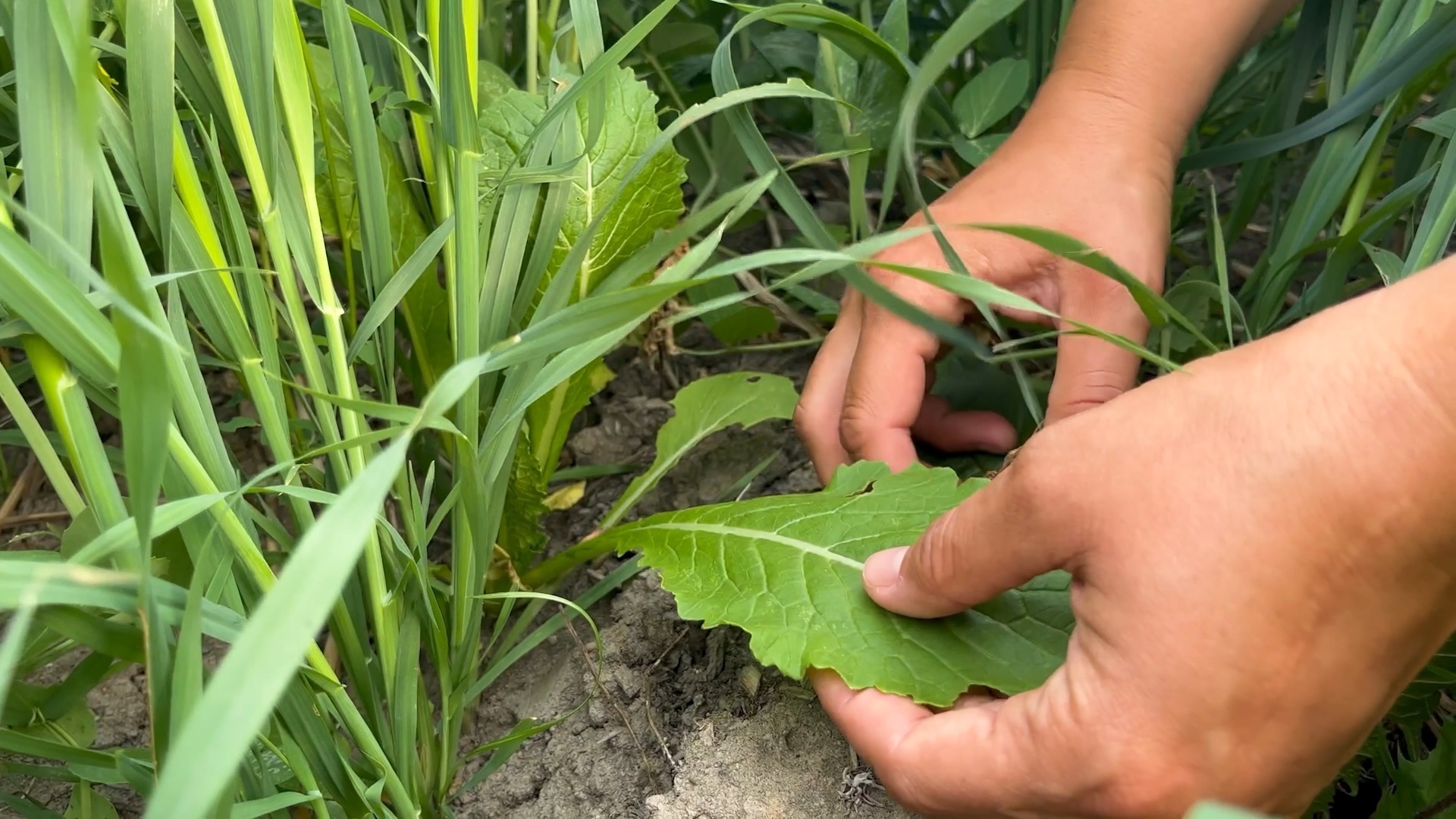
Hunter turnip-cross brassica, part of Jackknife Creek’s custom nine-way cover crop mix. Credit: Organic BC.

Multi-Species or Monocrop?

The Nobles had tried swath grazing earlier using a monocrop of oats, without success.

“Lots of times we’d get an early snowfall in October, and then it would warm up, and then freeze those swaths right down to the ground,” said Nora. “The cows had a really hard time getting it.”

When they switched to multi-species cover crops for swath grazing, they ended up with growth at different levels of the canopy, so the swaths would sit quite high because of the different interlocking species. They were airy with plenty of movement, and stayed nice and fluffy, even in extremely wet or snowy weather.

“They don’t get squashed down like a monocrop does,” added Nora. “The cows can easily find those swaths and dig through them.”

Another huge difference is that a blend is more palatable to cows than straight oats, so they don’t mind doing a bit of extra work to get a meal.

“If it’s just oats, the cows are not a big fan and they’ll stand at the corner and won’t want to go back out,” said Jolene. “So you do lose gains, forcing those cows to go after that feed.”

A multi-species cover crop is also a more balanced feed, with higher protein and a bigger energy spike compared to straight cereal—something that’s needed to keep the calves on the cows longer.

Later weaning has led to a huge reduction in illness at Jackknife Creek. The instance of load and pneumonia, something they struggled with when traditionally weaning in November, has essentially been wiped out in their backgrounding lot.

As well, one of the biggest changes they’ve seen with leaving the calves on the cows is that everything is fed by moving one wire—a huge time saver.

“When you’re not feeding a pen of older cows, a pen of younger cows, and a pen of backgrounders, you’re feeding everything all at once,” said Jolene. “We’ve been quite impressed with our young cows and how they’ve been able to finish growing, raise a calf, rebreed, and bring that second pregnancy to full term.”

The Right Mix

Jackknife Creek uses a custom annual cover crop mix for swath grazing, which consists of forage oats, forage peas, Italian ryegrass, hairy vetch, two brassicas (Hunter and Goliath), sunflowers, buckwheat, and millet. Hairy vetch and brassicas are the main driver, along with the cereals and peas, while sunflowers and millet add diversity and the Italian rye provides cover after its swathed into the winter.

In this nine-way mix, some of the species are in smaller proportions and not everything comes up every year. Some, like oats and peas, grow consistently tall alongside each other, while others pop up higher in the canopy as the season goes on. There’s also a variety of species, some with higher regrowth potential than others.

Pointing out the Hunter turnip-cross brassica, Jolene explained that while they cut at the end of August or September, there are still warm days after that.

“Even after a killing frost, these guys will come back, and with a completely basal growth habit,” she said. Gesturing at the base of the plant, she explained how there’s still enough leaf for photosynthesis and regrowth, while the tougher Goliath brassica has a thick stem and won’t regrow. And when you add in volunteer plants, such as chicory that was planted five or six years ago but keeps coming back, you have a lot of feed value.

Risk and Resilience

Another perk of swath grazing is that it boosts resiliency on the farm by spreading out risk. When a dry spell comes in May or early June, the hay crops and perennial pastures suffer. But, while the cover crops that are planted at the end of May won’t look great at first, they can take up the moisture that comes in July and August and turn into an extremely good crop.

On the other hand, if there’s early spring moisture and a dry summer, the hay crop will succeed while the cover crop may not. This spreads out the risk so at least one of the feed sources can take advantage of the moisture, no matter when that moisture comes or how long it lasts.

“We only take one hay cutting,” said Nora. “If that’s all we relied on, we would be in a really bad place for winter feed.”

While Jackknife Creek’s swath grazing program is tailored to their specific operation and local conditions, swath grazing is a viable option for many livestock producers, including organic farmers in British Columbia. For guidelines, considerations, and more details on the benefits of swath grazing, view the additional resources below.

“Cover cropping for swath grazing has been so beneficial to our operation, and we also feel it’s very beneficial to our soil too,” said Nora. “That diversity above ground is promoting diversity below ground, and we’re definitely seeing improvement in the health of our soils.”

Watch the video: youtu.be/FAIG7WdNjPU

Further reading: extension.sdstate.edu/swath-grazing

This article was funded in part by Agriculture and Agri-Food Canada through the BC Climate Agri-Solutions Fund delivered by the Investment Agriculture Foundation of BC.

Stacey Santos is the Communications Manager for Organic BC. She lives, writes, and gardens in the beautiful and traditional territories of the Lekwungen peoples, who are now known as the Esquimalt and Songhees Nations.

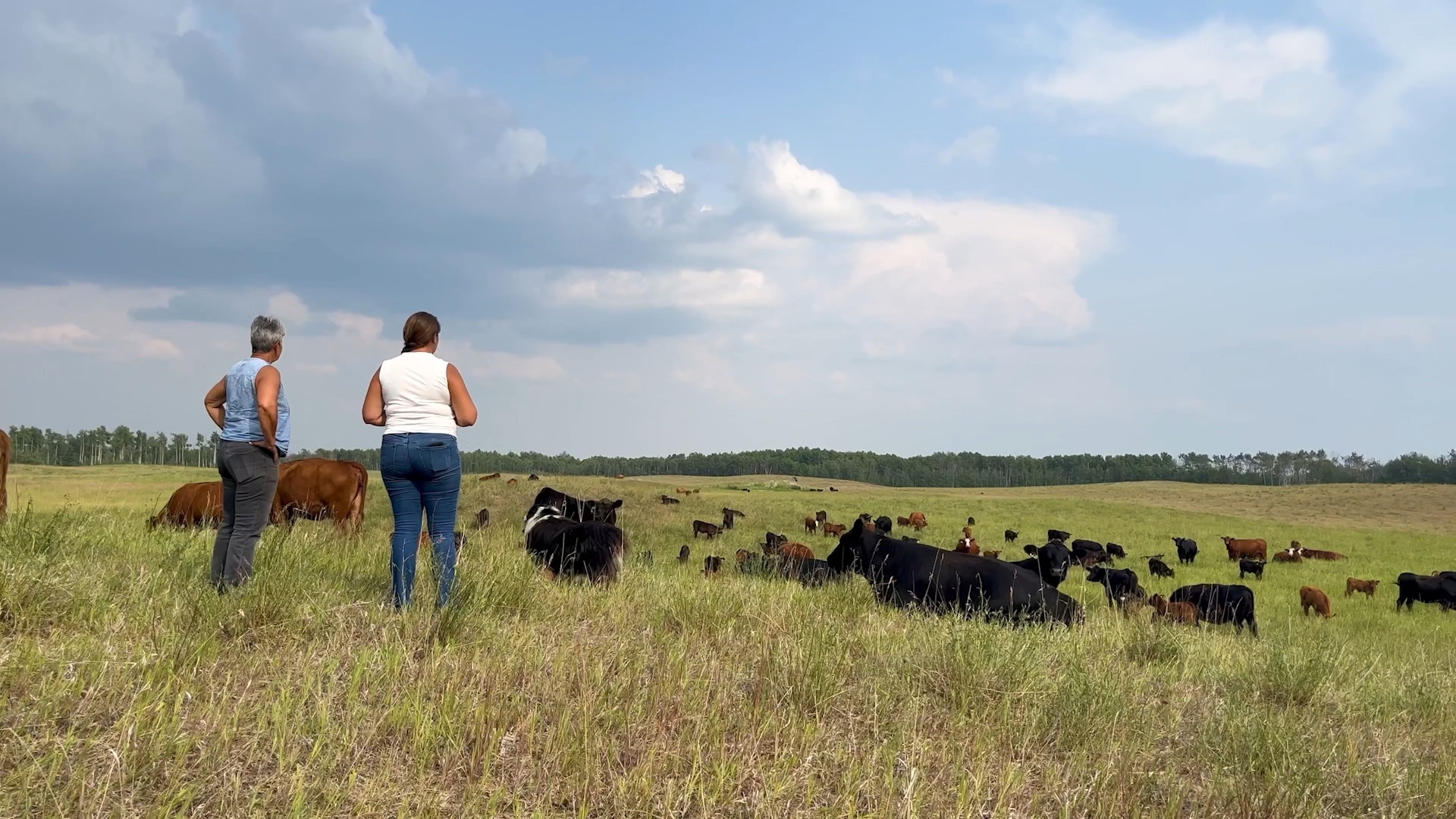
Featured image: Jolene Noble and Nora Paulovich overlooking their herd. Credit: Organic BC.
Post-Flood Conversations in the Fraser Valley

in 2024/Climate Change/Fall 2024/Grow Organic/Organic Community/Water Management

Chris Bodnar

When parts of the province experienced catastrophic flooding in November of 2021, we witnessed an incredible mobilization of resources in the agricultural sector to navigate the disaster as well as to rebuild.

At the same time, we also witnessed the unequal impact of the event on different populations. Very few Indigenous communities are protected by dyke systems. However, these communities are impacted directly by the dyke systems, which transfer risk from the protected areas to the outside areas. These areas, in turn, are not protected and actually experience greater impacts from displaced water during floods.

Given this, it came as a surprise when I received an invitation in February 2023 to participate in a meeting of agricultural producers and organizations with local Indigenous communities. I didn’t know what to expect, and was intrigued to learn more.

The gathering was organized by the Fraser Valley Floodplain Coalition, a group comprised of the Emergency Planning Secretariat and a collection of BC-based organizations and experts concerned with river, watershed, ecological and infrastructure management. The Emergency Planning Secretariat supports 31 Mainland Coast Salish communities to improve emergency planning and preparedness.

The Fraser Valley Floodplain Coalition came together following the 2021 floods “with a shared goal of helping BC’s flood recovery and ongoing flood management achieve the best possible outcomes.” The meeting with agricultural representatives was an attempt to establish dialogue between groups that don’t necessarily have a lot of interaction, but who all depend on finding ways to manage floods going forward.

The Coalition established five principles to guide the work of its members:

1.    Reducing Risk and Adapting to Climate Change;

2.    Advancing Reconciliation;

3.    Helping Salmon and the Coastal and Freshwater Ecosystems Where They Live to Thrive;

4.    Supporting Sustainable Economies and Resilient Communities Into the Future; and

5.    Everyone is Part of the Solution.

Ultimately, the Coalition started to work on finding solutions for future flood preparedness that look at new ideas, rather than rushing to build back the same infrastructure.

The Coalition has held two events to bring together various levels of government and agricultural organizations to discuss flood planning in 2022 and 2023 as well as sessions for agricultural groups and Indigenous groups in 2023 and 2024.

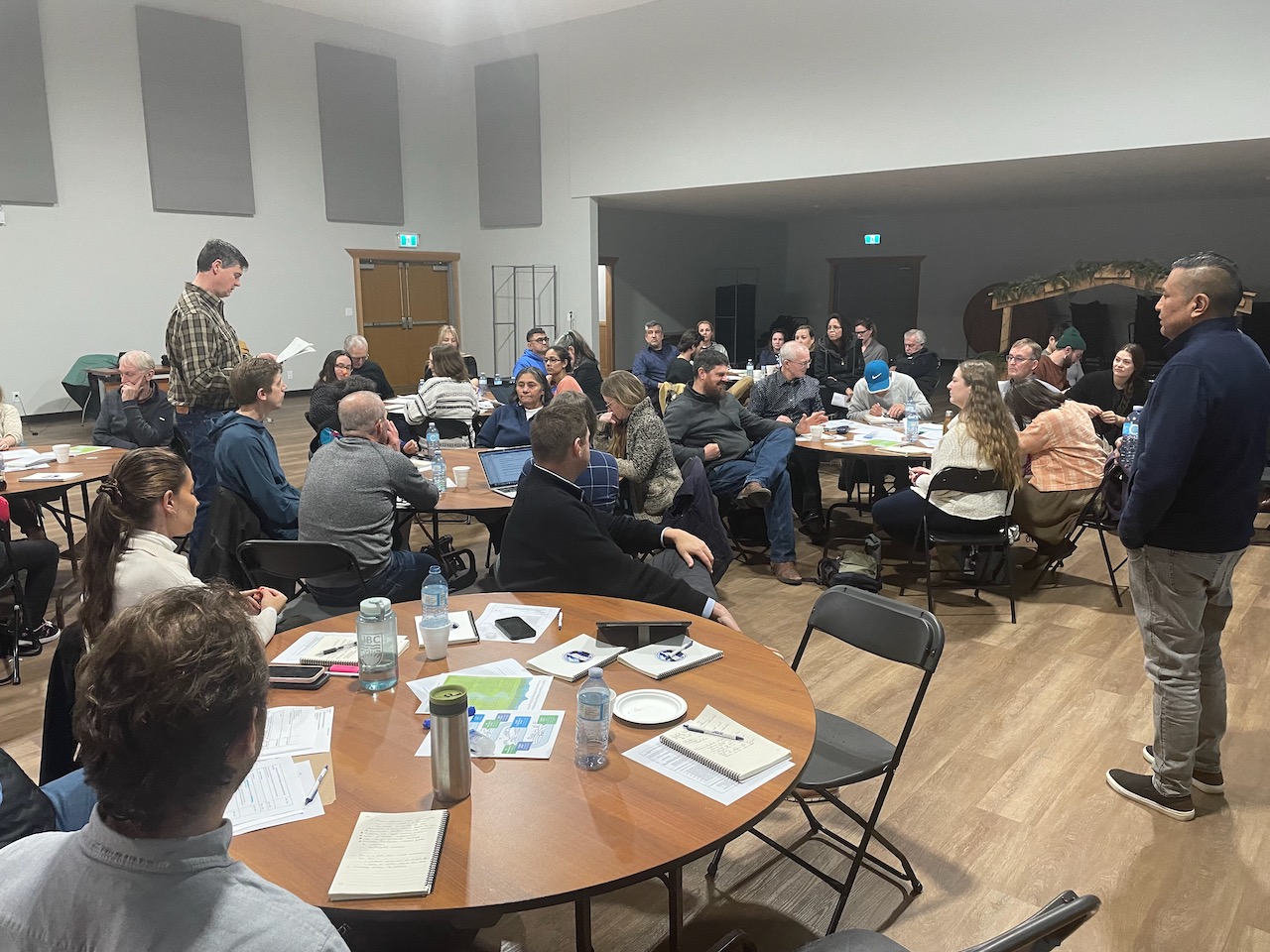
Meeting facilitators Jay Hope, Principal of Xixne Consulting, and rancher Dave Zehnder lead discussions at the February 2023 forum between farmers, agricultural organizations, and First Nations. Credit: Fraser Valley Floodplain Coalition.

This Won’t Be Easy, But It Can Be Rewarding

“We can do this the hard way or the harder way,” said Tribal Chief Tyrone McNeil at the opening of a meeting with various levels of government and agricultural organizations in June 2023. “If you’re here today I assume you’re ready to do this the hard way. The harder way will be in court.”

That message reminded participants that First Nations are not prepared to be burdened with the transfer of risk if flood mitigation efforts attempt to rebuild existing infrastructure. Likewise, there is an expectation that fisheries are accounted for in planning, with steps taken to adopt new technologies in flood protection infrastructure that protect salmon populations.

At the agricultural gathering in February 2023, representatives from eight First Nations and eight agricultural organizations attended alongside coalition members, farmers, and Indigenous community members. A series of presentations discussed options for managing flooding that also protect ecosystems that support fish. This includes using new designs for pump stations and floodgates as well as naturalizing floodplains with dike setbacks; for example, building dikes that are set back from waterways to provide a floodplain area rather than building dikes right against waterways.

At the end of the session, a key takeaway was that if First Nations and farmers can work together, there is a stronger case to be made to different levels of government to invest in flood planning that accounts for the needs of both groups. Collaborative work will also contribute to better understanding of each others’ needs.

What Next?

The meeting ended with a sense that more dialogue was desirable. The Coalition planned an event for November 2023 that took farmers and agricultural organizations’ staff on a tour of the Fraser Valley to learn about the Indigenous place names and stories of different locations.

The full-day tour was led by Naxaxalhts’i, the Cultural Advisor and Stó:lo Historian for the Stó:lo Research and Resource Management Centre. As someone who has studied Halq’eméylem place names for over 21 years, Naxaxalhts’i provided an in-depth demonstration of the long history Indigenous peoples have on the land we now occupy.

About 40 farmers and agricultural representatives attended the tour. A lunch session with Indigenous community members offered an opportunity to discuss next steps for collaboration. An idea to emerge from the session was a reciprocal tour of farms.

In May 2024, a tour of Fraser Valley farms doing innovative work to manage flood risk and restore ecosystems was held for farmers and Indigenous community members. Participants toured farms in Agassiz and Chilliwack to consider how food security can be achieved by protecting farmland from flooding while also protecting salmon populations through better design of flood infrastructure.

Another session during the tour allowed for participants to discuss next steps. The results of those conversations will influence future conver-sations and recommendations to governments for flood planning going forward.

At the end of the day, the invitation from First Nations to the agricultural community to participate in shared learning and conversation is an attempt to develop learning opportunities and result in constructive solutions that benefit everyone.

Applying This Knowledge

There was a moment during the first event when a lightbulb went off for me. As we discussed floodplains by design I realized that our farm—on the Fraser River floodplain and outside of diking systems—could benefit from a different way of thinking about flooding.

We have a large area of pasture on land that is peat bog and was once a wetland. One field cannot be effectively hayed due to the bog nature of the land—tractors risk getting stuck in the peat for significant portions of the year. The wet fields were cleared and planted into Reed Canary Grass—an invasive plant species—in the 1960s. The value of the forage is marginal.

Attending the forum renewed an interest in revisiting plans we had considered close to a decade ago, to restore the lowest field to a wetland. Over the past year we have been successful in getting funding through the province’s Beneficial Management Practices program to design a wetland that will provide more area for water during flood events. During the rest of the year, the area will provide substantial habitat for wildlife.

While this project on our farm is small and won’t prevent large floods, it does underscore the need to adopt new ways of thinking about flooding in our watersheds. Many of us in BC farm land on floodplains. Most of us probably haven’t thought twice about how our work interfaces with Indigenous communities. But if we are going to make meaningful progress on reconciliation, these are conversations that we must start to have—and continue on an ongoing basis.

Chris Bodnar co-owns and operates Close to Home Organics with his wife, Paige, at Glen Valley Organic Farm in Abbotsford.

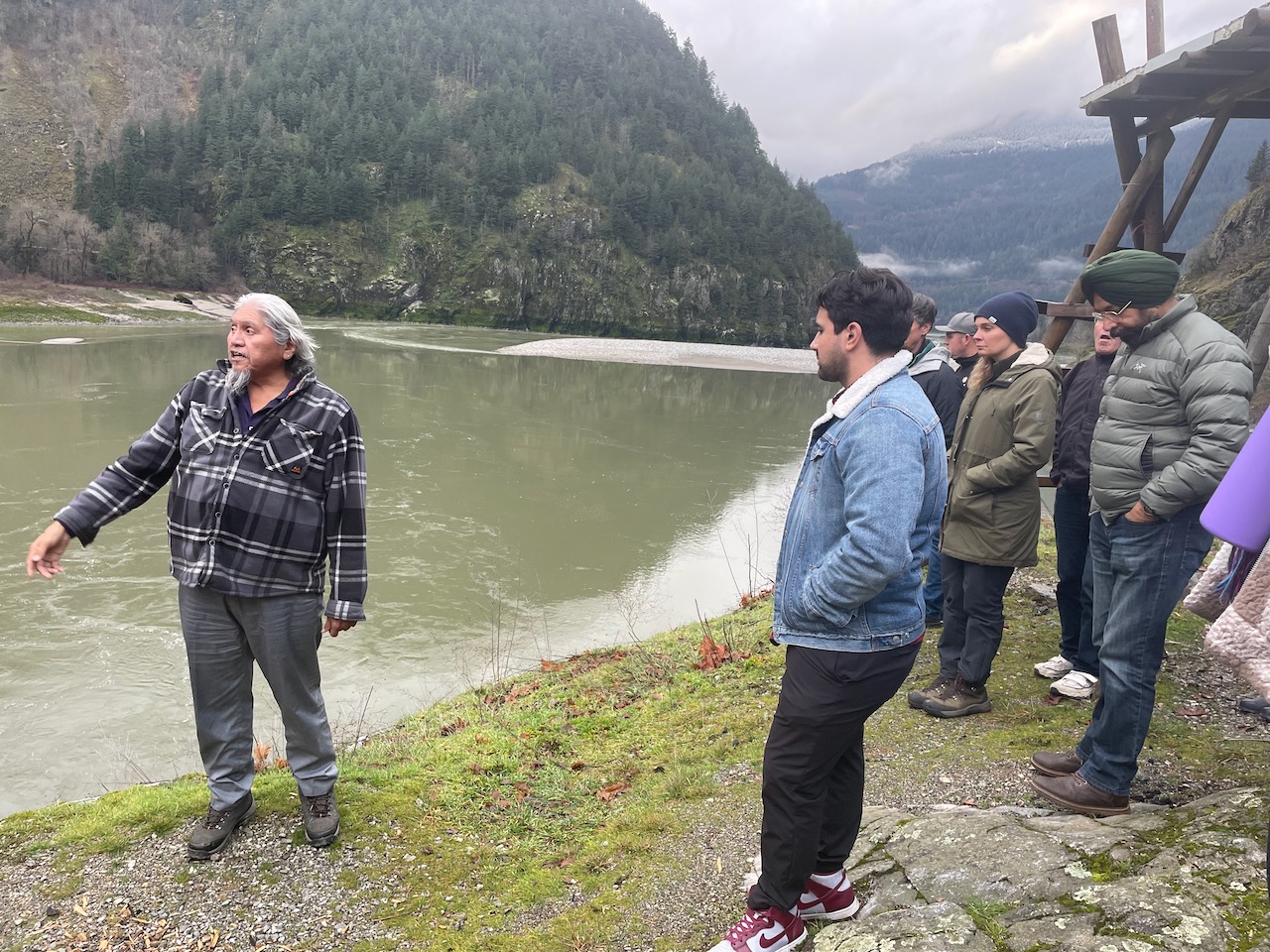
Featured image: At Kawkawa Lake in Hope, Naxaxalhts’i tells how local Indigenous communities have revitalized cultural traditions through the sharing of stories about the lake that are part of traditional celebrations. Many of these stories were almost forgotten during the residential school period. Many of these stories are not shared outside of their communities until the community is confident they have fully integrated the story back into their own histories. Photo Credit: Chris Bodnar.

Beyond Equivalency: The Importance of Organic Standards Governance in North America

in 2024/Fall 2024/Grow Organic/Organic Community/Organic Standards

Susanna Klassen

I have a confession: I live beside an amazing organic farm, and I buy imported organic vegetables. Not all the time! My partner and I are members of our neighbour’s Community Supported Agriculture (CSA) program (it’s the best), we grow some vegetables on our own burgeoning little farm, and we go to the farmers’ market on many a weekend. But in the depths of winter when I am inspired by a specific recipe, I am grateful for the imported organic peppers from Mexico, or the cauliflower from California, and all the hands that brought it to our small coastal BC town.

Perhaps, like me, you have stood in the organic produce aisle and contemplated the similarities of its bounty to what you would get from your (or your neighbour’s) organic farm. Are these peppers grown with the same requirements? What were the impacts on surrounding plants, animals, and waterways? Were the workers treated differently from how they would be on an organic farm in Canada?

Or, perhaps also like me, you’ve wondered about who actually gets to make decisions about the direction of the organic sector in different countries. You may have heard people criticize the weakening of the United States Department of Agriculture (USDA) organic standards over time. Do these critiques also apply to Canadian standards? Where does Mexico fit in?

Canada, the US, and Mexico all have significant agri-food trade: all three countries are within each other’s top four export trade flows for agricultural products1. Many people living in Canada depend on this imported produce from Mexico and the US, especially in the winter months.
Globally, inter-governmental negotiations around organic trade have focused on bi-lateral “equivalency arrangements” (EAs). Where an EA is in place, national governments have agreed to consider organic products certified under the other country’s organic regime to be equivalent to their own based on a comparison of regulatory systems2. Canada has EAs in place with both the US and Mexico2. The US does not currently have an EA in place with Mexico, as Mexico does not recognize the USDA’s standards as equivalent3.

The EA between the US and Canada focuses on addressing a limited number of controversial production practices that differ between the two jurisdictions (e.g. antibiotic use and hydroponic production), with limited mention of other requirements in either country’s detailed organic management standards4. The Canada-Mexico EA excludes livestock products, where livestock products produced in Mexico must be certified to the Canadian organic standards by a Canada Food Inspection Agency (CFIA) accredited certification body. In other words, while the Canadian government has agreed to treat organic products from the US and Mexico as “equivalent,” it does not mean that the detailed organic standards requirements in each country are the same.

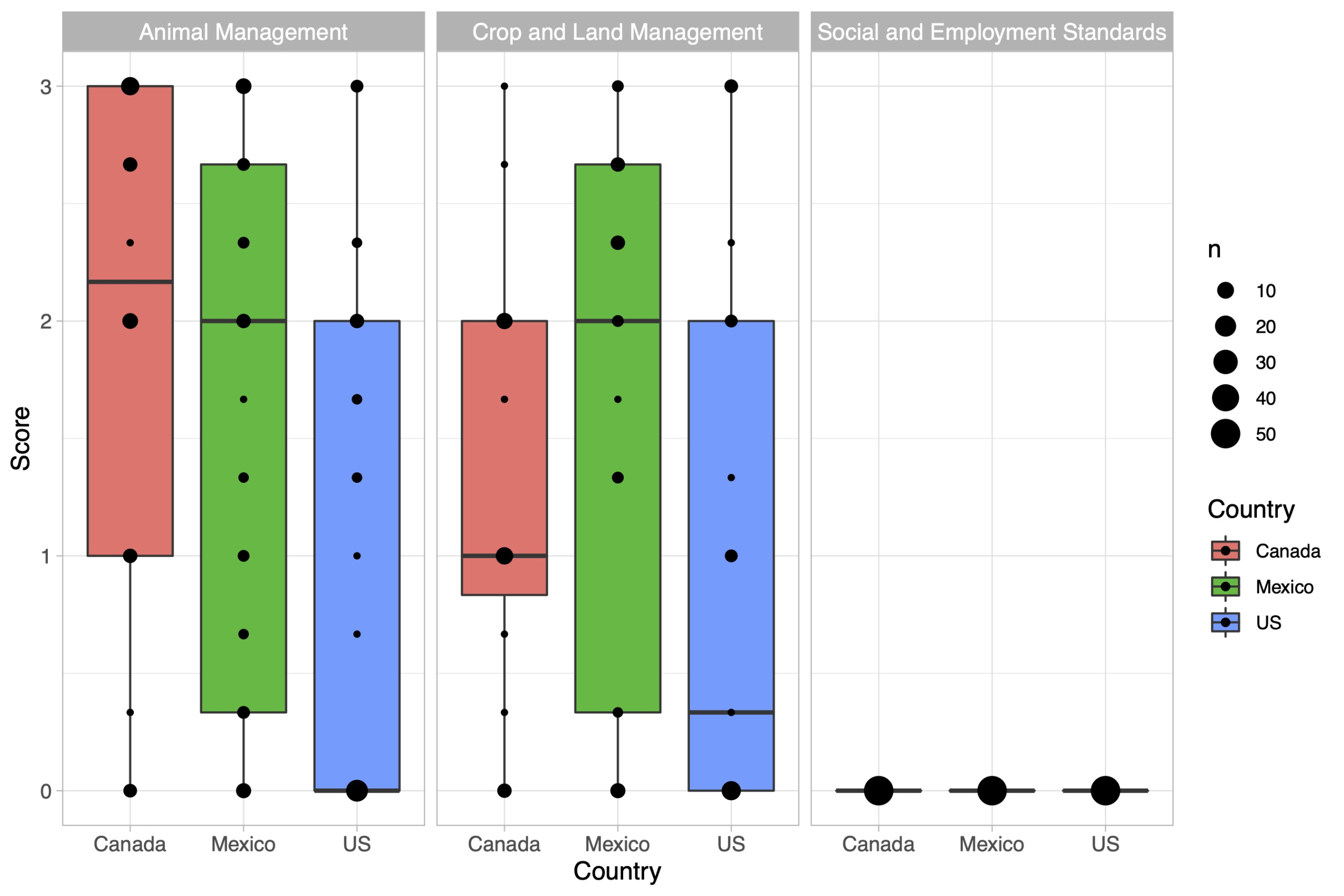
Figure 1: Scores for sustainability management practice requirements across the three domains evaluated. The size of the black dots represents the number of practices with that score (n).

Now, back to the peppers from Mexico and the cauliflower from California. To better understand how organic requirements differ between these three countries with such tightly integrated food trade, I (along with colleagues from the University of British Columbia) did some research to look beyond what would be included in an EA. Specifically, I was interested in how the national organic standards in each of these countries—each with well-established organic sectors and regulatory regimes in place—required or promoted sustainability, including ecological and social dimensions.

To answer this question, we built a framework of benchmark sustainability practices that we used to evaluate the requirements in the three national organic standards. This framework included practices (121 in total) related to crop and land management (e.g. soil health and fertility), animal management (e.g. outdoor access requirements), and social and employment standards (e.g. occupational health measures). We then scored each country’s organic standards based on the extent to which practices in each of these categories were required in the standards.

We found that the three countries’ organic standards were different from each other in several ways (Figure 1). For practices related to animal management, Canada consistently scored the highest. In particular, the Canadian standards contained clearer requirements for the general health and wellness of animals, transportation and handling of animals, and regulation of painful procedures and slaughter. Canada and Mexico scored similarly in most other categories. The US organic standards scored consistently lower across all sub-domains relating to animal management. Within the crop and land management domain, we found that Mexico had the highest scores for practices in most sub-domains except the presence of semi-natural habitat, where the Canadian standards were superior. The US also had the lowest score overall in this domain. We did find one commonality across the board: none of the countries’ standards contained any requirements related to social and employment standards.

Most readers are probably intimately familiar with the organic standards, so this likely isn’t new to you. But for me, the most important result of our research was not actually about the standards at all, but the formal processes for setting and maintaining the organic standards in each country—the standards governance. To compare these processes, we conducted interviews with 14 experts who have been engaged with development of the organic standards, international equivalency, or agricultural trade in one or more of the three countries.

This is where Canada really stood out. All three countries have a multi-stakeholder committee that serves as a standards governance body and contributes to the review of the national organic standards in some way. These committees are somewhat similar in their composition in that they include representation from producers, processors, and environmental or public interest groups. However, they differ in the level of control they have over decision-making, as well as the extent of government involvement. Only in Canada does this committee (the “Technical Committee”) have full control over decisions about the organic standards. Canada’s committee is convened by a government body (the Canadian General Standards Board or CGSB) that has no influence over the standards themselves, and is also distinct from the CFIA, which oversees the regulation and enforcement of the standards for organic agriculture.

In contrast, the equivalent committees in the US and Mexico—the National Organic Standards Board in the US, and the National Council for Organic Products in Mexico—do not have direct influence over the standards, but rather are consulted by the government body that ultimately makes decisions about the standards for organic agriculture in each country (the USDA Agricultural Marketing Service in the US, and the National Agro-Alimentary Health, Safety and Quality Service, or SENASICA, in Mexico). In other words, it is government officials—not the organic community or other relevant stakeholders—who have control over the standards in the US and Mexico.

This finding matters because it shows that Canada’s organic sector has processes in place to ensure that the organic standards are not shaped by a single interest, but that changes to the standards must be negotiated and informed by multiple relevant interests in the sector, not just those with the most power. While this might make it seem like changes happen slowly, this important work of the Technical Committee (and the Working Groups that support it) also ensures that chang​​es that are made are debated, informed, and ultimately, supported by a broad base of actors.

If the organic standards are the backbone of the organic sector, the participatory standards governance processes are the beating heart. The process may not be perfect—there are still many important questions about who should pay for the standards review process, the amount of volunteer time that goes into it, and representation on the various groups and committees, but our research suggests that this model is worth participating in, building on, and protecting.

Like most good research, our project has left me with more questions than answers (How will future trade agreement negotiations influence the trade of organic products? How will the organic community support social justice outside of the organic standards?). I still think a lot about those peppers from Mexico, but at least I feel more confident that their organic standards have pretty strong requirements for ecological health of the landscapes they’re cultivated in. And, more than ever before, I am quick to correct anyone that equates organic certification in Canada with the USDA National Organic Program. Even if our governments view the organic products as equivalent, these two things are not the same.

This article is based on research published in the Journal of Agroecology and Sustainable Food Systems. You can find the full article here.

Susanna lives in qathet where she and her partner are starting a small farm and raising their daughter as guests on the beautiful territory of the Tla’amin Nation. She did her PhD about organic agriculture in Canada and is now a postdoctoral researcher and instructor at the University of Victoria.

References
1 Chatham House. Resource Trade. 2021 [cited 2022 Feb 7]. resourcetrade.earth. Available from: resourcetrade.earth
2 Canadian Food Inspection Agency. Organic equivalency arrangements with other countries [Internet]. 2024 [cited 2024 Aug 15]. Available from:
inspection.canada.ca/en/food-labels/organic-products/equivalence-arrangements
3 USDA Agricultural Marketing Service. International Trade with Mexico [Internet]. [cited 2022 Aug 26]. Available from: ams.usda.gov/services/organic-certification/internation-al-trade-mexico?utm_source=pocket_mylist
4 Government of Canada. Canadian Food Inspection Agency. 2020 [cited 2021 Aug 3]. United States-Canada Organic Equiv-alence Arrangement (USCOEA) – Overview. Available from: bit.ly/3U14Izv

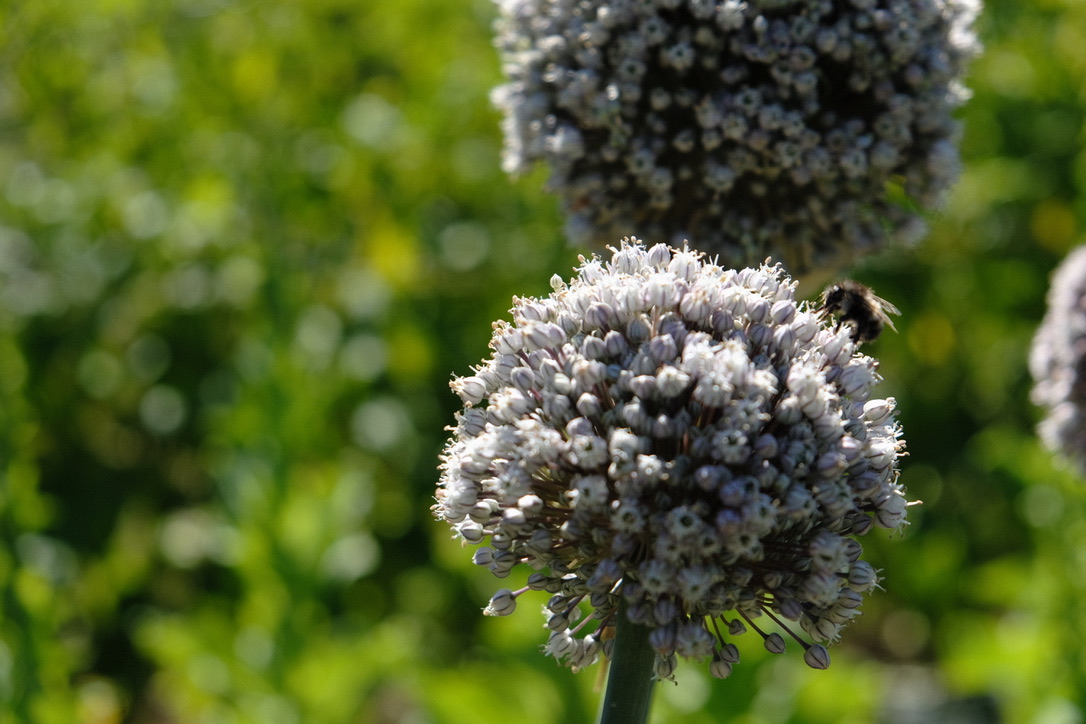
Featured image: Alliums going to seed at UBC Farm. Credit: Susanna Klassen.

Andrew Hammermeister: A Life Bridging Research And Farming

in 2024/Crop Production/Fall 2024/Organic Community/Organic Standards/Soil/Tools & Techniques

Marie-Eve Levert

“During my first encounter with an organic farmer, he told me that every time he walked through his fields, it didn’t feel like work. He saw so much wildlife—birds, deer, butterflies, insects—that it was like being in a park. His job, as he saw it, was to sustain the ecosystems around him.” For Dr. Andrew Hammermeister, this moment was a revelation, a sharp contrast to the traditional farming practices he had known.

Dr. Hammermeister, now the director of the Organic Agriculture Centre of Canada (OACC), has since become a driving force in shaping the Canadian organic landscape. If you’re involved in the science behind organic agriculture, you likely know him for his research, his leadership in building a national organic research agenda, or perhaps through Dalhousie University’s Certificate of Organic Agriculture program, where many have turned to him to deepen their agronomic expertise. As for me, I’ve had the privilege of knowing Andy for over a decade, through his work on national committees.

Recently, I sat down with Dr. Hammermeister, better known to me as Andy, to learn more about his journey into organic agriculture, and to understand what continues to fuel his unwavering dedication to the movement.

Early Days on the Farm

Andy’s roots in agriculture run deep, stretching back to his childhood. He grew up on a mixed beef and grain farm in southeast Saskatchewan. Surrounded by fields and grains in a mostly self-sufficient farm, studying agriculture seemed like the natural path for Andy.

It wasn’t until Andy was an undergrad in agriculture at the University of Saskatchewan that he first encountered organic farming. That experience would fundamentally change his view of agriculture.

“One summer, I had a job with a soil scientist. My role was to go out and take soil samples on farms throughout southeastern Saskatchewan. During that time, I came across a farmer in our local area. He was excited to take me out to his field and show me around, and that’s when I learned he was an organic farmer. It was something I knew nothing about at the time.”

The farmer’s pride in his fields and his deep connection to the land left a lasting impression on Andy. “He had installed shelterbelts and planted them by hand, watering and tending them for years. He told me that when he comes out to his field, he feels like he’s never working; it’s like going to a park. He loved the environment, the wildlife, and the beauty of his land. It was such a different approach to agriculture than what I had been used to.”

That encounter not only opened Andy’s eyes to organic farming, but it also set him on a path that would ultimately define his career.

Pursuing Higher Education and Moving East

Inspired by that transformative farm visit, Andy pursued a Master’s degree in Land Reclamation and his Ph.D. in Applied Ecology from the Univer-sity of Alberta. After completing his PhD, Andy joined the Native Plant Society of Saskatchewan to promote native ecosystems and conservation. However, his passion for agriculture and research remained strong. During a field day at the Agriculture and Agri-Food Canada (AAFC) Scott Research Station in Saskatoon, he reconnected with organic agriculture, reigniting his interest in the field.

Around the same time, Andy and his partner decided to move East. This move marked the beginning of a new chapter in Andy’s career, one that would see him play a pivotal role in advancing organic research and education across Canada.

Andy talking about organics. Credit: OACC

First Years at the Organic Agriculture Centre of Canada

As he was moving East, the OACC was in its emerging phase under the care of Dr. Ralph Martin, and two key employees, Dr. Derek Lynch and Dr. Av Singh. Initially, Andy’s role was a temporary post-doc position, but his interest in the work and the people he collaborated with meant he never left.

At the time, the OACC was working on some pioneering initiatives, including the development of the online Certificate of Specialization in Organic Agriculture at the then-Nova Scotia Agricultural College (now part of Dalhousie University). Ralph and others built one of the first structured organic curricula in Canada, even though they faced logistical challenges along the way.

“Ralph really laid the groundwork for the online certificate, building a network of professor across the country to deliver the courses,” Andy reflects. “Also, his decision to prioritize hiring PhD-level researchers at OACC helped establish organic research as credible within the scientific community. His emphasis on scientific integrity was instrumental in advancing the organic movement.”

Transitioning into Leadership

When Ralph moved to the University of Guelph, Andy transitioned into the Director role at the OACC while also becoming a professor. This shift wasn’t without its challenges, as Andy had to balance the expectations of teaching and research with his new responsibilities. Despite the hurdles, he embraced the challenge with the support of Dalhousie University, knowing that his leadership was essential in moving the centre forward.

Under initially Ralph’s and then Andy’s leadership, the OACC continued to take a significant role in national organic research, transitioning from regional research work conducted by the Centre to national coordination of organic science. One of his biggest achievements was establishing the first Organic Science Cluster, a national research initiative that brings together scientists, farmers, and industry experts across the country, in 2009. This approach strengthened the credibility of organic science in Canada and highlighted the importance of a coordinated effort in advancing organic research. The Organic Science Cluster represented a major shift in how organic research was coordinated nationally, and ever since its launch it has been helping address the unique challenges faced by organic producers.

The Organic Science Cluster, now in its fourth phase, has driven more than 30 million dollars in private and public investment in key research areas for organic in Canada, and has supported hundreds of scientists and graduate students across Canada working in collaboration with producers and industry partners to address their challenges while improving our understanding of organic farming systems, and identifying practices relevant to all of agriculture.

Andy out in the field with colleagues. Credit: OACC

The Farmers Who Inspire Him

While Andy’s work is grounded in science, his motivation continues to come from the people who are directly involved in farming. “The inspiration for me started with meeting that organic farmer who changed my view of agriculture. But over the years, it’s the farmers who have stayed committed to organic for 30, 40 years that inspire me the most. They’re not only environmentally sustainable but also economically viable, which is no easy feat. Their passion for the land is huge, and that’s what keeps me going,” he says.

This deep respect for farmers is a recurring theme in Andy’s career. Time and time again, he has emphasized the importance of listening to the needs and experiences of farmers when conducting research. “It’s the farmers who are out there every day, working with the land, and they have invaluable knowledge about what works and what doesn’t. My job is to take that knowledge and help translate it into research that can benefit them and the organic community as a whole.”

Looking into the Future

As Andy looks toward the future of organic agriculture, he is not just thinking locally but also globally. His involvement with the Technology Innovation Platform of IFOAM Organics International (TIPI) and the International Society for Organic Agriculture Research (ISOFAR) reflects his broader vision for organic farming. Both TIPI and ISOFAR bring together researchers and stakeholders from across the globe to foster innovation in organic agriculture. For Andy, being a part of this network isn’t just about contributing to science; it’s about supporting the international organic movement and ensuring that the global organic community continues to evolve.

“We need to think about the future of organic beyond our borders,” he explains. “TIPI provides that platform for collaboration, allowing us to exchange ideas, approaches, and innovations with researchers from around the world. ISOFAR works to build scientific knowledge and integrity in organic agriculture. It’s exciting to be part of something larger than any one country or region, and it’s a privilege to contribute to the dialogue on organic agriculture on a global scale.”

As Andy looks to the future of organic agriculture, his focus remains on those who will inherit the challenges and opportunities of the movement. “For me, it’s about making sure that those who come after us are prepared and have the tools they need to continue this work. The science, the knowledge, the commitment—it’s something we have to pass on,” he reflects.

Having worked with Andy on national committees, I’ve seen firsthand how his approach is rooted in bridging science with the practical needs of farmers and the broader community. His ability to ground the movement in science, while advocating for policies that support sustainable farming, has been invaluable. Andy’s commitment goes beyond his scientific expertise; it’s about ensuring that organic agriculture remains both practical and innovative, driven by a clear understanding of the challenges farmers face and the solutions they need. At the same time, he is committed to pursuing the vision and guiding principles of the international movement.

Marie-Eve Levert is the principal of Levert Organic Strategy. She has been involved in trade, international relations, and strategic planning for the organic sector for the past decade. She has led organic international trade missions in the United States, Europe and Japan and has been acting as a senior strategic liaison with industry associations, government, institutional and community stakeholders in Canada and abroad. Currently, Marie-Eve serves as the Chair of the Technical Committee for the 2025 revision of the Canadian Organic Standards (COS).

Featured image: Dr. Andrew Hammermeister against a snowy backdrop. Credit: OACC.

Climate Change Has No Borders

in 2024/Climate Change/Fall 2024/Grow Organic/Land Stewardship/Organic Community/Tools & Techniques

International Collaboration Towards Climate Resilience

Valerie Zimmermann

The Agroecological Transitions for Climate Resilience in British Columbia (BC) research project is working to support BC farmers and the BC farming industry to improve resilience to the impacts of climate change and extreme weather.

Climate resilience in farming involves not only producing food for the province, but also protecting farmer livelihoods, social well-being, and food security. By evaluating farm diversification and perennialization as climate resilience and climate change mitigation strategies over more than three years, this project is working in real-time to address challenges that farmers are facing.

This University of British Columbia-led initiative is working with BC farmers, farming organizations, and local government to develop farm-level and industry-level solutions to support farmers. This work will recommend actions for the farming industry and government to take to support climate-resilient farming in BC.

If you would like to learn more, please read the Project Overview below! You can also read the project announcement here.

Project Purpose

Agricultural land covers 40% of the earth’s surface and the food systems it supports are responsible for one-third of humanity’s contribution to glob-al climate change. Farmers are among the most vulnerable to climate change. Extreme weather events can cause unpredictable food prices and affect livelihoods, biodiversity, and food security at local, provincial, and national levels. The agro-ecological movement aims to help farmers build locally relevant, resilient, and sustainable food systems in response to climate change.

Our project builds on agricultural transitions research in farming communities in British Columbia, Germany, India, and Brazil. We are studying how community networks of farming organizations, governments, and consumer groups shape the incorporation of diverse and perennial crops in agriculture. Direct impacts of diverse and perennial farming practices on climate resilience are being measured through improvements in farmer livelihoods, food security, and carbon sequestration.

Diverse perennialization brings together many species of annual and perennial crops and trees into the same farm. Compared to annual cropping systems, perennial crops show promise for climate resilience because they capture carbon and protect farms against loss of soil quality, drought, and other impacts of climate variability.

Diverse perennial farming can improve climate resilience and increase farmer wellbeing through higher and more stable farm incomes, balanced farming labour across growing seasons, improved working conditions compared to annual cropping with high inputs, and improved farmer nutrition and health.

British Columbia Case Study

By working with farming organizations and farmers across BC, we are studying the pressures that farmers experience as they make decisions about using diverse and perennial farming practices. We will study climate resilience outcomes for perennialization and diversification over three years and gauge the potential to expand these practices in BC. We will test specific agricultural practices (including nutrient management and crop rotation) for climate resilience potential and recommend ways that the farming industry and government can support diversified perennial farming.

This work supports the success of farming in BC by producing research at the farm level and elevating farmer voices to address increasing climate-related and economic pressures for farmers.

The Project Team

This work is led by Faculty of Land & Food Systems researchers at the University of British Columbia. UBC researchers have partnered with BC farmers, Organic BC, BC Agricultural Climate Action Research Network, and the BC Ministry of Agriculture & Food to deliver this project, with support from the New Frontiers in Research Fund.

To learn more about this project, please contact Hannah Wittman (hannah.wittman@ubc.ca, UBC), Eva-Lena Lang (ed@organicbc.org, Organic BC), or Love-Ese Chile (lechile@bcacarn.ca, BC ACARN).

Featured image: Blueberries at Northbrook Farm. Credit: Maylies Lang.

Organic Stories: Gambrinus Malting, Syilx and Secwepemc Territory

in 2024/Marketing/Organic Community/Organic Stories/Spring/Summer 2024

Meet the Middle Man in Your Beer

Darcy Smith

As varied and innovative as craft beer has become over the last decades, it ultimately still comes down to four main ingredients: water, hops, yeast, and, of course, malt—I had never really thought much about malt until I found myself peppering Ken Smith of Gambrinus Malting with questions I didn’t even know I had.

Hops may have charmed us thanks to cute leaves and a habit of trailing their greenery up the sides of craft breweries everywhere. Yeast and water, a bit of a given? But malt is the ingredient that goes through the biggest transformation before it becomes beer. There’s a whole world of farming, science, and craft that goes into making the malts that make beer possible.

Gambrinus Malting was founded in 1992 when the original (German-but-living-in-the-Okanagan) founder decided to ship a decommissioned malthouse from Germany to Armstrong, BC and put it back together—because, according to him, Germans make the best beer in the world, and the best malt.

The intervening decades have brought growth, improvements, and even a buyout, and Ken now calls the malthouse a “German-inspired Canadian malthouse,” which continues to use the saladin-style germination vessels used in making old-world malts, and produces about 16,000 metric tonnes of malt annually. To this day, Gambrinus’ German style malt makes a pilsner that is considered the closest thing to a German pilsner that North Americans can make, even allowing one of Gambrinus’ customers to take gold in the most prestigious global pilsner award. That award? You guessed it, it usually goes to the Germans.Award-winning pilsners aside, Gambrinus also has a line of organic malt products, for which the beer world can thank Rebecca Kneen and Brian MacIsaac at Crannóg Ales. Long-time Gambrinus customers, Rebecca and Brian petitioned the maltsters (yes, that is the technical term for a maker of malt) to start offering an organic line of products which has only grown as word got around. When Gambrinus was acquired by Rahr Malting in 2017, the new parent company saw fit to grow Gambrinus’ line of organic products, focusing mostly on pale ale and pilsner malts that they provide to breweries and distilleries.

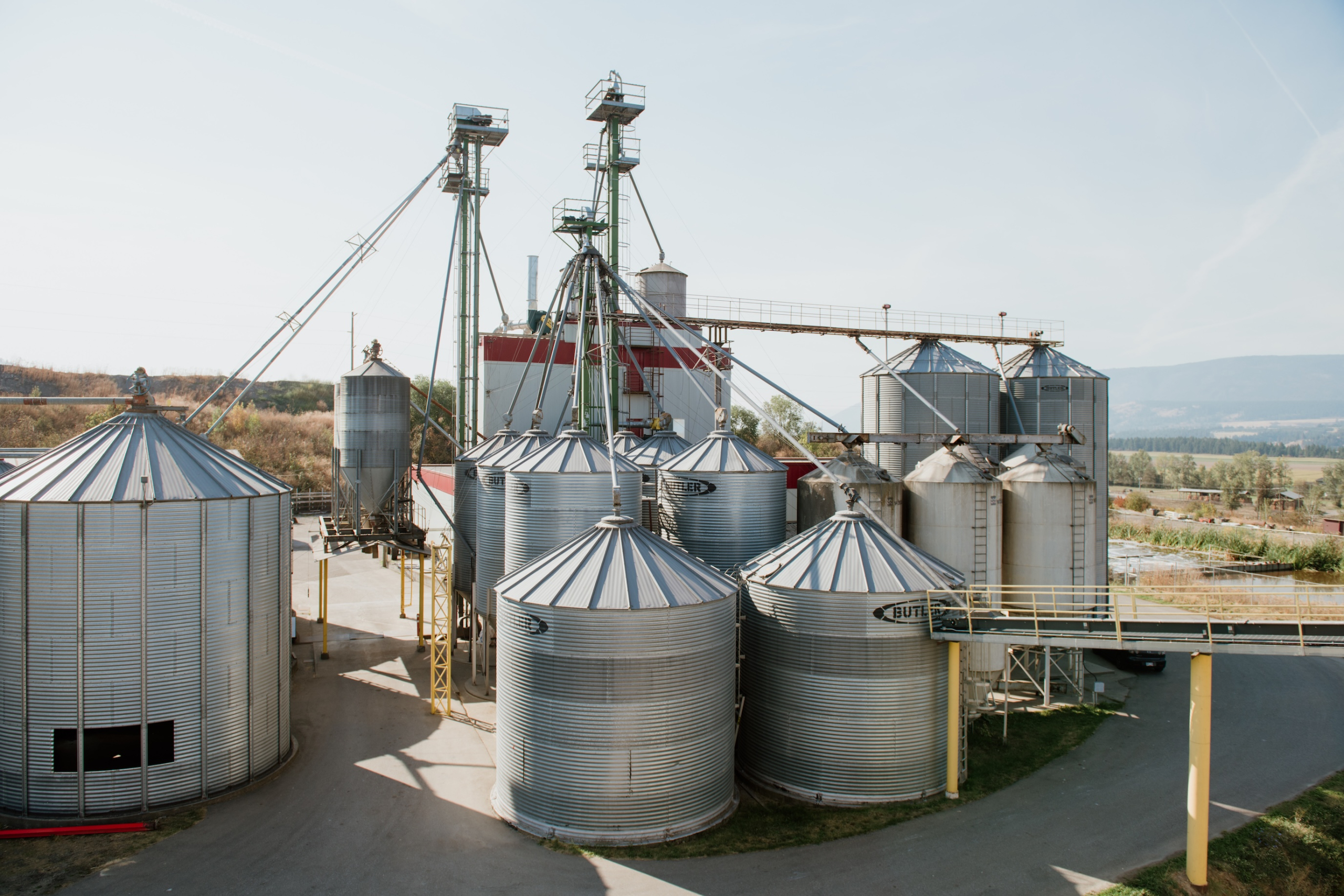
The German-inspired Canadian malthouse. Credit: Maylies Lang.

Rahr Malting is another malting company that can call on tradition—and German origins—for its professional chops. The Minnesota-based family-run business has been around for 177 years. “They’ve been through prohibition and a couple world wars,” Ken says, “and they’ve managed to persevere.” When they brought Gambrinus into the fold, they wanted to take what had been developed over 25 years and “build on what was created to turn it into something special, without removing any ties to the current community, branding, and history.”

That “something special” starts out as a raw ingredient: “barley is the typical ingredient,” Ken says. “But you can malt almost anything, from corn, to oats, to rye, it all depends on the needs of the market.” Gambrinus does mostly barley, with a bit of oats, rye, and wheat, grown on BC and Alberta farms. Everything from varietal to protein content to moisture can impact the malt so maltsters are particular about their ingredients.

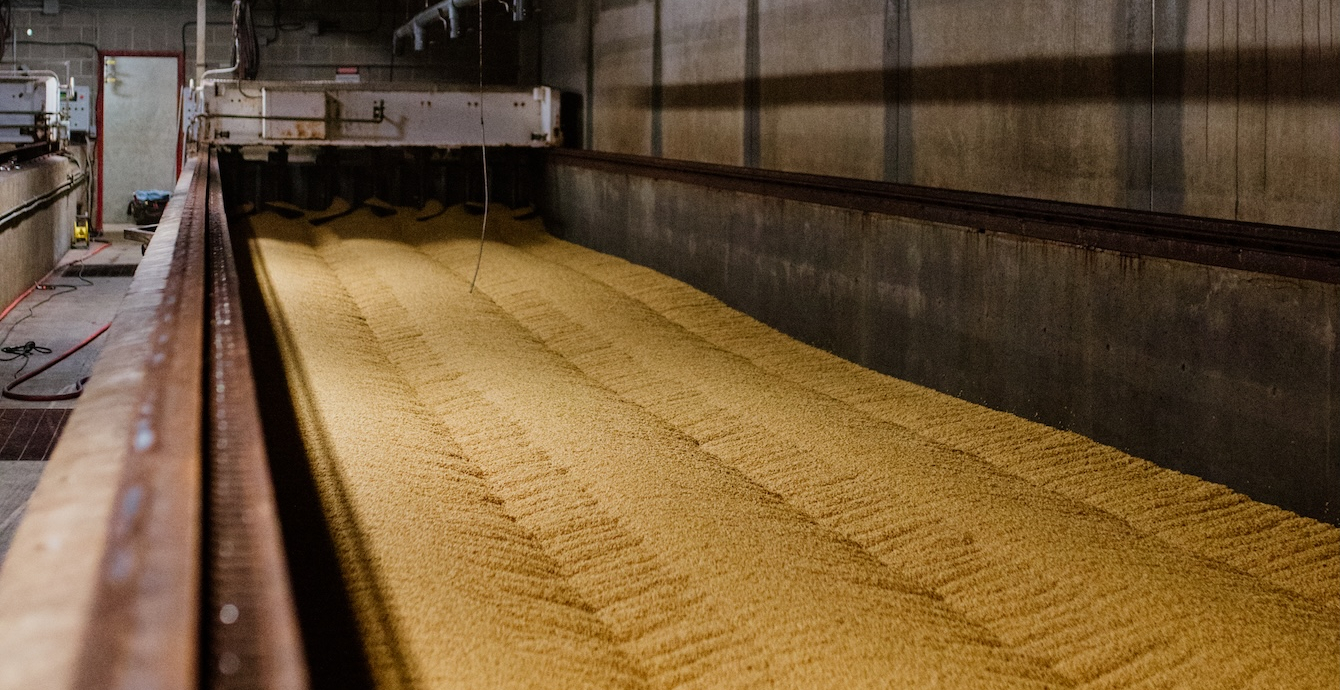
Once the barley arrives at the malthouse, it is cleaned and steeped. The moisture content jumps from about 12 to 40 percent. Next up is germination in those saladin-style boxes. “The germination process is where most of the magic happens,” says Ken. “We sprout the barley to the point that we’re satisfied that it will meet the enzymatic requirements of the brewhouse, then we want to lock in all that goodness so we take it to the kiln.” Beer contains enzymes that convert the starch in malt into sugars, a process which starts during germination. Kiln-drying suspends this process at the right moment, while adding some flavour and colour and bringing the moisture down to four and a half to five percent. “It’s now malt, not barley anymore,” Ken says.

This 5,000-year old process “is incredibly scientific nowadays, with huge investments into different sensors, trending, and monitoring,” Ken says. “It is unbelievably challenging to make a consistent product when the inputs are changing daily. The barley will show up and react differently in the malthouse, but the legit expectation from customers is that we make a malt that is consistent and reliable.”

It’s not just the barley: “Water is paramount to success,” says Ken. It’s one of the hardest things they deal with each year, how much water to use, how warm it needs to be, and when to apply the water—especially during steeping and germination. “If we get that wrong, the finished product won’t be where we want it to be.”

Malt making requires “an incredible amount of testing from the moment the grain is selected from the farm field all the way along until it leaves for the customer.” What are those tests looking for? “Everything. Protein, enzymes, colour, to name a few. Depending on the product, there are an array of sensory decisions to be made,” Ken says. “Analytics become core for decision-making as maltsters.” Pilsners, for example, require a lighter product (a one point five to one point seven on their colour scale), while darker beers such as munichs can be in the 30-plus range.

Monitoring and decisions are happening on a daily basis, and experience helps, Ken says: “We take each batch and accumulate that data.” But then they get the next year’s shipment of barley: “Every crop year resets us. We can build on experience over decades, but the grain coming in each year is different. In drought season, we might have smaller kernels; in a cooler year, more plump.”

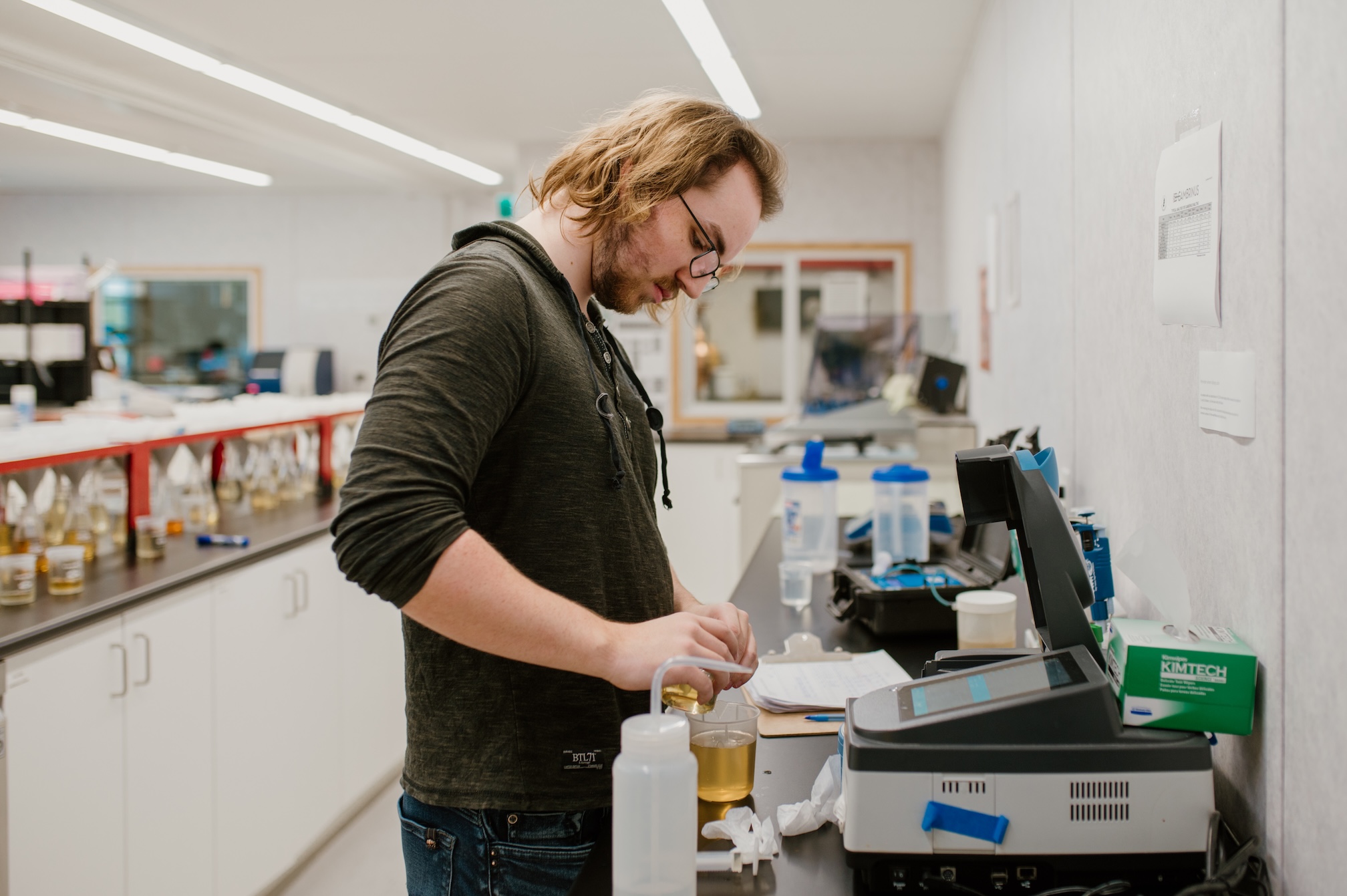
Ken is particularly excited about Gambrinus’ just-launched IPA malt, “a malt-forward, light-coloured, single-ingredient malt which is primarily used for west coast and hazy IPAs” These beers are distinctive to this region, and, Ken says, “we are trying to simplify ingredients for brewers and give them something new.” Ken first figured out this “super delicious” IPA malt would be his new favourite when he found himself enjoying drinking the wort in the laboratory. “The one thing you can’t really automate is sensory testing: taste and smell. You still need humans to test that,” Ken says. “Every day in the lab, when we process the malt in order to get all this data, we do something called a wort.” When brewing beer, wort is the liquid that comes from the mashing process, before it goes to fermentation and becomes alcohol. “We take the malt to wort. Then we can taste that liquid and compare sensories.” They do it in teams of at least five or six each day to make sure the products taste and smell how they want them to—no doubt a coveted role.

Rigorous testing is an essential part of modern-day malting. Credit: Maylies Lang.

When not tasting wort, Ken is the director of operations at Gambrinus. He is “responsible for the overall human and financial health and safety of the organization,” he says. He comes with a background in software design, data analytics and business: “my initial role was to help with the modern transition to using more technology,” and while somewhere along the way he fell in love with malting, he speaks with equal passion about the people who make the malt.

Gambrinus’ safety program—safeguarding the people making the malt—is Ken’s baby. When he first joined the company, he redeveloped it from the ground up, once he reckoned with how inherently dangerous any production facility can be: “there’s a million things that can go wrong, from chemicals to large augurs to forklifts and moving vehicles.” Ken says that Gambrinus “has been recognized on a provincial level a couple times now for contributions to safety in food manufacturing.” There’s plenty to celebrate there, including being the first malting company to achieve the Occupational Safety Standard of Excellence.

Ken lives and breathes safety not just within the walls of Gambrinus, but along the whole supply chain. Organic certification might have started out as an answer to a specific customer need, but for Ken it’s answered a number of other needs too. “The organic regime requires you to consider all elements of risk, from customer interaction to procurement traceability to inventory and quality management and more,” Ken says. He digs organics so much that he’s now on the board of the Pacific Agricultural Certification Society (PACS). “I’m passionate about it,” he says. “Organics is important to consumers maybe for different reasons than it’s important to manufacturers.” For Ken, “It’s accountability right from the farm field to the final product.”

He sees a future where more producers are growing organic grain destined for more organic maltsters, and then, of course, for more organic craft beers. It’s in part why he got involved with PACS: “most of the people involved are producers. There are not very many processors on boards, looking at organics from a manufacturing and distribution element.”

He names Fieldstone Organics, another Armstrong-based producer, as a community champion. Through their events, he’s been able to see the community come together. “There’s just so much passion and commitment to community in organics.” For Ken and Gambrinus, there is more to organics than just economics. It’s about sustainability and sustainable food practices. “It makes communities better, and the food chain more reliable,” Ken says.

Barley on conveyer belt. Credit: Maylies Lang.

Speaking of making communities better, for Gambrinus, “the future is about doubling down on our commitment to employees, community, and product.” The craft beer industry is changing as people’s tastes and habits change. Ken names a few shifts: people under 30 “have really slowed down on alcohol consumption,” is one. Another is “tastes shifting to ready-to-drink options that aren’t craft beer.”

Gambrinus is adapting and evolving with the rest of the sector, launching new products, including the previously-mentioned “super delicious” IPA. The small-batch nature of Gambrinus makes for excellent testing ground, and Gambrinus has released three new products in recent years. Non-alcoholic beer has started to catch up with the rest of the craft beer market, and Ken sees potential in that realm. But he says maltsters “are the grandpa in the whole thing. The brewers are the cool kids with skateboards, they’re the ones reacting to changes and recognizing changing habits, and coming to us and saying we need this to meet this need.”

Ultimately, Ken sees a lot of opportunity for organics in the beer world: “I want to better understand the industry and see how we can encourage more people to consider organics. It turns out some of the most passionate people in the world are involved in organics, and now I’m passionate too.”

PS: If you have spent your time reading this article wondering how Gambrinus got its name, we have something in common. At the end of my conversation with Ken, I finally asked about the name. Gambrinus is named after “a mythological story about a guy named King Gambrinus, who sold his soul to the devil to become the first immortal brewer.” When the devil came to claim his soul, he outdrank the devil, thus keeping his soul, impressing the people so much they crowned him King Gambrinus, and eventually ending up on a sign outside of a re-constructed German malthouse in a charming little valley.

Darcy Smith is the editor of the BC Organic Grower, and a huge fan of organic farmers. She also manages the BC Land Matching Program delivered by Young Agrarians.

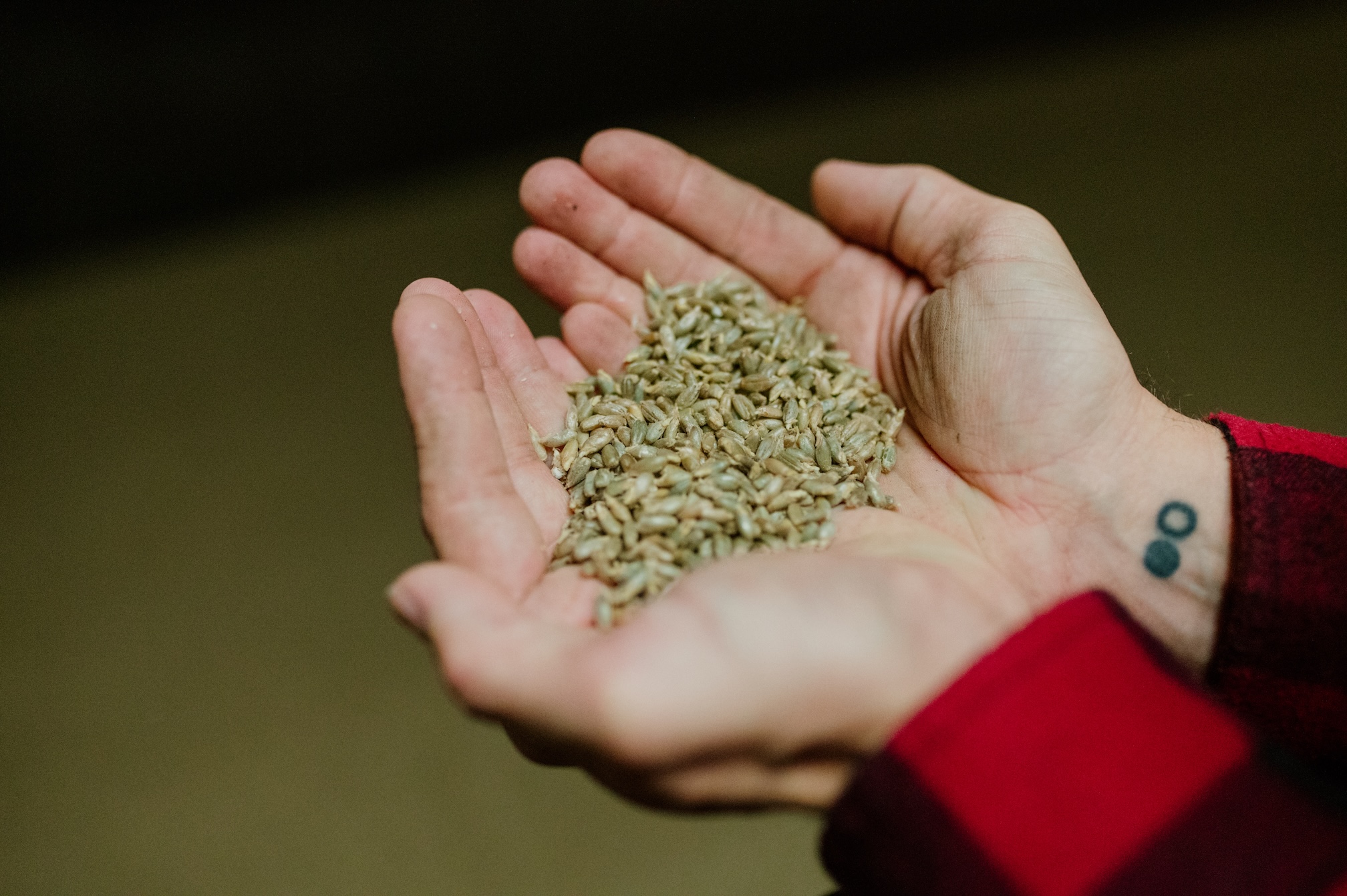
Featured image: Hands holding barley grains at Gambrinus Malting. Credit: Maylies Lang.

Biodynamic Farm Story: In Which Chickens Cause Compost Problems

in 2024/Crop Production/Land Stewardship/Organic Community/Preparation/Spring/Summer 2024/Standards Updates/Tools & Techniques

Anna Helmer

I guess everyone knows the main claim to fame of a perfectly-run Biodynamic farm is that it is a closed loop system. Everything needed by the farm is produced within the farm. Going outside the gate, especially for fertility, indicates a problem with farm health. Biodynamics, and particularly the preparations, are intended to help re-balance the farm system.

A closed loop farming system is a lofty goal. There is apparently little public glory in success, and there may be scant time left over for self-promotion on social media. How would we even know these farms exist? I am betting they don’t do social media. Social media may be an unbalancing force. I digress.

If only these farmers were writing this article, instead of yours truly with her woefully inadequate Biodynamic credentials. You seem to be stuck with me, however, as I keep saying yes when asked.

I am strongly motivated by the belief that way too many of our farm dollars flow off the farm and I think Biodynamics can help with that. As you know, I am low on the learning curve and not moving quickly—there is little risk of disconnect with non-Biodynamic farms. Try to keep up.

Okay. Let’s carry on. I have prepared a meticulous outline for this column. I should experience no difficulty executing the task with vigour, accuracy and just the right number of words.

Au contraire. Not at all. As if.

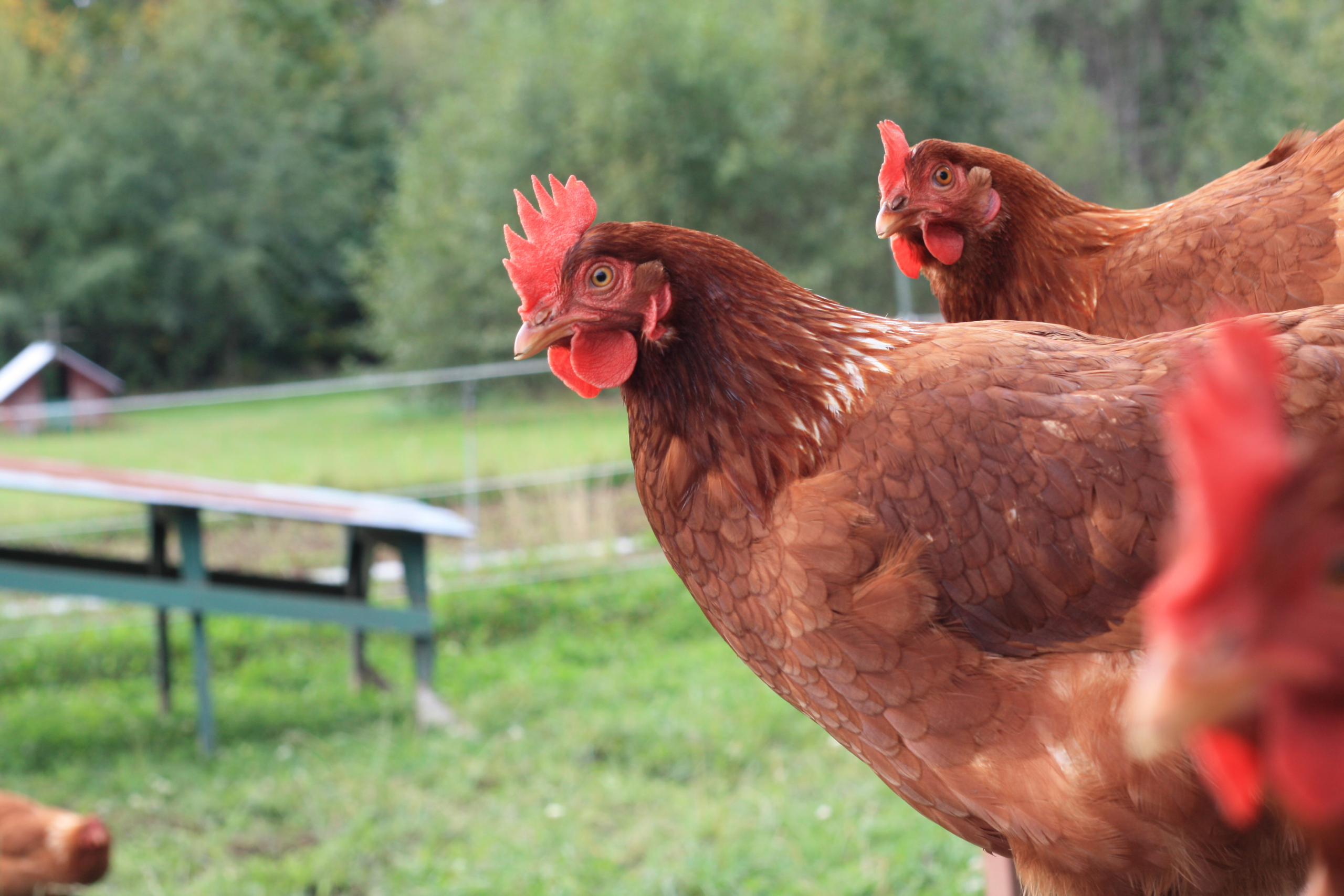
I have but a starting point and it is this: the chickens are really making a meal of my latest beautiful, Biodynamically-organized compost pile of cull potatoes. I’m generally a supporter of chickens (and their eggs), but in the spring they can really wear out their welcome. In this case, they have all but ruined my compost pile. It looks like a cull potato wasteland.

I may have mentioned (not more than a few hundred times, I am sure), that I have been on a now years-long process of developing a composting regime that deals with all our cull potatoes. My goal has been to emulate cattle, those champions of cull potato processing. In his lectures, Steiner used plenty of bovine analogies to describe the effects of the preparations. In fact, cattle, along with their pasture and the sun, are capable of being part of an exemplary closed loop system.

Why not just get some cows? Too much work frankly, and I am not afraid to say it. I comfort myself with the thought that there are cattle people out there who buy potatoes at the grocery store. We all do the best we can, right?

So, absent cattle, my goal has been to turn cull potatoes into dirt using the Biodynamic compost preparations. It’s a tall enough order. You won’t find potatoes on any list of likely composting stock because they don’t go easy. One of the tricks I have is to try to let as many of the potatoes freeze as possible during the winter. I stockpile the cull potatoes in the cooler as I am sorting and then layer them onto the pile whenever the temperature is below zero.

I stop adding potatoes in April. That’s when I mix it all up and pile it high. In order to give the pile an idea of what’s expected some of the adjacent finished pile is sprinkled on top.

And of course, I add the Biodynamic preparations. The compost preparations are my favourites because they don’t require spraying equipment and endless stirring. I also love the smell of the valerian liquid 507.

They are also my favourites because I can really see their effect, in the form of piles of dirt where once lay piles of potatoes. It’s a profound transformation. I believe I could put an old car in there and confidently expect results.

To return to the chickens. They have been let out of their run for this special two-month period between the end of snow and the planting of the garden. This is an indulgence allowed to them on account of the amazing eggs they produce during this period.

However, the chickens are not respecting my composting program. Since I finished the pile two weeks ago, they have made it part of their daily routine to spend an hour or two scrambling around pecking at what I can only imagine are precious earthworms. Scratch scratch peck peck. They have reduced my plump, proud pile to a flattened, dried, fish-on-a-stick sort of thing.

It’s a very unsatisfactory situation, made especially acute because we recently hosted a Pemberton Farmers’ Institute meeting. Several conventional seed potato growers are part of that group, and they tend to be a little eccentric where cull potatoes are concerned. Cull potato compost piles form no part of conventional seed potato acceptable practices. Cull potatoes are considered a disease source and should be fed to cows or buried in a deep hole.

It was that afternoon, as the chicken crowd departed the compost area and the farmer crowd started arriving, that I realized that the compost pile, located in full view of the parking area, resembled nothing other than a careless deposit of cull potatoes.

Thankfully, I was able to squash potential approbation by presenting our impressive group of special guests from the organic world. My cull potato composting program was not mentioned, the chicken freedom days are soon to be numbered, and I’ll shortly be able to restore the integrity of my compost pile.

Balance emerges.

helmersorganic.com

Anna Helmer farms in Pemberton where she juggles rather than balances. 

Featured image: Rascally chickens looking for trouble at UBC Farm. Credit: Hannah Lewis.

Predator Profiles

in 2024/Crop Production/Grow Organic/Pest Management/Spring/Summer 2024

Linda Edwards

[Editor’s note: As of 2024, Organic BC is more than three decades in the making, and younger sister the BC Organic Grower is on it’s 27th volume! What better time to look back on some original content from the early days of this magazine? Read on for an early-2000’s series on predator insects by Linda Edwards.]

Fly Away Home: Lady Bug Beetles (Coccinellidae)

First published in Summer 2001 (Vol 4, no 3)

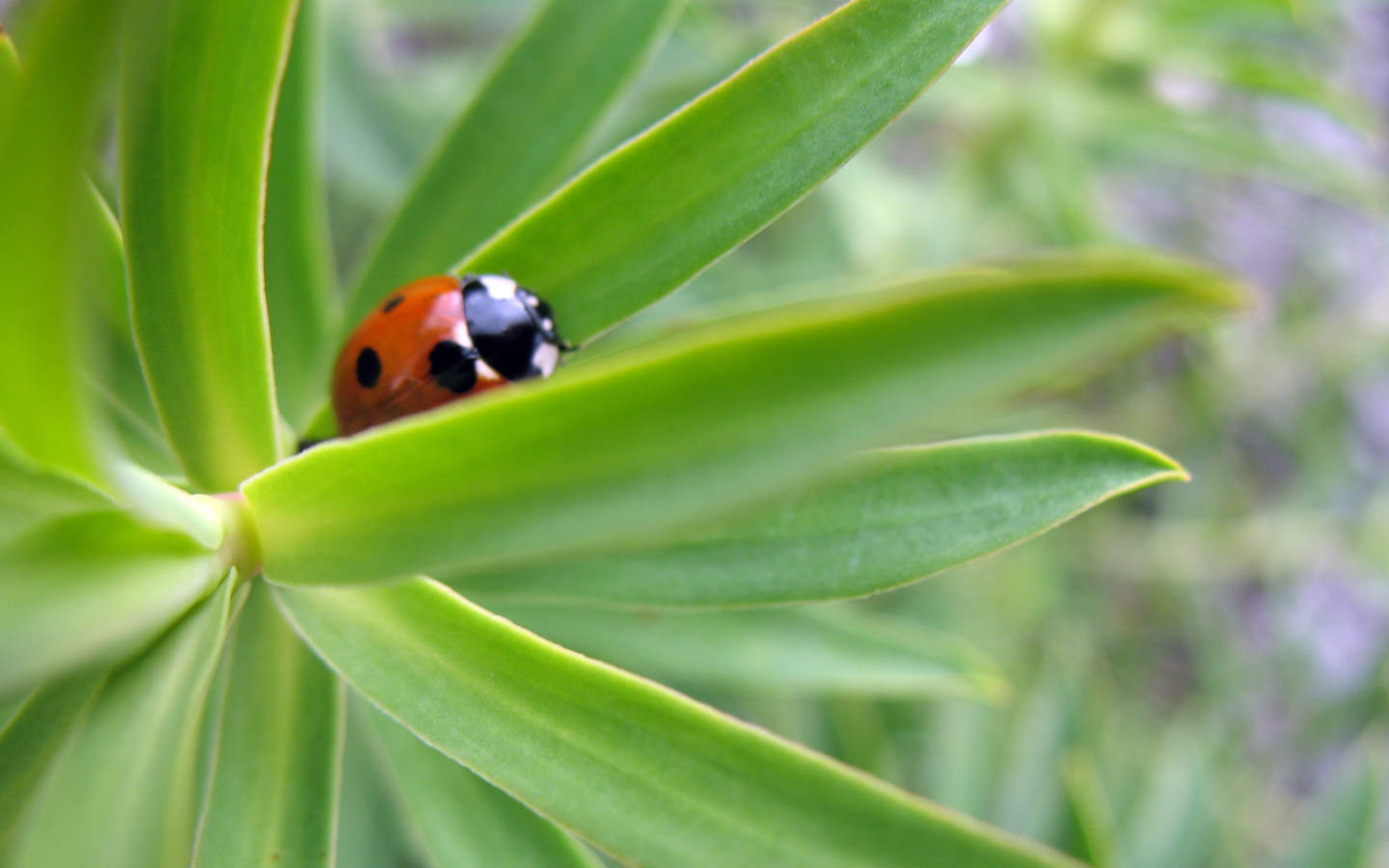
Lady bug beetles are probably the best known and most appreciated, if not loved, of all insects. The adults come in many sizes and colours—pink, red, yellow, and orange. Some have no spots and others have as many as 19. These adults over winter in groups under rocks, fallen trees, and in hollows in hillsides and mountainsides. Their bright yellow, spindle-shaped eggs are laid end up on leaves, in clusters of 10 to 30.

The egg clusters are similar to those of their much less popular cousins, the Colorado potato beetle. However, you will find potato beetle eggs only on potato and nightshade plants and rarely are aphid populations high enough on these plants to attract lady bugs to stay long enough to lay eggs. In other words, you are safe to destroy egg clusters you may find on these plants.

In about five days, tiny, bristly black, alligator-shaped larvae hatch out. After they moult, they are grey to blue-grey with purple and orange markings. They feed for about a month and then enter a pupal or resting stage where they become adults in about 10 days. The pupae are immobile, orange-red bumps with black markings that you find attached to everything from bark and leaves to fence posts.

Both the adults and larvae live mainly on aphids. However, they are not very effective at keeping aphid populations from becoming a problem in the first place. Unlike some other predators and parasites, lady bug adults have no special ability to locate their prey. They have to actually bump into something to find it. They also have a short attention span; careful observations (an entomologist’s idea of fun) have shown that if they do not locate prey in 2.5 minutes on a plant they leave, so that low populations tend to escape their notice and therefore control. When there are high populations of aphids, lady bugs do accumulate and are effective in cleaning up infestations. Unfortunately, damage has often already occurred.

One should never use the word “stupid” to describe insect behaviour—though it is tempting when contemplating lady bug larvae. They can be observed wandering aimlessly on the top of a leaf where there are no aphids and never checking underneath where there may be many. Needless to say, survival rate is very low. This, plus the fact that this insect has only one to two generations a year, means the numbers of lady bugs available for biological control is relatively low.

Don’t bother buying ladybugs for control of aphids in a specific situation. The insectaries that sell them, collect them as hibernating adults (usually in Colorado) and keep them cool and dormant until they ship them to you. When you open the container in your garden or orchard, the beetles fly out with only one genetically implanted aim in mind: to fly as far as they can as quickly as they can to get off that mountaintop where they entered hibernation. Flight distances are usually at least half a kilometre and not infrequently much further. Years of research have clearly shown that the only way to keep them where you want them is to put a cage over the plants to be protected.

As you know, damaging outbreaks of aphids in organic production tend to be infrequent. If lady bugs aren’t effective in preventing this from happening, what is? It is the many other less conspicuous predators and parasites. Next issue, I will tell you about one of my favourites—Aphidoletes aphidimyza—the serial killer of the predator world.

The Serial Killer of the Predator World: Aphid Midges (Aphidoletes aphidimyza)

First published in Fall 2001 (Vol 4, no 4)

Most predators kill and feed until satisfied and then rest until they get hungry again. Not Aphidolotes! While a larva can get through a life cycle on as few as six aphids (the only food they eat), if there are more in the vicinity, it will just keep on killing! This ability to survive at low numbers but respond to high numbers is very useful. This means they don’t have to leave an area when numbers drop and can therefore keep resurgences of pests (as can occur with predators like lady beetles) from occurring. It also means because of this tendency to kill as many as possible not just as many as necessary, they can bring high populations of aphids under control more quickly than most of the other predators.

Aphidoletes kill aphids by piercing their victim’s leg tissues and injecting a toxin. This paralyzes the aphid, stopping it from feeding and therefore killing it. Every once in a while, the midge larvae stop and suck out the contents of their prey, leaving behind a black shrivelled body.

This is an indigenous and wide-spread species. The adults are seldom seen, however. They are very tiny, mosquito-like, dark brown, and only fly at night. They feed on honeydew generated by the aphids. Unlike predators like lady beetles, they have wonderful searching ability. An Aphidoletes adult released at the edge of an acre-sized field of plants, with just one plant in the middle with aphids, will find that plant and lay eggs on it. This kind of knowledge is another example of how entomologists like to spend their time!

The eggs—always laid near aphids—look like flecks of paprika. These hatch in two to four days. The larvae, which grow to a maximum of 0.3 millimetres, are bright to pale orange. They are cylindrical and smooth. They too are not easily seen because they are usually under an aphid, killing it. After feeding and growing for one to two weeks (faster in hot weather, slower when it is cool), the larvae drop to the ground and pupate for one to three weeks—again temperature dependent. The adults emerge, lay up to 200 eggs, and the cycle starts over again. There are three to five generations per season, which can result in very high populations. Short days in the fall triggers hibernation. They overwinter as pupae in the soil and leaf litter. It has been documented that there are at least 65 kinds of aphids that this predator will eat. Imagine if you will, years of entomologists searching out aphids and feeding them to Aphidolotes larvae. Yep! They eat that one too!

Such a wonderful predator! So why are there ever outbreaks of aphids anywhere? Their weakness from a growers point of view is that they don’t like cool weather. Their emergence from hibernation is triggered by long day length. They do not start to emerge until around the first week in June. Unfortunately, in many cases, by that time aphid populations may already be high (a good deal if you are an Aphidoletes and possibly why they have selected for late emergence) and be causing damage to crops. The Aphidolotes will become in many cases the most important predator in bringing them under control—but the higher the populations, the longer it will take.

Aphidoletes can be purchased for release. They are the main predator used against aphids in greenhouses so every insectary rears them. You receive pupae in containers. Put them in a warm place out of direct sunlight. Check about every 12 hours. When you see a number of adult “flies” under the lid, take them out and release them into the area where aphids are a problem. Do releases in the evening or very early in the morning before the sun comes up. The adults can dehydrate and die in direct sunlight. After at least most of the adults have flown, put the lid back on, and take it back inside until more adults emerge. Repeat until there are no more. It is okay to tap the side of the container to activate them.

The number you release depends on how much you want to spend, which tends to depend on how bad the situation is. Releases can be very effective especially in places where native populations of Aphidoletes may be low i.e. annual crops or a tree nursery. However, they will not be effective under cool conditions so early spring releases—before naturally occurring ones would emerge—are not recommended. Average daytime temperatures should be above 18 degrees Celsius. There have also been some successes with mid-summer releases, which reduced chronic aphid populations so much that there were very few that were left to over winter and consequently populations were much lower the following year. There have also been releases that made no difference at all. This insect also does not do well under very dry conditions. It is thought that the pupae tend to dry out.

Fair Weather Friends: Green Lace Wings (Chrysoperla cernea and Chrysoperla nigricornis)

First published in Winter 2002 (Vol 5, no 1)

Green lacewings are very good predators, but don’t rely on them to be effective until early summer. There are two main species in BC. Adults of both feed on aphid honeydew and plant fluids. C. nigricornis adults and the immature larvae of both are also predaceous. Aphids are preferred but they will also eat psylla, mites, leafhoppers, thrips, and small caterpillars.

The adults are one of the most beautiful insects—large membranous wings, green bodies, red or gold iridescent eyes, and long fine antennae. They are nocturnal and are often attracted to lights at night. The oval eggs on slender stalks are laid mainly on leaves. They are white at first but turn grey just before hatching. The larvae are mottled yellow, grey, or brown and look like little alligators. They are very active and voracious predators. The larvae form green pupae inside a spherical white cocoon in foliage when they complete their cycle. Egg to adult takes about 30 to 40 days and there are two generations a year.

They overwinter either in the pupae form or as adults in litter, buildings, or under bark. There are relatively few early in the spring so they are not very effective then. The overwintering adults are present but the females do not start laying until night temperatures are warm—usually mid- to late-June.

Lacewings can be purchased from insectaries. However, research has shown that this almost never increases local population. Most of the time, the lacewings arrive as eggs (without their stalks) glued to cardboard. This is the most inexpensive method. However, research and careful observations have shown that the first larva to hatch eats most or all of the other eggs on the cardboard. There are better survival rates from eggs mixed with materials like vermiculite, although at least a third are crushed during the mixing and handling. Larva in individual holders can also be purchased but they are very expensive. Adults are unsuitable because like ladybugs, they tend to fly up to four kilometers as soon as they are released.

Linda Edwards was one of the most influential members of the organic community in BC, and has been greatly missed since her passing in 2020. Linda was a scientist, researcher, and expert in organic fruit trees, and committed organic advocate through her work on the boards of many associations. She also, clearly, loved talking bugs!

Featured image: Lady Bug Beetle. Credit: (CC) Gorupka.

Promising Developments in Robotic Weeding Technology

in 2024/Crop Production/Grow Organic/Spring/Summer 2024/Tools & Techniques

Stacey Santos

The robots have arrived to help with weed management on the farm, but where do you start? How do you know what’s right for your crop, your acreage–and your budget?

Thankfully, a number of options have emerged for managing agricultural tasks with robots, along with a crop of experts who are working on finding Canadians the most promising options for robotic weed control.

In a recent episode of the Organic BC Podcast, host Jordan Marr sat down with two members of Ontario’s AgRobotics Working Group, who explained why robots have become a viable option for farmers, including organic producers in BC who are looking to boost sustainability, soil health, and efficiency on their farms.

AgRobotics Working Group

Since 2021, an AgRobotics Working Group, led by Haggerty AgRobotics and the Ontario Ministry of Agriculture, Food and Rural Affairs (OMAFRA), has paved the way for the use of autonomous robots in farming. The group, which also includes growers, grower associations, agri-business, universities and colleges, federal and municipal governments, and technology companies, serves multiple functions, but foundationally it exists to help farmers make smart decisions as they consider investments in tools that can be really expensive.

“We’re trying to basically ground truth so producers do not have to be guinea pigs,” said Kristen Obeid, weed management specialist with OMAFRA and chair of the AgRobotics Working Group. “We want to work out all the bugs first, because this is complicated.”

“We want to deal with challenges that the farmers want us to solve,” added Chuck Baresich, farmer and president of Haggerty AgRobotics. “We look through our network and say, ‘Does anyone have an idea of a solution that may or may not solve that problem? Let’s go test that and see.’”

Why robots, and why now?

Part of the answer is that the technology has developed to the point that some of these tools are just plain good at delivering on what they promised to do, and meanwhile they’re starting to be able to compete on cost with other methods of weed control.

But, there has also been a major development in agriculture that motivated farmers to give these tools serious consideration: herbicide resistance.

“Herbicide resistance is going to be the biggest challenge facing agriculture in the next decade,” said Kristen. “In Ontario alone, we have 23 resistant weed species.”

From a chemical perspective, weed control options are not as available or as effective as what they used to be.

“Resistance is on a trajectory,” Kristen added. “It’s not going away. We need to find different integrated weed management solutions for growers to implement and not continually rely on herbicides.”

But what about good old fashioned mechanical cultivators pulled behind tractors driven by farmers, aided by RTK GPS? Why should farmers consider robots instead of those tools?

Soil damage.

A lot of these robots incorporate artificial intelligence, so they only take out the weeds, with minimal soil disturbance. And, the robots are often lighter than traditional tools, so there’s a lot less soil compaction.

And then, there’s the potential for these robots to save farmers the precious commodity of time when compared to traditional mechanical cultivation.

“That’s where the allure of robotics comes in,” said Chuck. “RTK and auto-steer systems have got pretty good reliability and trustworthiness, and we’re at the state now where we can take that knowledge and move it into an unattended machine.”

Let’s talk about cost

The costs are variable. Kristen and Chuck discussed six robots, and the price varied from $60,000 to a quarter million (CDN), depending on the robot.

What matters most, anyway, is cost effectiveness and value proposition–also difficult to pinpoint because the value of one of these machines really depends on the context of any given farm.

“These robots will never compete against a 120-foot-wide sprayer,” said Chuck. “Where the robots compete is if, say, you’re used to bringing in a manual weeding crew. Or traditionally, when a farmer has to cultivate, they take either themselves or one of their top workers and put them in the tractor. They can be doing something else of more value than sitting in a tractor seat, whether that’s seeding a different crop or monitoring for disease or something else.”

“This robot has nothing else to do, so it actually doesn’t matter that it’s moving slowly, as long as it gets over the field.”

Tools under evaluation

The FarmDroid

One of the tools the AgRobotics Working Group has been evaluating is the FarmDroid, a 900 kg, solar-powered robot that uses a geolocation seeding mechanism to plant in a perfect grid pattern across your farm. Knowing where every seed is, the FarmDroid then weeds that exact same field after planting, before the seeds even come out of the ground.

It’s completely autonomous–it charges itself, runs through the night, and doesn’t require any input from the operator other than if there’s a problem.

The tradeoff for its precision is that the FarmDroid is very slow–its top speed is 0.8 km per hour and it can only handle about eight acres every 24-hour period. If you’re a larger producer and wanted 50 acres of a crop planted on the same day, you’d need multiple FarmDroids running at the same time.

You also need to be cognizant from an operational perspective that you also only have eight acres a day for the weeding process. You need to make sure the field you’re putting it in is appropriately sized so the FarmDroid can get to all the weeds before they grow too large to be taken out.

AgroIntelli Robotti and Naio Orio

The FarmDroid is best suited to higher value horticultural crops like carrots or beets, but is too low to the ground, too small, and too slow to make much economic sense for field crops like soy and corn.

For those kinds of crops, the AgRobotics Working Group has been evaluating different robots, including the AgroIntelli Robotti and the Naio Orio.

These machines are quite similar to each other and can go through crops that are waist high or more, and can do four to six 30-inch rows at a time.

The only difference between the two is that the Naio Orio is an electric robot that can get eight to ten hours per battery charge, and that the Robotti has a little diesel engine that can run for about 60 hours on a tank of fuel.

Both are really precise machines with camera guidance and three-point hitch attachments, so they’ll fit your existing cultivator or other implement. They can also accommodate larger acreage: the Orio can keep a 50-acre field under control, while the Robotti is closer to 100 acres.

Nexus La Chèvre

Jumping back to horticultural crops, another interesting tool is La Chèvre (“The Goat”) from Nexus.

La Chèvre has a series of cameras at the front of the machine that are programmed to know what the crop is. If it sees anything that’s not lettuce, for example, it sends a pair of mechanical grippers down to remove whatever the obstacle is.

The real advantage is that this robot can be trained to leave microscopic weeds alone, resulting in less soil disturbance. And, it also has the advantage of being able to pull out slightly larger weeds, which the other systems cannot do.

“Where we’re seeing some interest in a robot like this is from farmers who might set up a herbicide program where they put down some form of residual and then use the robot from that point on to do weed control,” said Chuck. “Generally speaking, they’re trying to get the robot up to five acres in a 24-hour day–approximately three workers worth.”

Options for no till systems

For the most part, the robots that Kristen and Chuck deal with aren’t a great fit for a no-till system, and one of the main reasons is what Chuck calls “trash”—the residual roots, stock and leftovers from the previous crop that plug up the tooling and are too much for the cultivator to deal with.

The AgRobotics Working Group is working on solutions: they have one grower doing a trial with the Robotti in a strip-till system, carrying out traditional spraying in the strips and then using the robot closer to the crop.

They’re also looking at tooling options and moving into alternative technologies, whether it’s laser weeders, spot sprayers, or electrical weeders for a more precise weeding system. But, these systems are much more costly and complicated.

“Again, you talk about trade-offs,” said Chuck. “Nothing is cheaper than a cultivator, and the second you start moving to vision systems, AI systems, cameras, mechanical arms, lasers, whatever it is, all of a sudden it gets very costly, very quickly.”

Robots aren’t magic

While Kristen and Chuck are optimistic about the role these machines can and will play on the farm, they do come with limitations.

For one, your soil conditions have to be such that the robot can accommodate it. For example, in wetter conditions, the FarmDroid operates better and covers more ground on sandier soil than clay.

And then there’s the internet. With all of the RTK GPS technology, you need to be reliably connected at all times, which can be a barrier.

Another hurdle is the investment, which Chuck describes as a tough pill to swallow.

“Most people aren’t rolling around in cash,” he said. “You know they’re sitting there saying, ‘Hey, I already spent my $300,000 or $400,000 on a tractor, or on this piece of equipment, or whatever. And you’re asking me to do that again and abandon my initial investment?’”

“There are very legitimate reasons to be hesitant.”

Adding to the fear is the constant improvement of technology (in five years time, there’s going to be an upgraded version) and questions around the service (if I’m buying a robot from France, what happens if it breaks down?).

But there’s good news: Businesses are popping up across the country that are trying to solve these issues and provide service to producers who purchase the equipment.

Success stories

While there are some considerations to keep in mind, both Kristen and Chuck are extremely optimistic about the potential of these tools. Here are some success stories they observed in their trials:

From Kristen: “In the Holland Marsh area of Ontario, we have a fig leaf that is now resistant to two groups of herbicides that growers use in their carrot and onion production rotation. We’ve had tremendous success with the FarmDroid. We’ve tested in sugar beets, and then this past year we trialed it in onions and again, with great results.”

“The other one that we had last year was planting onions with the FarmDroid and getting a more consistent size of onion sets,” she added.

From Chuck: “One of the other robots we’ve used is called a Naio Oz, and we had a great experience with one of our customers using it to mark out rows of garlic, and then plant the garlic and weed it over the summer. That was a great use case of a scenario where the farmer’s using the robot like an assistant.”

A lot of potential, but beware of the hype

When doing your own research into agricultural robotics, don’t get sucked into the hype around AI and machine learning, even when robotics companies make wonderful claims on their websites.

“Not all of the stuff we’re doing works,” said Chuck. “I’m a very optimistic person and I love the technology, but boy, I don’t want to oversell it.”

“I think the market will pick the winners and the losers, but I think the technology is very, very promising,” said Kristen. “There are still lots of questions and lots of hurdles before there will be widespread adoption. But I think we’re on a good path forward.”

Listen to the full podcast

To learn more about any of the tools discussed here, or to learn more about the AgRobotics Working Group, visit:

AgRobotics Working Group
Haggerty AgRobotics
FarmDroid
Naio Orio
Nexus La Chèvre

This article was funded through Sustainable Canadian Agricultural Partnership, a federal-provincial-territorial initiative.

Opinions expressed in this article are those of the author and not necessarily those of the Government of Canada or the BC Ministry of Agriculture and Food. The Government of Canada, the BC Ministry of Agriculture and Food, and their directors, agents, employees, or contractors will not be liable for any claims, damages, or losses of any kind whatsoever arising out of the use of, or reliance upon, this information.

Stacey Santos is the Communications Manager for Organic BC. She lives, writes, and gardens in the beautiful and traditional territories of the Lekwungen peoples, who are now known as the Esquimalt and Songhees Nations.

Featured image: The Naïo Orio robotic weeder. Credit: Naïo Technologies.

Growing from Little to Big: How Salt Spring Coffee Navigated Growth

in 2024/Marketing/Organic Community/Spring/Summer 2024

Ryan Kilthau

In 1996, founders Mickey McLeod and Robbyn Scott opened a coffee roasting café on Salt Spring Island with the mission of bringing sustainable coffee to their island community. Salt Spring Coffee was born, and the freshly roasted coffee quickly became an island favourite, sparking conversations with customers about coffee quality and sourcing.

In their quest for coffee that was environmentally friendly and fair to farmers, Mickey and Robbyn made several origin trips to Central America and Indonesia, visiting coffee farming communities in Costa Rica, Peru, Nicaragua, Sumatra and Uganda. Together, they built long-term, direct trade partnerships with coffee producers, who not only shared their hospitality but also shared their generational expertise in organic coffee production and regenerative agricultural practices.

As a result, Salt Spring Coffee became one of the first 10 companies in Canada to be Fair Trade Certified. Since committing to fair trade, Salt Spring Coffee has contributed millions in fair trade premiums, which are additional funds paid directly to coffee farmers who decide on how to reinvest the money within their communities.

Growth

Growth began organically. In the 90’s, it was common for coffee traders to sell coffee based on quality score with little connection to the farmers who produced it. However, Salt Spring Coffee’s direct trade partnerships contributed to a richer understanding of both green bean quality and coffee production. The result was an exceptional cup of coffee with a relationship to coffee farmers that resonated with consumers, and the demand for Salt Spring Coffee’s organic, fair trade coffee grew.

A year after the café opened, Salt Spring Coffee became among the first certified organic coffees in Western Canada to be sold in grocery stores.

Bug Baker and Jodi Dueck roasting coffee at Salt Spring Coffee in Richmond. Credit: Salt Spring Coffee.

Overcoming Challenges

The café on Salt Spring Island quickly outgrew its coffee roasting capacity. The 7.5 kilogram coffee roaster was upgraded to a 30 kilogram roaster, but it wasn’t enough to keep up with demand. Mickey and Robbyn drew up plans to build a coffee roasting and education facility on Salt Spring Island, but after several months of planning, the zoning application was denied. A new space was found on the mainland, and in 2010, Salt Spring Coffee expanded roasting operations to Richmond, BC.

New operations meant expanding the family run business and growing the team. Salt Spring Coffee’s commitment to making a positive social and environmental impact was just as important to internal operations as it was to the coffee supply chain, and in 2010, Salt Spring Coffee became B Corp Certified.

Future

With a growing company, it was more important than ever to Mickey and Robbyn to go, beyond sustainable, to regenerative agricultural and social practices. In 2024, the Salt Spring Coffee team worked together with the Regenerative Organic Alliance, ROA, and coffee producers to launch Canada’s first Regenerative Organic Certified® coffee.

Regenerative organic certification sets the highest standard in the world for soil health, ecosystem preservation, and farmworker fairness. For a farm or product to be Regenerative Organic Certified®, it must first meet USDA organic requirements. From there, additional rigorous standards must be met including sustainable agricultural practices, animal welfare protections, and social responsibilities including supporting the wellbeing and livelihoods of farmers and workers.

Regenerative organic certification provides a holistic framework that ensures communities and ecosystems flourish throughout the coffee supply chain, from crop to cup. At Salt Spring Coffee, it’s another step forward in their mission to change the world for the better.

saltspringcoffee.com

Ryan Kilthau is senior marketing manager at Salt Spring Coffee. He’s an avid coffee drinker and enjoys sailing the BC coast including Salt Spring Island.

Featured image: Mickey with coffee farmers Byron and Sara Corrales. Credit: Salt Spring Coffee.

1 2 3 4 5 29
Go to Top