Author

Darcy Smith - page 29

Darcy Smith has 283 articles published.

Woolly Bear Farm

in Farmer Focus/Organic Stories
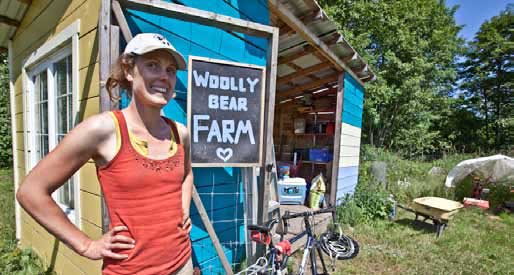
Liz at Woolly Bear Farm

Hannah Roessler

A New Farmer Struggles to Go From Caterpillar to Butterfly

I have been pretty amazed by every farmer I’ve ever met — their competence, determination and impressive suite of skills.

But now that I am a new farmer myself, I find myself in awe of Liz Perkins of Woolly Bear Farm, a one-acre market garden in Cordova Bay, near Victoria. While I have dabbled seriously in farming for years, exploring various permutations, styles, and types, I only really jumped in with both boots once I had an established, relatively low-risk scenario within which I could safely start farming “on my own.”

Liz, on the other hand, found a raw piece of land and just went for it — and her efforts and risk-taking have really paid off.

Challenges Aplenty

We all know how difficult it can be as a new farmer just starting out. It’s always the same things that get in the way — infrastructure costs are overwhelming, mistakes are plentiful, and land is hard to come by.

Most people don’t get into farming because they love business and marketing; they do it because they love to grow things. Starting up your farm is fun and exciting, but like any new small business it can also be a financial quagmire, layered with intense knowledge requirements and drastically shifting parameters. Not for the faint of heart.

But uncertainty is something that you just have to be comfortable with in order to be a good farmer. And Liz is a darn good farmer. She spent a year in Vancouver working with food through a social justice lens, an entry point to farming that is common among many of the younger farming generation.

She then spent a couple of years working on urban agriculture initiatives, but soon realized that she was not as passionate about educating people about farming as she had originally thought. What she really wanted was to just do it herself — to farm and produce an abundance of food.
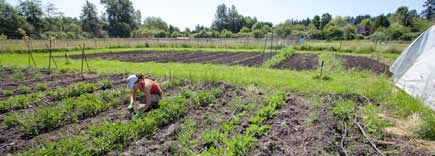
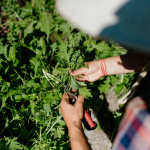
Weeding at Woolly Bear Farm

A Farmer’s Education

She applied to the UBC Farm Program and to the Linnaea Ecological Gardening Program, ultimately settling on Linnaea, a farm school located on Cortes Island, BC, where she attended their holistic, full-immersion permaculture program.

“Being at Linnaea changed my life. It was incredible,” says Liz with a smile. The in-depth training offered through Linnaea along with the community-building aspect left a deep impression on her, and she knew she was on the road to farming forever.

While Linnaea Farm School set the course, an apprenticeship with Rachel Fisher and Saanich Organics helped Liz put the structure in place for a successful business.

Says Liz, “I learned an incredible amount during my time with Saanich Organics. Rachel taught me how to grow an abundance of vegetables, and I learned so much about the business aspect of farming.”

After her apprenticeship, she optimistically stuck an ad in a couple of local papers asking to rent an acre of land for farming in exchange for $500 per year, a box of veggies a week, and of course, farm tax status. She had several replies from interested land-owners and says that overall, it was not too difficult to find someone willing to rent to a start-up farmer.

Fast Track to Certification

Despite the perception that organic certification can be difficult for leasing farmers, according to Liz, it’s not as hard as new growers may think. “There had been nothing growing in that field for the six years that my landlord had lived there prior to 2011, so he signed an affidavit guaranteeing that no prohibited substances were applied to the land in the last three years. This meant I could fast-track to organic certification after one year on the land,” says Liz.

She adds, “The fact that I might get kicked off the land at any point is a bummer of a risk, but I don’t think I would have been able to farm without being able to sell at Moss Street Market and Saanich Organics. Both institutions have been a big marketing and moral support network for me. So far, no regrets!”
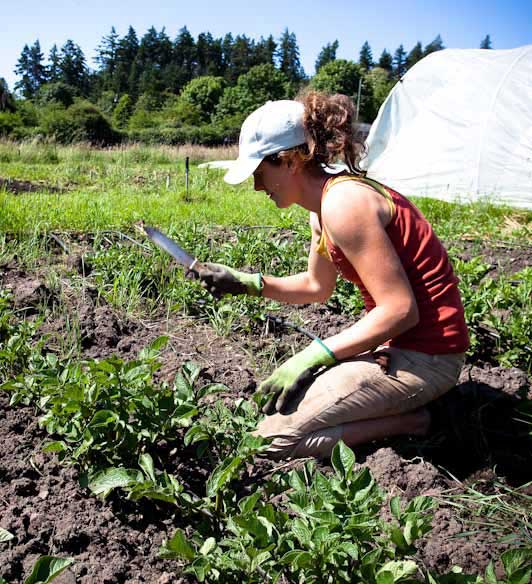
Weeding at Woolly Bear Farm

However, acquiring the land and the certification were only the first steps, and Liz went on to encounter more challenges. Her original business plan underestimated her initial set-up costs, and she is ever-grateful to her parents for helping out financially until the business gets on its feet. The first year, her farm’s humble sales of $10,000 were not enough to cover expenses, and in year two she just broke even – doubling sales to $20,000. She is now in her third year of farming and can smell financial freedom with a prediction of $30,000 in sales and of course much-reduced expenses.

Hard Won Advice

Says Liz, “Some of the things I had to do to start out, I just didn’t consider. I had to spend so much time preparing and setting up the farm, I had no income to live on.

“I feel like I wasted a lot of money on failed experiments. I got the wrong tiller, tried to use solely pond water for my irrigation (which didn’t work), bought huge coolers to act as my cold room, I had to learn how to build because everything I built kept getting blown down….

There’s a lot to consider when starting out, and I think that if I knew what I know now, I’d start out differently, and save a lot of money!”

The best part of this conversation is that Liz is laughing. She is taking it all in stride. Even while she’s on leased land, she’s just planted a section of blueberries on her rented acre. When I comment on her impressive ability to take chances, her bravery, she jokes that maybe she’s really just a bit crazy. But there is no denying that her farm looks really good. Liz Perkins is the picture of success for a new farmer, and she’s doing a great job at Woolly Bear Farms. I think she’s got the right recipe to make it work. Maybe we all need a dash of “a little bit of crazy” to be successful farmers.


Learn more about Liz’s path to farming independence:

Linnaea Farm

Saanich Organics

Hannah Roessler has farmed in Nicaragua, Washington, and BC on permaculture farms, polyculture cafetals, organic market farms and a biodynamic vineyard. She has an MA in Environmental Studies, and her research is focused on climate change and small-scale organic farming. She currently farms on the Saanich Peninsula on Vancouver Island. 

Nanoose Edibles

in Farmer Focus/Organic Stories
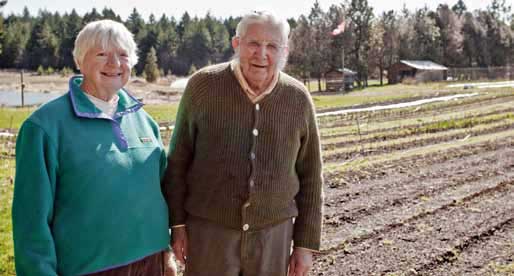
Barb and Lorne Ebell, Nanoose Edibles

Hannah Roessler

It Takes Dedication, Devotion, and a Community to Raise a Farm

I had been trying for weeks to make it to Nanoose Edibles Farm to visit Barbara and Lorne Ebell, but bad weather on the Malahat Highway turned me back each time. The day I finally made it was sunny and warm, and I could barely contain my excitement.

I’d recently read an interview with Barbara Ebell in a local paper, explaining the hardships encountered by farmers on Vancouver Island; it was a deliciously blunt article, and she caused quite a few ripples. I had heard great things about this remarkable woman, but nothing quite prepared me for the amazingly accomplished yet humble person I met. “I’m a farmer and I really like to farm,” says Barbara, “but I’m always under pressure to do more. People have been phoning me since that article saying ‘now what are we going to do?’”

It’s understandable that folks are approaching the Ebells for solutions. Barbara and her husband Lorne Ebell have a successful farm business…which they started only after successful careers in forestry and agriculture. Over tea and cookies, we discussed their fascinating farm backgrounds, and it’s clear that agriculture has always run deep for them; it’s in their blood.

Barbara’s mother was born on a large estate farm in England, and her Swedish father emigrated to Golden, BC, where the family sold farmed vegetables and fruit, fish from the Columbia River, and wild game to the CPR. Lorne, an agriculturalist through and through, attended school in Manitoba and Alberta before taking a job in the Ministry of Forestry. After several years of working in the Canadian government, Barbara and Lorne moved to Liberia, Africa where Lorne was Head of Botanical Research for the Firestone Rubber Company. They spent seven years in Liberia, working on a huge plantation housing 13,000 residents.

As Barbara recalls, “The women were excellent farmers and wonderful marketers. My collards were only regular size and theirs were the size of small bushes!” I find myself thinking that Barbara could probably grow collards the size of trees if she wanted to, but I don’t say that.

After a brief stint working in Guatemala, and then several years in the state of Bahia in Brazil, they returned to Canada where Lorne went back to working in Forestry Research and Barbara took a position with the Ministry of Agriculture in the Policy Branch. After the adoption of Canada’s Employment Equity Act in 1986, provincial governments followed suit and Barbara became the first Manager of Women’s Programs for the Ministry of Agriculture to help “push the envelope” of women’s advancement in the government.

I find myself thinking that Barbara could probably grow collards the size of trees if she wanted to, but I don’t say that.

As they crept closer to retirement age they began to contemplate what their next steps would be, “We thought…hmmm, what should we do now? Well, we’ve got farming in our blood, so we should farm!” says Barbara with a laugh. Walking around their beautiful farm, I’m having trouble resolving my image of “retirement” with the dug pond, drained land, tool wizardry shop, seed saving shed, greenhouses, seedling carousel, orchard, blueberries, and more. Lorne describes how they started farming on weekends and holidays, driving up from work in Victoria to clear 12 arable acres of blackberries and roses… and I am firmly set in my feeling of awe.

Nanoose Edibles

Everyone on the Farm Needs to Farm

Early on they focused on strawberries, which their daughter advised them to price at five dollars a pound because “if we don’t start that high people will never pay more… and we can’t really go up from that even today!” says Barbara with a smile. “But we can sell every strawberry we produce. We started with the assumption that we would grow high-end organic food, because otherwise you’re just producing cheap food for people and working your head off! And you’re not really getting anywhere.”

Barbara and Lorne were among the first island farmers to sell direct to local restaurants. They were ahead of the game in the early days, but sales have started to drop as big box stores mushroom up all along the highway headed up island. They have a beautiful and successful on-farm market — people come from far and wide to buy their produce, and customers are encouraged to walk around the farm and have a look at what’s growing. They sell their vegetables, plants, and eggs, as well as grain, flours, homemade soups, honey, fish, salad mix, and cookies (that I ate several of), and much more, and they are open every day during the summer time. Profits from their off-farm sales (CSA and farmers markets), farm sales, and restaurants are roughly equal.

If you have your fingernails painted gold, well, that might make you think twice about farming.”

When I asked if they hire retail help, Barbara firmly stated, “Everyone on the farm, needs to farm. Can’t be a bookkeeper or a vendor or answer the phone without knowing how to farm, otherwise you can’t possibly answer a question intelligently about the produce or do your job properly. If you have your fingernails painted gold, well, that might make you think twice about farming.”

She says this with a hearty laugh and her blue eyes twinkle something fierce, and I glance down and take comfort from my own dirty fingernails and calloused hands.

Building the Future: A Farmers’ Co-operative

“You get these really wonderful people working for you, and you can’t pay them minimum wage! You have to honor what they are doing. This year we are setting the foundation for a farmers’ cooperative so that by next year they [the workers] will be running the farm, not us. We will stay on as members so we can help them make decisions. We might come have a peek to make sure they are getting things right and sticking to the program. The idea is to put the farm itself into a partnership,” explains Barbara.

Succession planning is tough for many farmers, and though it is clear that the Ebell family is an environmentalist gang, and everyone loves the farm, each family member is out doing other things in the world. Putting the farm into a partnership promises to be an exciting way forward to keep this land producing food for a very long time.

Although partnerships can also be difficult to navigate, the Ebells are clearly grateful for their farm workers. Barbara is generous with praise, pointing out things on the farm that different workers have done or made. As she says, “You can have all the education in the world, but if you’re not practical on the ground you can’t be paid for the fact you went to university — not on a farm. You have to be paid for what you actually produce.” This honoring of practical skill sets is echoed in the meticulous attention to detail in their well-designed farming systems. Lorne’s mechanical and technical acumen is astonishing; walking into his workshop is like walking into a wizard’s den.

Nurturing the Land is Everyone’s Responsibility

Barbara believes that while farmers are here to grow food for people in the community, it’s the community’s responsibility to ensure that continues. As she says, “That is the missing piece of the equation if you really think about it. Farmers have to keep producing, set proper prices for themselves, make sure there is enough supply for people to buy – but the rest is not the farmer’s responsibility, it’s a social responsibility. Public participation and advocacy doesn’t really happen. And if you don’t push it or fight for it, it just won’t happen.”

Barbara has many great ideas for the future of farming — more education, apprenticeships, more support from the public— but it’s hard to take all these things on while farming at the same time. “If you go anywhere else in the world, you’ll see it happen — the farmer farms! You don’t have to get all gussied up and see the premier, and tell them they should be buying your vegetables!” But their example is inspiring — talking with Barbara has the distinct effect of making me want to visit the Premier immediately to demand better agricultural policies. While wearing my farming clothes. No gussying.

Their example is inspiring — talking with Barbara has the distinct effect of making me want to visit the Premier immediately to demand better agricultural policies.

On the drive back to Victoria I’m thinking about many things, mainly about how great it has been to hang out with such an amazing woman in agriculture. She ended our visit with this wonderful piece of advice, “Farming just gobbles up your life and your time, so you need to have other loves in your life. If you run into a really long tedious spell and you are frozen in for 3 or 4 months, you start to really think ‘I don’t like this.’ It’s not because you don’t like farming – it’s because you don’t like your life! Ha! And in the summertime you are working like hell, but you need to socialize. You know that what you do is crazy, but you don’t feel as crazy when there are others there with you; you need to make fun of it.”

And with that she gives a little nod, and as I share a smile with this twinkling-eyed wise woman, I think about all we can learn from her.


Check out the many videos on the Nanoose Edibles Youtube channel!

Hannah Roessler has farmed in Nicaragua, Washington, and BC on permaculture farms, polyculture cafetals, organic market farms and a biodynamic vineyard. She has an MA in Environmental Studies, and her research is focused on climate change and small-scale organic farming. She currently farms on the Saanich Peninsula on Vancouver Island.

Wise and Winsome at Wind Whipped Farm

in Farmer Focus/Organic Stories
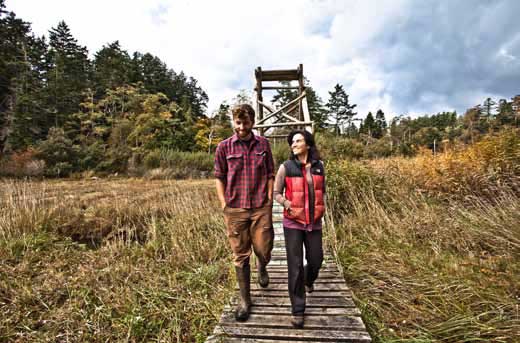
Alex and Virginie at Wind Whipped Farm

Hannah Roessler

Stepping Up to the Challenge

The wind was quiet and the sun was shining as I headed down William Head Road towards Wind Whipped Farm in Metchosin on the southern tip of Vancouver Island. I was on my way to meet Alex Fletcher and Virginie Lavallee-Picard, the two dynamic and incredibly sweet young farmers who are the proud owners and founders of Wind Whipped Farm.

Alex and Virginie met and became friends at Victoria’s Pearson College where they were both students. Soon afterwards, they attended the College of the Atlantic in Maine, a small alternative school that focuses on Human Ecology, and is home to a 7-acre organic farm.

[bsa_pro_ad_space id=1]

“I’m not from a farming background. I’m more of an opportunist,” laughs Virginie. “I was more interested in free veggies than the actual idea of farming.” However, one year working on the farm led to another. In her third year, she moved on to the farm and, it became clear that Virginie was hooked.

Finding His Way Back to the Farm

Alex didn’t consider farming a realistic career path. “I never really considered it as an option. My parents had come from farming families in Saskatchewan and they sort of saw it as a dead-end with the increasing expansion of industrial agriculture, along with a heavy workload and low income.” But despite his family history, Alex got involved in farming at the College, feeling it would give him more clout in his interests in Environmental Policy to have experience working on an organic farm. Something tells me that having the chance to work with Virginie out in the fields wasn’t too bad either.

With a strong love for food systems, the environment, and each other, they moved back to Metchosin to Alex’s parents’ property, trying to decide their next steps. They secured a contract with Pearson College to research the viability of incorporating more locally grown produce into the cafeteria at the school. It proved to be a crucial turning point for these two farm-dabblers, as a result of a conversation with Tom Henry, the editor of Small Farm Canada Magazine. As Virginie remembers, “He said that if we want the college to have more local produce, we should grow it ourselves.”

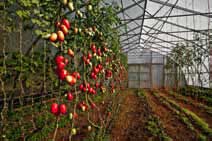
Tomatoes at Wind Whipped FarmSquash at Wind Whipped Farm


“He outright challenged us. If you want it, then do it!” Alex laughs at the memory. “He even said that he would come by to give us advice on a good location and till up my parents’ land so we could get started.”

Reflecting on this conversation spurred these two thoughtful environmentalists to consider their options. They realized that one of the largest barriers to accessing local food in their community was the lack of people growing it. They had access to land, an existing cabin on the land that they could fix up, cheap rent and a deep love for working outside. And they already had some farming experience under their belt from their time at College of the Atlantic. It seemed as though it couldn’t be easier to make the transition to farming!

Farming: A Five Year Plan

They broke ground in 2008, and through to 2009 engaged in what they call “part-time, super-low-budget farming.” “It’s hard to know just what we were doing back then,” says Alex as they both laugh. Certainly there was a lot of trial-and-error, but they did manage to produce a yield and delivered their produce by bike trailer to their local market.

[bsa_pro_ad_space id=1]

In 2010 they took to the road on their bikes to tour farms of eastern Canada, learning how other farmers were “making it work.” They eagerly absorbed all the farming tips they could, from different ways to clean salad mix to how to build a whizbang garden cart. They found the opportunity to learn from others invaluable, and returned home eager to continue working on Wind Whipped and implement some of their new-found knowledge. They started out with a 5-year plan and began investing in infrastructure—greenhouses, fencing, rototiller, a truck—all the pieces that they needed to be successful in their venture.

In 2011 they began The Local Food Box Program. Members pay $425 for a 16-week veggie box program. The boxes are delivered to two dropoff locations in Victoria or available for pick up on the farm. Wind Whipped also works with partners from Parry Bay Sheep Farm, Stillmeadow Farm, Winter Creek Farm, Ridgeview Farms and SRS Farms to offer a meat box option containing pork, chicken and lamb, and/or an egg option. They feel that this type of collaboration really adds value to their operation, and as Alex explains, “We access a larger group of customers, and create another local marketing opportunity for a few Metchosin producers. It’s great to be able to partner with other farmers in this way.”

In Search of Community

The land of Wind Whipped Farm is a gorgeous and peaceful 10-acre parcel on the ocean, worth far more today than when it was purchased in the early 80s. For new young farmers starting out, it might seem as though Alex and Virginie have everything they need to be successful—but it’s still not easy. As Viriginie explains, “we are so very lucky compared to others, but we still have land and housing barriers. We can’t have housing for workers, and our cabin is more of a seasonal dwelling than a home. Farm-worker housing is really needed.”

And more than that, they are lacking in what they really need: a strong agricultural community. Alex explains that, “We just don’t feel as though we are quite part of a thriving agricultural community. There are a few really big pieces missing. There are some great farmers around, but not a lot of young farmers who can continue the farming tradition in this area, because prices are so high. Also, there is no Agricultural Community Plan, something that we sorely need.” Virginie agrees. “How do we have conversations around keeping new farmers in Metchosin? As far as I know, this conversation isn’t happening at the municipal level. If we value the agricultural landscape, we need to actively support new growers to live here.”

If we value the agricultural landscape, we need to actively support new growers to live here.”

After a wonderful morning full of interesting conversation, I stroll up the hill from their cabin and leave the farm, loaded with squash, garlic and tomatoes. It’s clear to me how the problems these two have outlined can spell trouble for a future generation of farmers in this community. But it’s also clear how lucky Metchosin is lucky to have these articulate and motivated young farmers to help point things in the right direction.


Hannah Roessler has farmed in Nicaragua, Washington, and BC on permaculture famers, polyculture cafetals, organic market farms and a biodynamic vineyard. She has an MA in Environmental Studies, and her research is focused on climate change and small-scale organic farming. She currently farms on the Saanich Peninsula on Vancouver Island.

1 27 28 29
Go to Top