Small-Scale Growing Big
Ailsa McFadyen-Mungall
“We have to be a little more particular about our growing. We’re trying to get a lot of food off a small space,” says Shawn Dirksen, owner and operator of Northstar Organics. But “a little more particular” does not do Northstar justice. Farming on a 10-acre plot on the Saanich Peninsula on Vancouver Island, Shawn optimises his growing spaces with precision to ensure production is thriving.
I visited Northstar in April, on one of the first days that felt like spring, just before the season was about to bloom. I was greeted by Shawn, who was wearing a big work hat, as well as his canine companion Zambi, who accompanied us while we talked, munching on carrots.
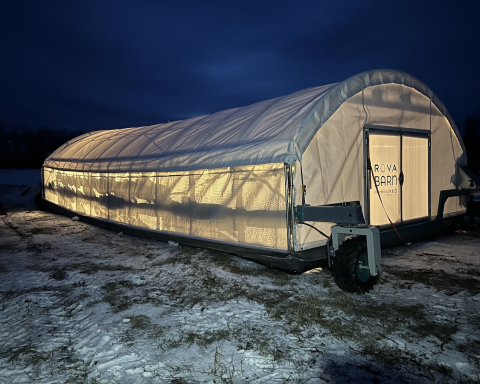
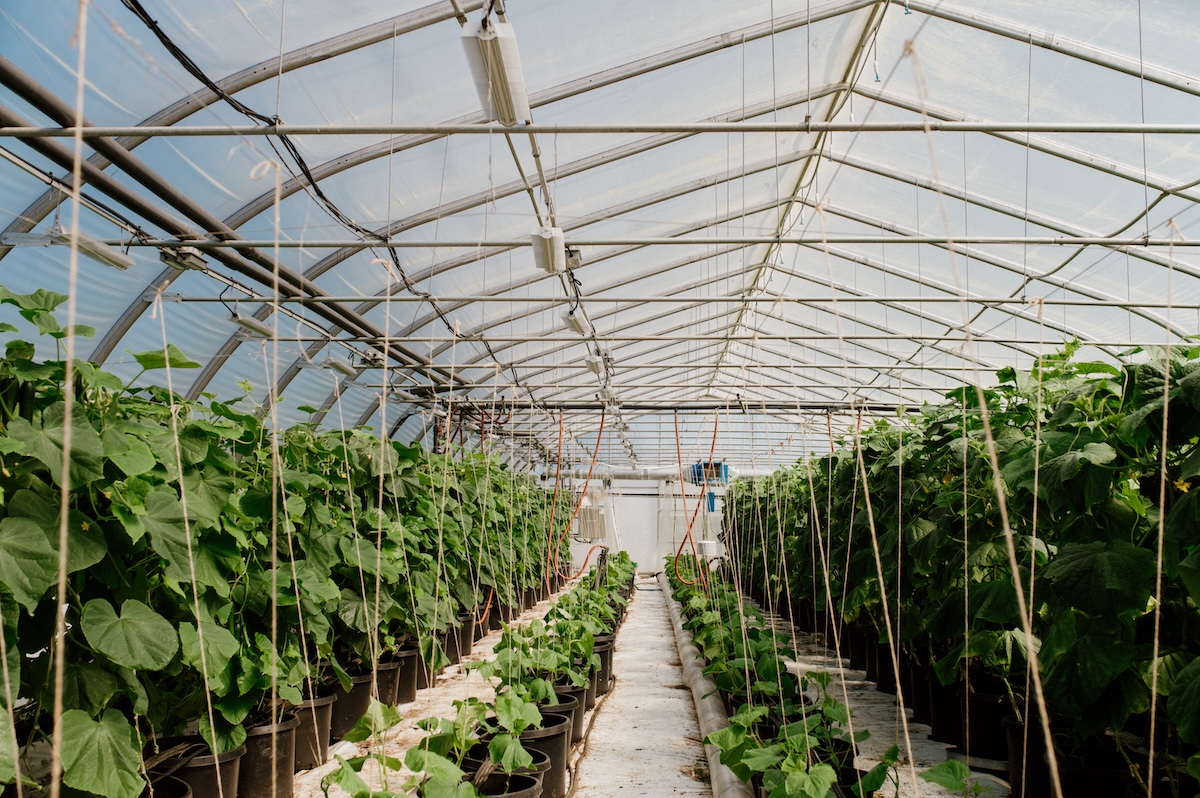
Walking onto Northstar’s land, you’re met with the farm’s cornerstone feature: the four high-tech greenhouses which run all year long, pumping out luscious veg from January to December. These big white tunnels produce a comforting whir as they regulate a collection of environmental controls, building the ultimate environment for the crop inside.
Shawn grew up with heated greenhouses, and traces his connection with the technology to his generational family farm back in Ontario where his grandfather used a “giant old oil boiler” to heat greenhouses for flower crops. Now, decades later, Shawn is using natural gas and high efficiency condensing boilers which deliver heat to the greenhouse through a series of radiant tubes. But Northstar’s greenhouses don’t just heat. These houses are high tech: they regulate heat, humidity, artificial light, airflow, and irrigation.
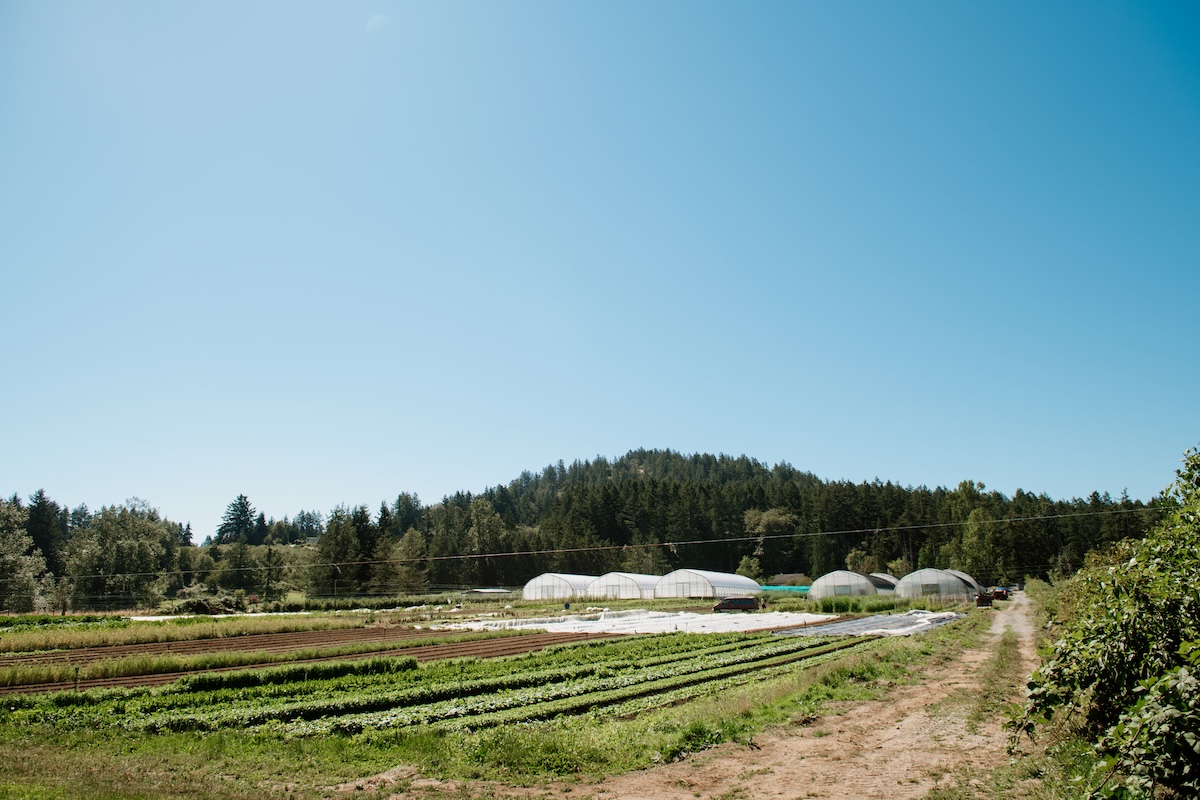
Vertical airflow fans move air from the peak of the house down to the bottom, keeping the humidity even and regulating CO2. Radiant heat stops moisture from condensing on the plant’s leaves, preventing disease. Artificial lighting boosts production in the winter months. Northstar puts a lot of time and attention into managing their greenhouses, and consequently, that means they put in a lot of money as well.
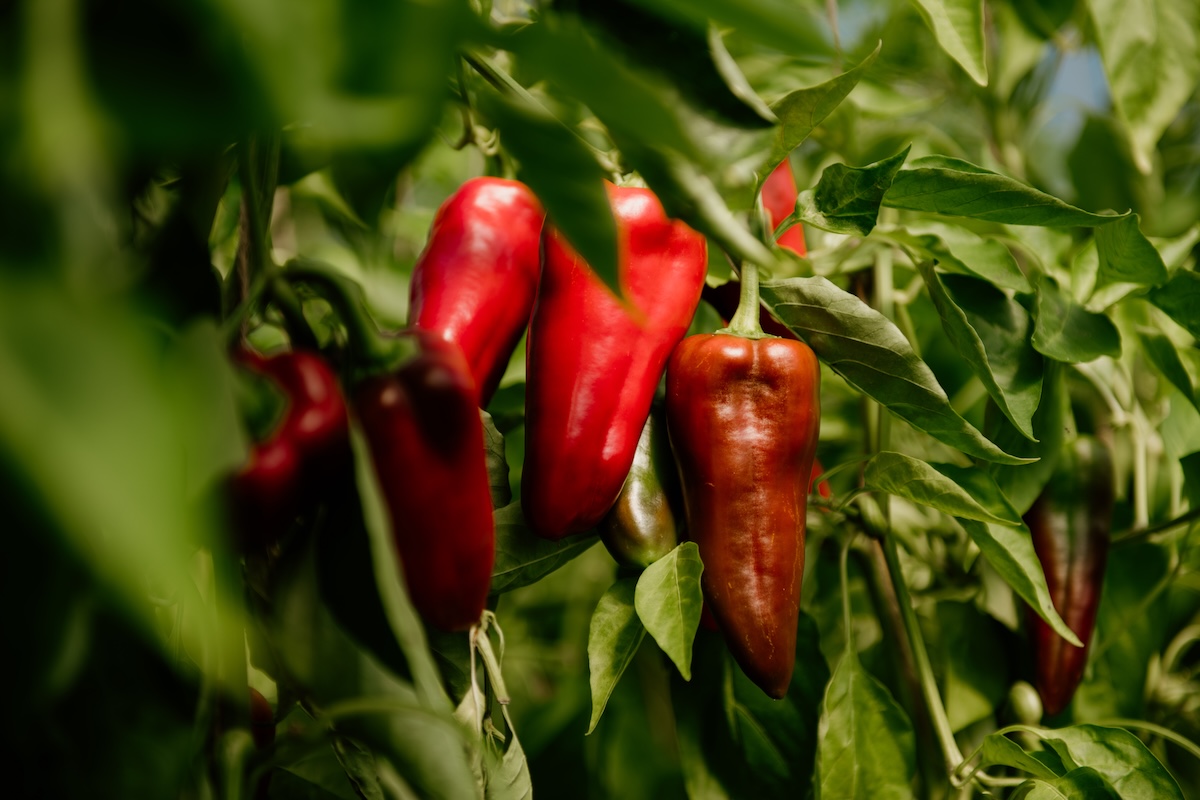
“It’s capital intensive to grow this way,” Shawn says. “But, because we’re selling at premium prices, we can make it make sense. And we’re really early with production. The amount of peppers or eggplant that we’ll get out of a greenhouse like this—which is producing right until basically Christmas—really is so much more than we would get out of a field crop.”
Shawn has many years of practice curating a delicate balance for his greenhouse crops. “Using technology is the thing I like a lot. I know that’s a bit unusual for organic farmers, but that’s what I get really into.” He says that it’s “just fun for me to be working out the numbers of what’s going to make things work.” Since his time in Ontario, he has been fiddling with greenhouse tech.
But Shawn always knew he eventually wanted to move out west. He moved to Vancouver and worked as a landscaper “as long as [I] could stand it,” he chuckles. Once he was sick of city living, he moved to Lasqueti Island for seven years, where he started a small veggie farm (complete with an off-grid high-tech greenhouse where he generated his own electricity from solar panels), and met “the love of my life” during his time there. As the age-old story goes, Shawn followed his love connection, leading him to the Saanich Peninsula where she lived. This is how Northstar finds itself here today.
But Northstar wasn’t his first stop in Saanich. Shawn farmed for many years at Haliburton Farm, a community-supported, small-scale incubator farm further south on the Peninsula. Each farmer at Haliburton has a small plot, producing as individuals but sharing common resources, such as equipment, farmers’ market stalls, and a CSA box program. Haliburton is the place where Shawn honed his high-output production: “I really did it super, super, super intensively. It’s probably the most money I’ve made in farming, that little one-acre plot.” Shawn reminisces that the connections formed through his time working within the Haliburton community were critical in his growth as an organic farmer: “I got a sense of how to sell things, and how to grow things that work in this climate. I was able to learn from a community of organic farmers about the certification process. It was as a farmer at Haliburton that I started to establish connections with customers and markets as well as restaurants and stores, and these connections are still integral to [Northstar’s] success.”
Although Shawn had been farming with organic principles and practices for decades, it wasn’t until his time at Haliburton that he found the path to certification, and similarly certified his following venture at Northstar. He has “both a carrot and a stick” behind his desire to have Northstar adhere to the organic certification. “The stick is that I grew up on a family farm that did not grow organically and I could see how it was damaging for the land and damaging for us to be involved with that level of toxic chemicals,” he says. “But that’s not the main reason. The main reason is that it just naturally falls into what I think is the way I want to grow. And anything else feels a little bit out of place.”
For example, Shawn goes on to say, “the methods that I naturally want to use for pest control and disease control are about bringing in beneficial insects.” Rather than relying on insecticides, Shawn’s inclination is to tinker with biological pest control. The farmers at Northstar closely monitor crops for pests and respond by introducing targeted predatory insects. To do this, Northstar has built a close relationship with the local Applied Bio-nomics branch in Saanich, who supply them weekly with biological defenses against problem insects. For instance, when green peach aphid is spotted, the farm brings in Aphidoletes aphidimyza, a parasitic midge whose larvae feeds on aphids. When two-spotted spider mite is found, the farm brings in Phytoseiulus persimilis, a predatory mite higher on the insect food chain. And the list goes on.
This inclination towards biological pest control is likely another influence from Shawn’s time in the world of greenhouses. He says that traditional organic field crop growers “would be more tempted to grow banks of native plants to encourage insects. And we’ve done that too.” He showed me the hedgerow that ran the length of the long east end of his property. “But that’s not enough. We’re bringing in tons of bugs. So many. All the time.”
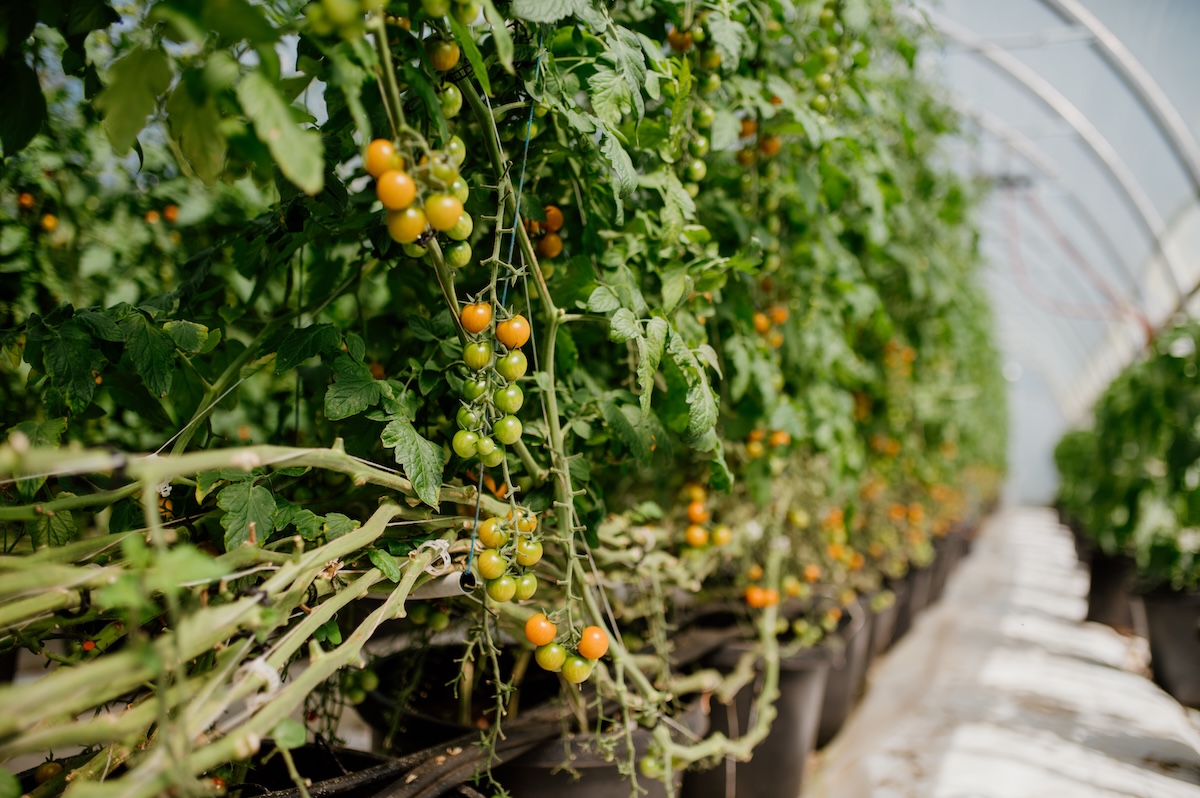
But Northstar’s modus operandi isn’t just reactive. On the contrary, the farm has organized their growing systems to be extremely preventative of potential harm. This is best exemplified in their use of grafting: using the resilient root stock of one genetic strain and attaching it to the tastier fruiting top of another. “All of our tomatoes and eggplant and melons and pickling cucumbers we graft onto really resistant root stock,” Shawn says. “This is to get around diseases, to make them less vulnerable to insect predation, and it’s part of why we’re able to get our tomatoes to grow all the way through the year.”
In the past, Northstar had outsourced this service to the mainland, but the farm’s commitment to its organic certification took precedence: “we used to buy grafted plants from Bevo farms in Delta, but then they dropped their organic certification, so we had to learn all of a sudden.” When Shawn could no longer find a reliable source for the organic grafted plants he had come to rely on, the farm took the responsibility upon themselves. And they took it in stride. Northstar has honed their in-house grafting to a science through the countless plants that require attention each season, dissecting at precisely the correct angle and encouraging fusion with silicone clips. With time, Shawn says, “you can get fast at it.”
He tells me that organic principles are critical for guiding the farm’s culture: “The employees that are here, I don’t think many of them would choose to work at a conventional farm. I think the reason that they’re here is the feeling of trying to nurture the soil, trying to provide healthy food, and trying to create a healthy work place. If those things were missing, it would be a very different place.”
Northstar has a hefty team of dedicated full-time staff, including a head grower, a harvest manager, and a number of “year-around employees [who] have been with the farm for multiple years and so are expert at their work.” The intensive output and uninterrupted growing season at Northstar means that the core staff hold full-year positions, which cultivates a workforce that is uniquely cohesive in a profession as seasonal as farming, where employees tend to come and go with the work. Northstar is different. Shawn’s staff have been there for years, and enjoy a comfortable amount of security knowing their job won’t disappear in the fall.
Shawn clearly values the team assembled at Northstar, and trusts their judgement enough to hold an annual meeting every November to discuss the passing season: “we like to get together with all the employees and we spend half a day—sometimes more than that—just talking about the things that worked, the things that didn’t work, and any innovations that anybody’s thought of that might be helpful.” He points to this tradition as essential for the farm’s steady refinement and continued success.
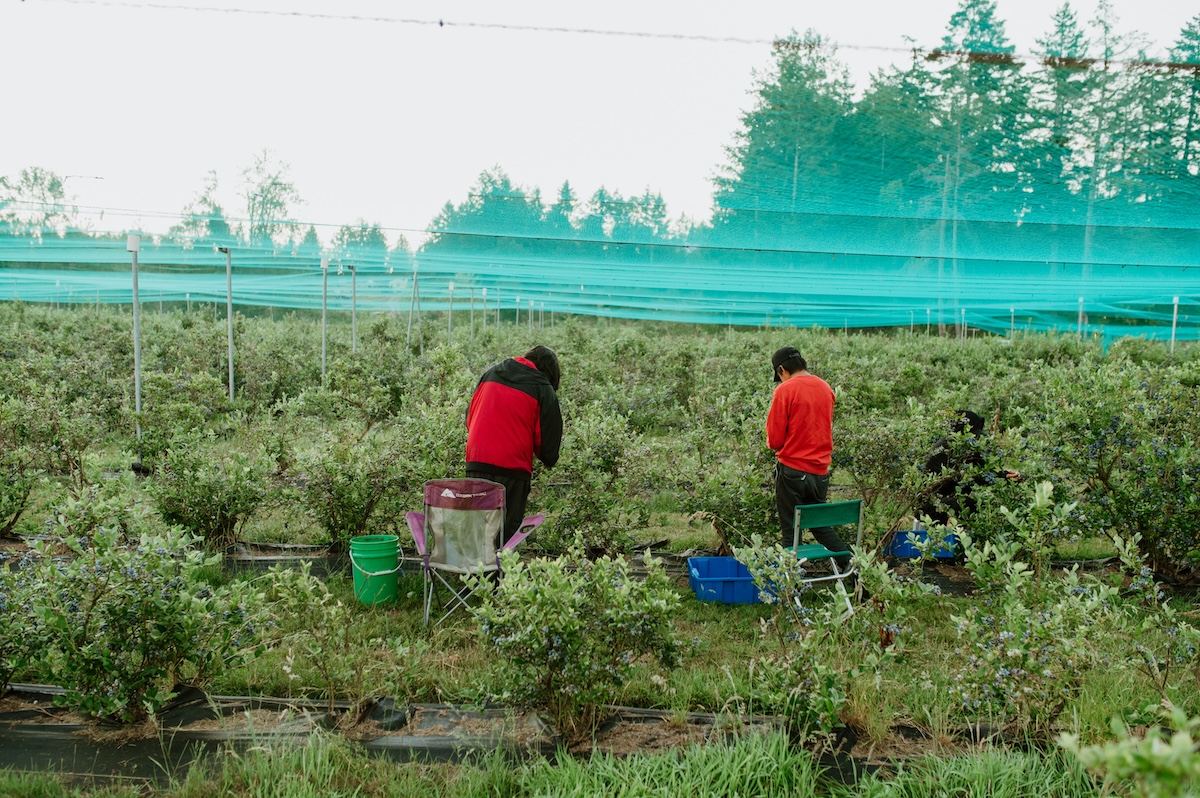
Work does pick up in the spring and summer seasons, however, and Northstar requires additional assistance outside of the core crew as the outdoor crops begin to boom. Shawn has found a distinctive solution to this problem as well. He says, “it’s not practical to hire new people every spring who are often unskilled, and it’s not possible to hold onto employees if they are laid off every winter.” Instead, Shawn hires a handful of temporary workers from Mexico through the Temporary Foreign Worker program as the season heats up. “The program allows us to have the same experienced employees come to the farm exactly as things get busy. They’re able to put in as many hours as they want, and all of their housing and transportation is paid for, so they’re able to earn enough that they’re happy to come back each year. I think it is a win for the farm and a win for them.”
Northstar is not afraid to embrace novelty and similarly not afraid to explore unconventional and intensive methods of organic farming. As a result, they find themselves on the cutting edge of how a small organic farm can function. Shawn seems proud to have found a system that works for him, satisfied to be growing as efficiently as possible. But when asked if he desired the broader organic sector to be moving in a similar direction, he says: “I think there’s space for everyone. Farming the way that we’re farming out here is capital intensive. It’s not going to work for everyone. And I think there needs to be space for people who want to do it on a smaller scale and more seasonally. So, it’s not that I want to see everyone move that way. But it definitely is possible. For anyone who’s inclined to do it, it’s possible to make a living doing it. And to be pushing how much you can grow in a relatively small space.”
Like its namesake, Northstar is illuminating a guiding light for what the future of small-scale organic farm can look like.
Ailsa McFadyen is a farmer living on Vancouver Island. Working in multiple facets of her local food system, Ailsa’s days are filled with food production, writing, and singing.
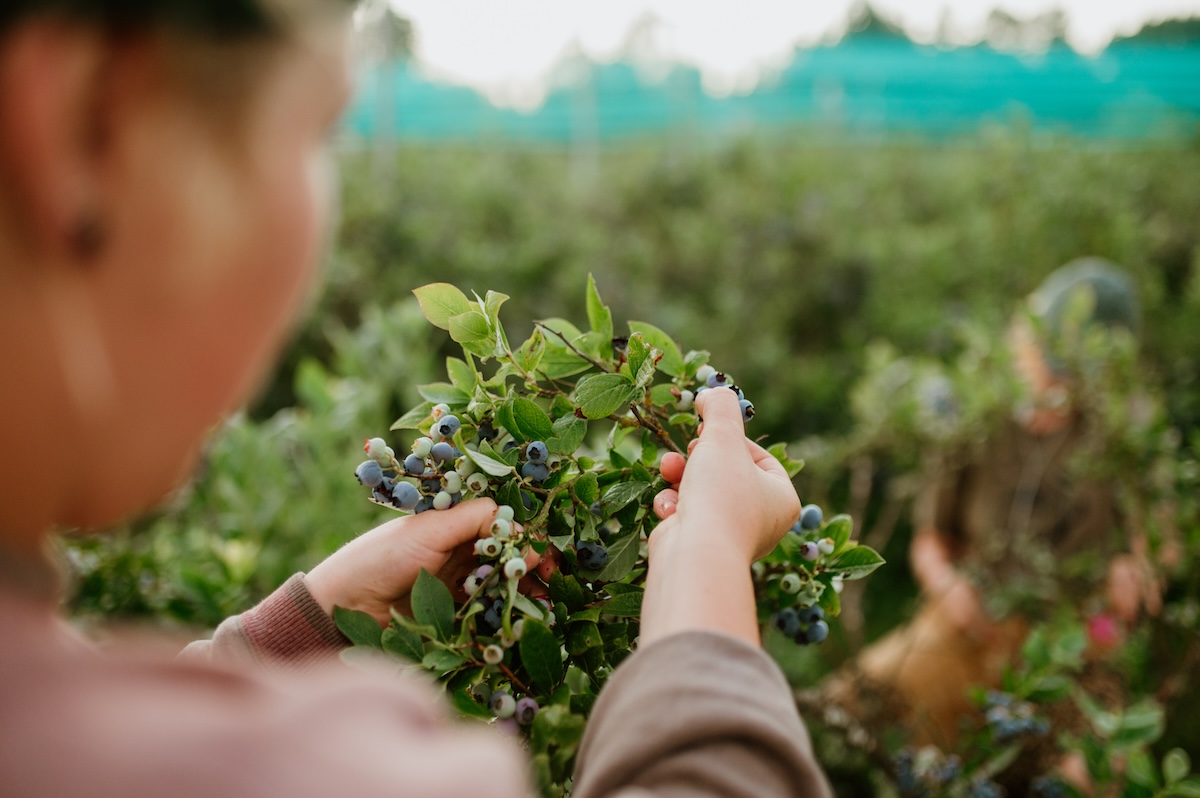
Featured image: Harvesting blueberries. Credit: Maylies Lang.