Chris Bodnar
When parts of the province experienced catastrophic flooding in November of 2021, we witnessed an incredible mobilization of resources in the agricultural sector to navigate the disaster as well as to rebuild.
At the same time, we also witnessed the unequal impact of the event on different populations. Very few Indigenous communities are protected by dyke systems. However, these communities are impacted directly by the dyke systems, which transfer risk from the protected areas to the outside areas. These areas, in turn, are not protected and actually experience greater impacts from displaced water during floods.
Given this, it came as a surprise when I received an invitation in February 2023 to participate in a meeting of agricultural producers and organizations with local Indigenous communities. I didn’t know what to expect, and was intrigued to learn more.
The gathering was organized by the Fraser Valley Floodplain Coalition, a group comprised of the Emergency Planning Secretariat and a collection of BC-based organizations and experts concerned with river, watershed, ecological and infrastructure management. The Emergency Planning Secretariat supports 31 Mainland Coast Salish communities to improve emergency planning and preparedness.
The Fraser Valley Floodplain Coalition came together following the 2021 floods “with a shared goal of helping BC’s flood recovery and ongoing flood management achieve the best possible outcomes.” The meeting with agricultural representatives was an attempt to establish dialogue between groups that don’t necessarily have a lot of interaction, but who all depend on finding ways to manage floods going forward.
The Coalition established five principles to guide the work of its members:
1. Reducing Risk and Adapting to Climate Change;
2. Advancing Reconciliation;
3. Helping Salmon and the Coastal and Freshwater Ecosystems Where They Live to Thrive;
4. Supporting Sustainable Economies and Resilient Communities Into the Future; and
5. Everyone is Part of the Solution.
Ultimately, the Coalition started to work on finding solutions for future flood preparedness that look at new ideas, rather than rushing to build back the same infrastructure.
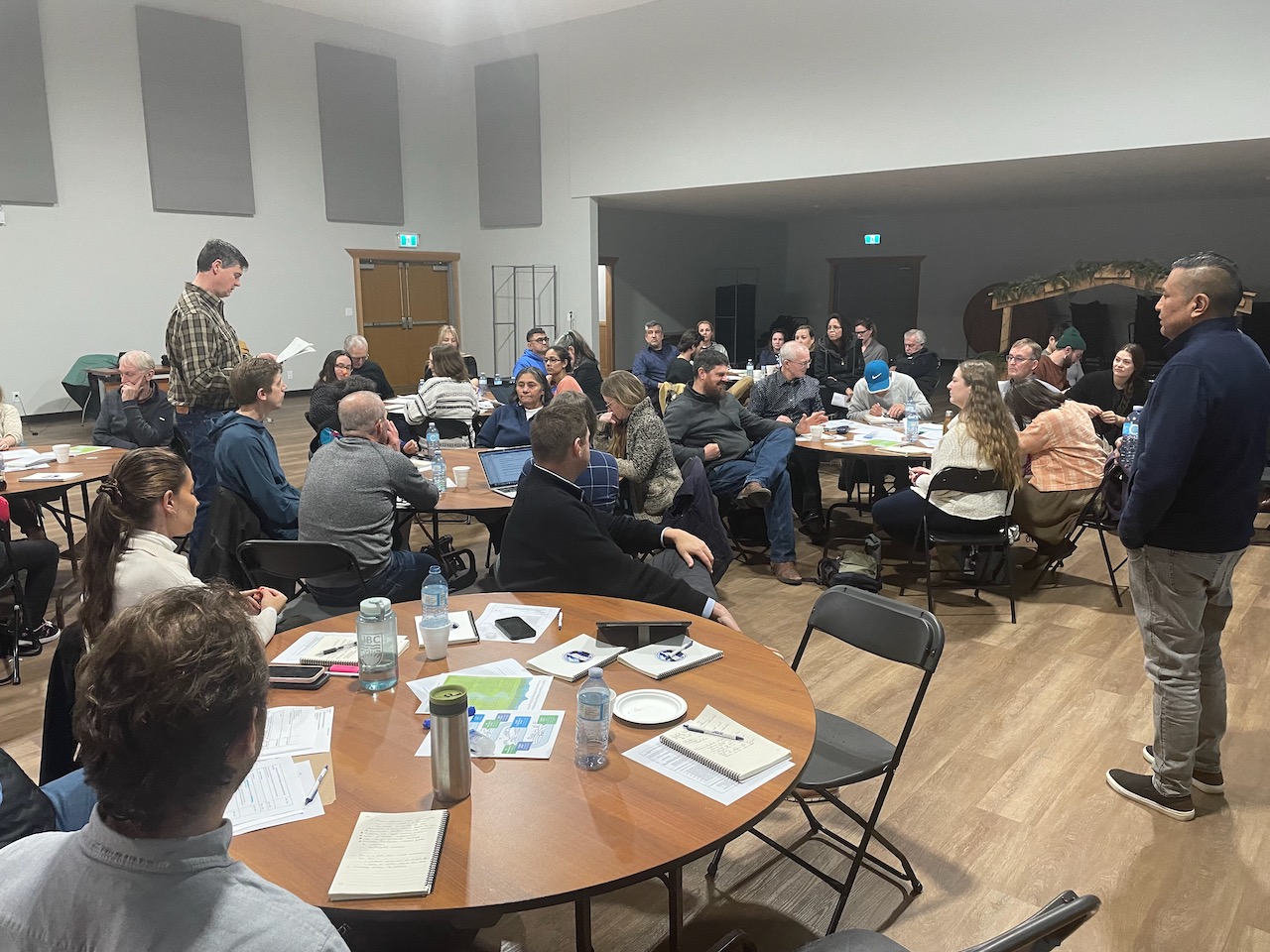
The Coalition has held two events to bring together various levels of government and agricultural organizations to discuss flood planning in 2022 and 2023 as well as sessions for agricultural groups and Indigenous groups in 2023 and 2024.
This Won’t Be Easy, But It Can Be Rewarding
“We can do this the hard way or the harder way,” said Tribal Chief Tyrone McNeil at the opening of a meeting with various levels of government and agricultural organizations in June 2023. “If you’re here today I assume you’re ready to do this the hard way. The harder way will be in court.”
That message reminded participants that First Nations are not prepared to be burdened with the transfer of risk if flood mitigation efforts attempt to rebuild existing infrastructure. Likewise, there is an expectation that fisheries are accounted for in planning, with steps taken to adopt new technologies in flood protection infrastructure that protect salmon populations.
At the agricultural gathering in February 2023, representatives from eight First Nations and eight agricultural organizations attended alongside coalition members, farmers, and Indigenous community members. A series of presentations discussed options for managing flooding that also protect ecosystems that support fish. This includes using new designs for pump stations and floodgates as well as naturalizing floodplains with dike setbacks; for example, building dikes that are set back from waterways to provide a floodplain area rather than building dikes right against waterways.
At the end of the session, a key takeaway was that if First Nations and farmers can work together, there is a stronger case to be made to different levels of government to invest in flood planning that accounts for the needs of both groups. Collaborative work will also contribute to better understanding of each others’ needs.
What Next?
The meeting ended with a sense that more dialogue was desirable. The Coalition planned an event for November 2023 that took farmers and agricultural organizations’ staff on a tour of the Fraser Valley to learn about the Indigenous place names and stories of different locations.
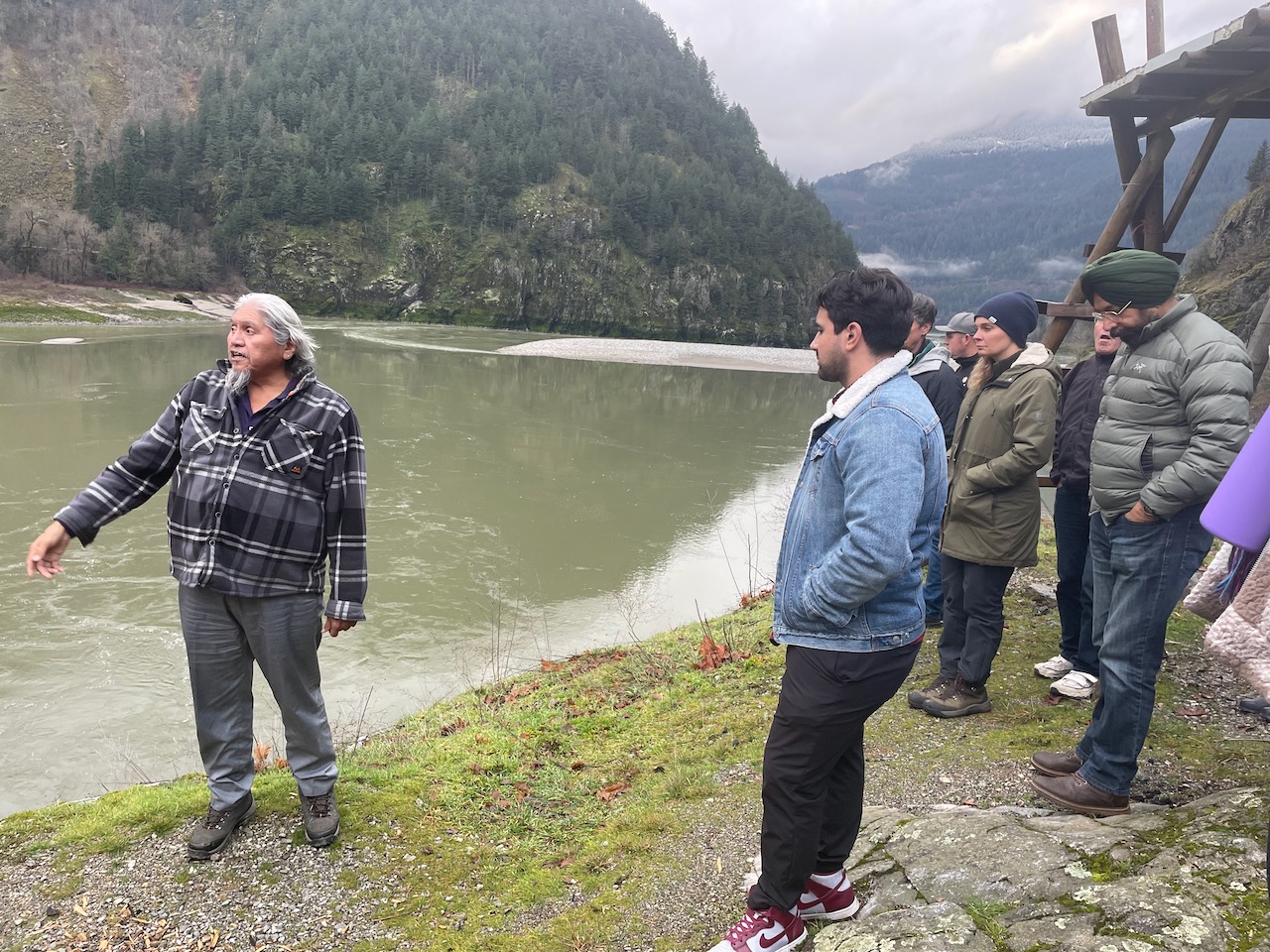
The full-day tour was led by Naxaxalhts’i, the Cultural Advisor and Stó:lo Historian for the Stó:lo Research and Resource Management Centre. As someone who has studied Halq’eméylem place names for over 21 years, Naxaxalhts’i provided an in-depth demonstration of the long history Indigenous peoples have on the land we now occupy.
About 40 farmers and agricultural representatives attended the tour. A lunch session with Indigenous community members offered an opportunity to discuss next steps for collaboration. An idea to emerge from the session was a reciprocal tour of farms.
In May 2024, a tour of Fraser Valley farms doing innovative work to manage flood risk and restore ecosystems was held for farmers and Indigenous community members. Participants toured farms in Agassiz and Chilliwack to consider how food security can be achieved by protecting farmland from flooding while also protecting salmon populations through better design of flood infrastructure.
Another session during the tour allowed for participants to discuss next steps. The results of those conversations will influence future conver-sations and recommendations to governments for flood planning going forward.
At the end of the day, the invitation from First Nations to the agricultural community to participate in shared learning and conversation is an attempt to develop learning opportunities and result in constructive solutions that benefit everyone.
Applying This Knowledge
There was a moment during the first event when a lightbulb went off for me. As we discussed floodplains by design I realized that our farm—on the Fraser River floodplain and outside of diking systems—could benefit from a different way of thinking about flooding.
We have a large area of pasture on land that is peat bog and was once a wetland. One field cannot be effectively hayed due to the bog nature of the land—tractors risk getting stuck in the peat for significant portions of the year. The wet fields were cleared and planted into Reed Canary Grass—an invasive plant species—in the 1960s. The value of the forage is marginal.
Attending the forum renewed an interest in revisiting plans we had considered close to a decade ago, to restore the lowest field to a wetland. Over the past year we have been successful in getting funding through the province’s Beneficial Management Practices program to design a wetland that will provide more area for water during flood events. During the rest of the year, the area will provide substantial habitat for wildlife.
While this project on our farm is small and won’t prevent large floods, it does underscore the need to adopt new ways of thinking about flooding in our watersheds. Many of us in BC farm land on floodplains. Most of us probably haven’t thought twice about how our work interfaces with Indigenous communities. But if we are going to make meaningful progress on reconciliation, these are conversations that we must start to have—and continue on an ongoing basis.
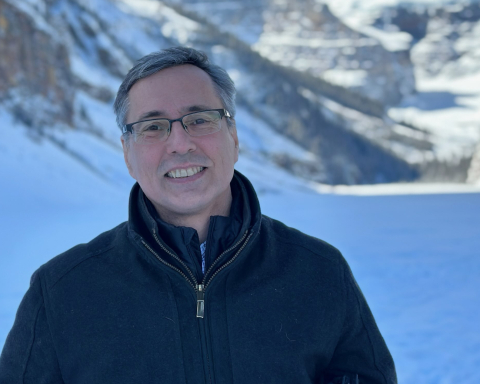
Chris Bodnar co-owns and operates Close to Home Organics with his wife, Paige, at Glen Valley Organic Farm in Abbotsford.
Featured image: At Kawkawa Lake in Hope, Naxaxalhts’i tells how local Indigenous communities have revitalized cultural traditions through the sharing of stories about the lake that are part of traditional celebrations. Many of these stories were almost forgotten during the residential school period. Many of these stories are not shared outside of their communities until the community is confident they have fully integrated the story back into their own histories. Photo Credit: Chris Bodnar.