Anna Helmer
The sunny weather is persisting, but the shortening days are denying the heat a chance to build beyond a most pleasant warmth. Even the drought, which is also persisting, has its work cut out for it now that the morning dew is so heavy. We are gunning hard to get through these last few weeks before the hard deadline of winter puts a decisive end to field work.
The goal is always to finish planting garlic, which is the last of the field jobs, the morning before the first snow-laden clouds lower into the valley. At that point, the snow will mercifully cover up and temporarily defeat the farm problem areas. Currently, those areas are rather difficult to ignore, and in some cases running completely amuck.
The heaviest dew in the world isn’t going to irrigate the weak areas of our fields that are now dry and caked, stubbled with dead foliage, and worst of all, contrasting starkly with the lush green of the surrounding healthy areas. These silt-heavy old river beds struggle in the dry, hot summers. Our system of mowing the cover crop to provide lush mulch fails here because there’s nothing to mow. The slightest rain will green it up a little, but it needs so much more. We’ll apply a rye cover crop, and hope it catches before it snows.
Also glaringly obvious is the fact that it’s been a very good year for burdock and thistles on the Helmer Farm. Our efforts to control their growth were inadequate and now we have a daunting gauntlet of prickles and sticky seed heads on the field fringes and wild meadows. Grazing cattle would be so effective at pounding them into submission, if we had any of those.
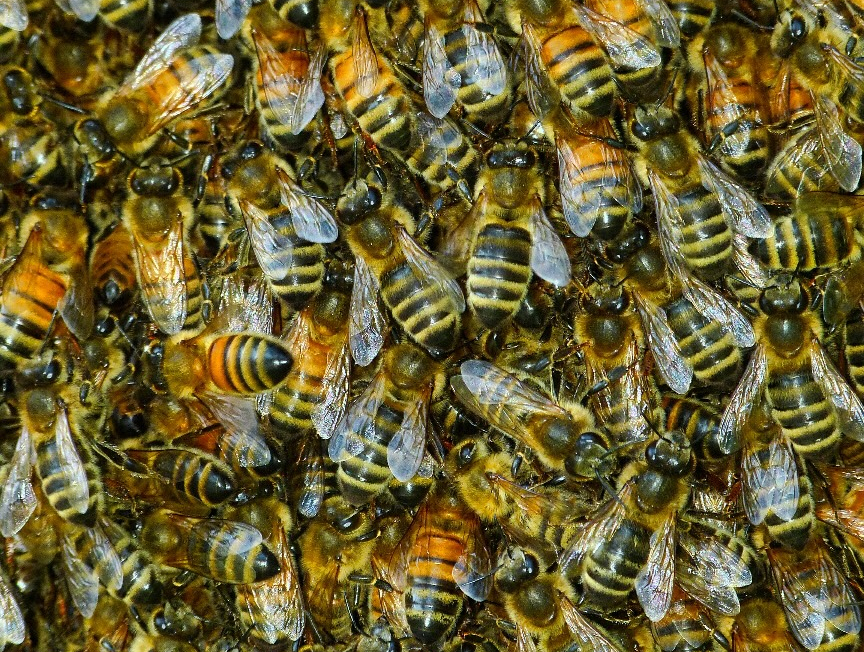
The honey bees lost the plot and occupied the tool shop for a few days last week. Everything was submerged in a seething mass of bees. It wasn’t a normal swarm though; one where, with kind words and gentle guidance, the precious and industrious bees could be coaxed into a new hive box. No, no, no. They were having none of that. The air was filled with angry little bee missiles, and the tone of the hum was more of a growl, the vibe aggressively anti-human.
Using the full honey frames we had just pulled from the hives, we eventually did manage to entice some masses back into a box, but many, many times that number just died. The tool shop, even cleaned up, has not returned to normal. It retains an odd smell, and the windows are caked with a film of something left behind from the rivers of bees that were crawling on them.
We don’t really understand what happened, although it had to be connected to the honey pull we had just done. It’s not an unusual time to pull honey of course, and we always leave an excessive amount behind in the hive—but for some reason, this time, it made them mad. We upset them terribly. Something went out of whack.
It was after the bee occupation of the tool shop that I realized that the farm may have become a little off-balance. A lot is made of the concept of balance in Biodynamic farming theory. In fact, one of the basic tenets is the recognition that each farm develops a unique identity based on the balance between all the aspects of the farm. The animals, the people, the natural features, the outputs, the inputs—everything matters to everything else, and those relationships influence the whole farm identity.
While every farm, Biodynamic or not, has an identity, the work of the Biodynamic farmer revolves around intentionally keeping the whole thing nicely balanced—the goal being that all farm production is supported by on-farm-sourced fertility. The preparations indicated in the original lectures are unique to Biodynamics and are intended to help achieve the balance.
Theoretically, it’s a noble goal and is also useful for creating smarmy farm descriptions. Reality, as usual, treats such carefully constructed, high-minded idealism rather roughly. At this point in the season, and perhaps this year more than others, the balance on our farm has been dis-rupted. The crispy field areas, the burdock and thistles, the bee’s occupy movement—these are indications of more teeter than totter, if you catch my drift.
There is a path to balance. While I would not attempt to control the crispy, flighty, clingy, and stingy energy of the farm this fall, we can certainly add something calm, cool, and collected. Cattle, for example, would be perfect. Perhaps around a thousand would do? I haven’t told you the half of what’s going on.
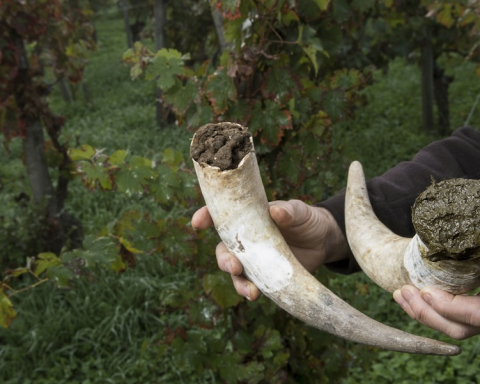
Well, we aren’t doing that, but we have the next best thing: BD500. If we can cover as much ground as possible with this preparation, I think we can regain the poise of the farm. The timing is perfect: the earth is about to take its last big inhalation before the winter.
I need to think more about what that means exactly, but I like the imagery.
Anna Helmer farms in Pemberton and hopes next year is a good one for agriculture in BC.
Featured image: Swarm of bees. Credit: (CC) Sid Mosdell from New Zealand.