Emma Holmes
As BC’s organic industry specialist and a Regional Agrologist, I have been able to meet many members of our organic community across the province. I also get to collaborate with other experts at the Ministry of Agriculture, and I am keen to highlight them and the important work they do, so you can get to know them—and hopefully collaborate with them too! This issue, I interviewed Nicole Pressey, Regional Agrologist for the Cariboo Chilcotin Coast region.
Emma Holmes (EH): Thanks so much for agreeing to do this interview! So let’s kick it off, when did you join the ministry?
Nicole Pressey (NP): I started fall 2016. I think it was September. I was very excited. It’s my dream job.
EH: Did you grow up in agriculture?
NP: No, no. I grew up in Toronto, not far from High Park on Lake Ontario. So pretty much a city kid, but I would hang out in the park a lot. Food, and eating good food, was always important growing up. And then I became aware of the environment in my teen years. In fact, I convinced my dad to get recycling in the condominium we lived in. He was a Superintendent.
I went to school for environmental studies, starting at York University, finishing my degree at the University of Northern British Columbia (UNBC). The biology professor, Darwin Coxon, was such a great instructor and the way he explained biology, his passion, was really engaging. I took a physical geography course about land formations and plate tectonics, which helped me understand why the land is formed this way, and why the soil or rivers or water bodies are the way they are. I had an environmental ethics course with Annie Booth that explained the different subsets of environmental ethics and why people do what they do. Understanding the why fits well with agriculture, especially as a regional agrologist when trying to encourage people to engage in projects or beneficial management practices, or support them to affect change or solve their challenges.
So, it just kind of came together. I started working for the Ministry of Environment in the Integrated Pest Management program in Prince George, regulating pesticide use. It was mostly vegetation management and herbicide use on forestry plantations.
I transferred down to the Okanagan, where I was exposed to more complaints about pesticide use and gained a better understanding of agriculture. I met Carl Withler, the Regional Agrologist for that area during my time in the Okanagan. He described his role: working with farmers and ranchers, local government and First Nations, land use planning, emergency management, handling enquiries and complaints. It sounded like a really diverse and different role, which I am drawn to; the variety and challenges, and working directly with people.
Then I took the Range Agrologist position in Burns Lake. I was working closely and on-the-ground with ranchers around grazing and hay cutting tenures on the Crown land base.
When we were in Burns Lake, I volunteered with the fall fair association. The community and teamwork and living in a rural area really appealed to me.
EH: It sounds like you have lived in a lot of communities in BC.
NP: My now-husband, Josh, and I moved to Prince George in May 1997 and lived there for eight years. We lived in Summerland for 13 months, then in Burns Lake for 10 years and we’ve been in Quesnel for 10 years now.
EH: So, you have experience in a wide range of agricultural systems?
NP: Yeah, it’s really neat. With climate change, we’re seeing some people, some producers especially, shift and push the envelope on what the climate can support.
In the South Cariboo, at high elevation, they’ve always been doing season extension techniques. And I’m hoping that they can share those season extension techniques with people who want to, say, grow watermelon or cantaloupe in the Cariboo outside of the banana belt (the Fraser River bench system). It was good to be a range agrologist and live in Prince George and Burns Lake because I saw what the climate and environment is like and what people are capable of doing.
EH: So cool. Tell me more about your current role.
NP: I’m a regional agrologist for the Cariboo and Central Coast, which aligns with the Cariboo Regional District boundary and the Central Coast Regional District boundary.
I explain my job as extension specialist and economic development officer for farmers, ranchers, and food processors. I’m the first point of contact for folks, whether it’s local government, producers, or Indigenous communities.
The NStQ is a modern treaty in the Cariboo and it involves the Tl’exelc First Nation (Williams Lake), the Xats’ull First Nation (Soda Creek), Stswecem’c Xgat’ten First Nation (Dog Creek/Canoe Creek), and Tsq’escen First Nation (Canim Lake).
It is the first treaty to include provincial range tenures. There is an overlap of proposed treaty lands with Crown range. The range tenure is held by private ranches. Because Crown range is such an integral part of a successful ranch, the Province provided the mandate to negotiate ranch acquisitions as part of the treaty negotiations.
Three ranches and a hay farm were purchased by the Province, and leased to each community until the treaty is finalized. Staff from the Ministry of Agriculture and Food’s Indigenous Partnerships and Reconciliation team engaged with each of the communities on three separate ranch transition contracts. The ranches switched from owner-operated to community-run operations with different business considerations, outside of raising forage and livestock. With the guidance of Erica Nitchie (Team Lead of Indigenous Food Systems), Ministry resources supported each community in taking on each ranch to mirror their vision.
It was so great to learn from the communities and Erica, how separate visions can come to fruition under a government contract. While the contracts have ended, Kristy (Kristy Palmantier, Indigenous Agriculture Development Officer), Erica, and I remain connected with the communities.
EH:The Regional Agrologist positions are so interesting because they’re all so different depending on the region, and you really need to be a Jack-of-all-trades.
NP: Yes, it’s so true. And I get so caught up in my region that when I call a colleague in another region, I am reminded of how diverse our work can be.
EH: What projects are you currently working on?
NP: I get to sit on two regional extension committees because the Cariboo is split into two, to better align with regional livestock associations and the climate difference between Williams Lake and Quesnel.
The North Cariboo is paired with Hwy 16, and we have a crop demonstration for a changing climate project underway. We’re identifying crops that can grow in a hotter, dryer climate.
The Central and South Cariboo is paired with the North Thompson and North Okanagan. We’re trying to figure out which species you can intercrop with that will encourage pollinators and biodiversity while also being used for livestock feed.
So yeah, they’re exciting projects! We’ve done a lot of the groundwork over the last fiscal and hope to demonstrate it moving forward.
EH: Where in the region are you located?
NP: I live in Quesnel and am able to work from the Ministry of Forests office in Quesnel. I travel down to Williams Lake and 100 Mile House. Sadly, I don’t make it to the Central Coast as often as I would like.
EH: What is the best way for folks in your region to get a hold of you?
NP: The best way for people to reach me is my cell (250) 267-2765, my desk at (236) 713-2223, or Nicole.Pressey@gov.bc.ca.
Emma Holmes is the Organics Industry Specialist with the BC Ministry of Agriculture and Food. She studied Sustainable Agriculture and Soil Science at UBC, and then farmed on Salt Spring and worked on a permaculture homestead on Orcas Island. She now lives in Vernon and loves spending time in the garden. She can be reached at: Emma.Holmes@gov.bc.ca
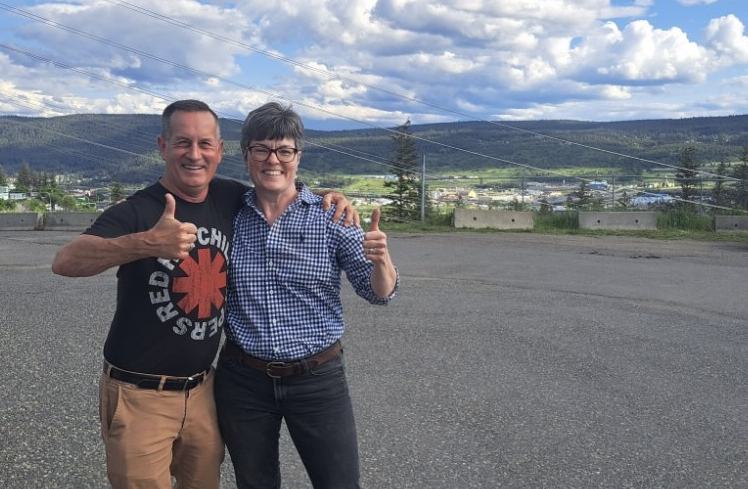
Featured image: Nicole Pressey with mentor Carl Withler. Photo provided by Nicole Pressey.