
Healthier Soil and a More Resilient Operation
Stacey Santos
At Jackknife Creek Land & Cattle in Alberta’s Peace River Country, the Noble family is implementing innovative cover cropping practices on their farm, specifically swath grazing in their cattle operation. This practice not only ensures their cows are well fed during the winter, but it also simultaneously aligns with organic principles, enhancing soil health and bolstering the overall resilience of their land, livestock, and entire operation.
In a recent episode of Organic BC’s Innovative Cover Cropping Tour of BC series, we had an inside look at Jackknife Creek’s swath grazing techniques and the many benefits of this management practice.
But First, What is Swath Grazing?
Swath grazing (also known as windrow grazing) is the practice of seeding a cover crop mix, typically comprising annual forages and cereals, from mid-May to early June. The cover crop is then cut down and formed into swaths from late August to mid-September, just before the arrival of killing frosts.
These swaths are then left in the field during the winter to extend the grazing season, even beneath the snow. This practice not only captures the nutrients from the manure and urine on the fields, improving soil health, but it also reduces the labour associated with hauling manure or moving bales around.
Generations of Innovation
Jackknife Creek Land & Cattle is a multi-generational farm run by Bob Noble and Nora Paulovich, along with their adult children Jolene, Cara, and Lee. It’s a mixed operation with cattle, grass seed, and grain cash crops and a dedication to innovation, from value-added products and marketing right down to evolving farm practices that promote soil health and reduce their reliance on inputs.
The family’s passion for soil health began during Nora’s years as manager of the North Peace Applied Research Association (NPARA). Jackknife Creek transitioned to swath grazing after being inspired by the practices of soil health proponent Gabe Brown from North Dakota, who they heard speak at an NPARA event.
“We seed nine different species at the end of May or June and swath that in late August or September,” said Nora. “It’s become a major feed source for us. We’re leaving our calves on longer now into February, and weaning them after that, and find they’re doing remarkably well. We’ve been doing feed testing and [have seen] very high planing nutrition on those cover crop swaths.”
From Grass to Swath
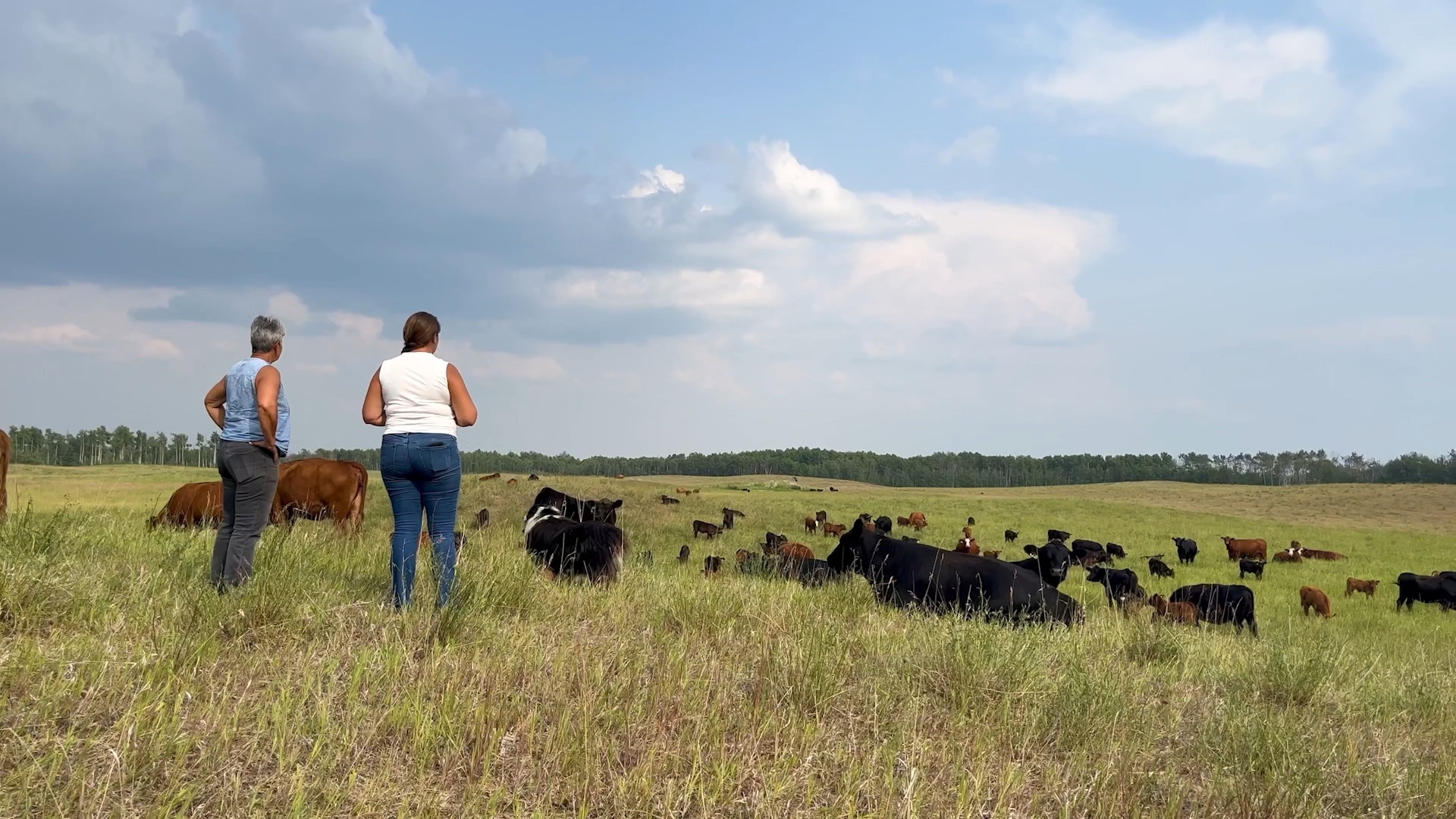
Jackknife Creek calves out on pasture in the spring. The pasture is primarily grass for May and the start of June, with smooth brome sod holding their cows up well in the wet months leading up to calving. As the higher legume perennial pastures become ready for grazing, the cows are trailed out to the fields that have the most stockpile.
“We typically do daily moves in the summer,” said Jolene. “All of our cows are in one herd, so we can do that. We’re not moving three different herds every day, or every three days, or whatnot. It’s more intensive.”
Depending on the year, the cows are on the perennial pasture into September and October. When the plane of nutrition starts to decline in the fall, the cows are moved onto swath grazing, which they continue on into February.
Multi-Species or Monocrop?
The Nobles had tried swath grazing earlier using a monocrop of oats, without success.
“Lots of times we’d get an early snowfall in October, and then it would warm up, and then freeze those swaths right down to the ground,” said Nora. “The cows had a really hard time getting it.”
When they switched to multi-species cover crops for swath grazing, they ended up with growth at different levels of the canopy, so the swaths would sit quite high because of the different interlocking species. They were airy with plenty of movement, and stayed nice and fluffy, even in extremely wet or snowy weather.
“They don’t get squashed down like a monocrop does,” added Nora. “The cows can easily find those swaths and dig through them.”
Another huge difference is that a blend is more palatable to cows than straight oats, so they don’t mind doing a bit of extra work to get a meal.
“If it’s just oats, the cows are not a big fan and they’ll stand at the corner and won’t want to go back out,” said Jolene. “So you do lose gains, forcing those cows to go after that feed.”
A multi-species cover crop is also a more balanced feed, with higher protein and a bigger energy spike compared to straight cereal—something that’s needed to keep the calves on the cows longer.
Later weaning has led to a huge reduction in illness at Jackknife Creek. The instance of load and pneumonia, something they struggled with when traditionally weaning in November, has essentially been wiped out in their backgrounding lot.
As well, one of the biggest changes they’ve seen with leaving the calves on the cows is that everything is fed by moving one wire—a huge time saver.
“When you’re not feeding a pen of older cows, a pen of younger cows, and a pen of backgrounders, you’re feeding everything all at once,” said Jolene. “We’ve been quite impressed with our young cows and how they’ve been able to finish growing, raise a calf, rebreed, and bring that second pregnancy to full term.”
The Right Mix
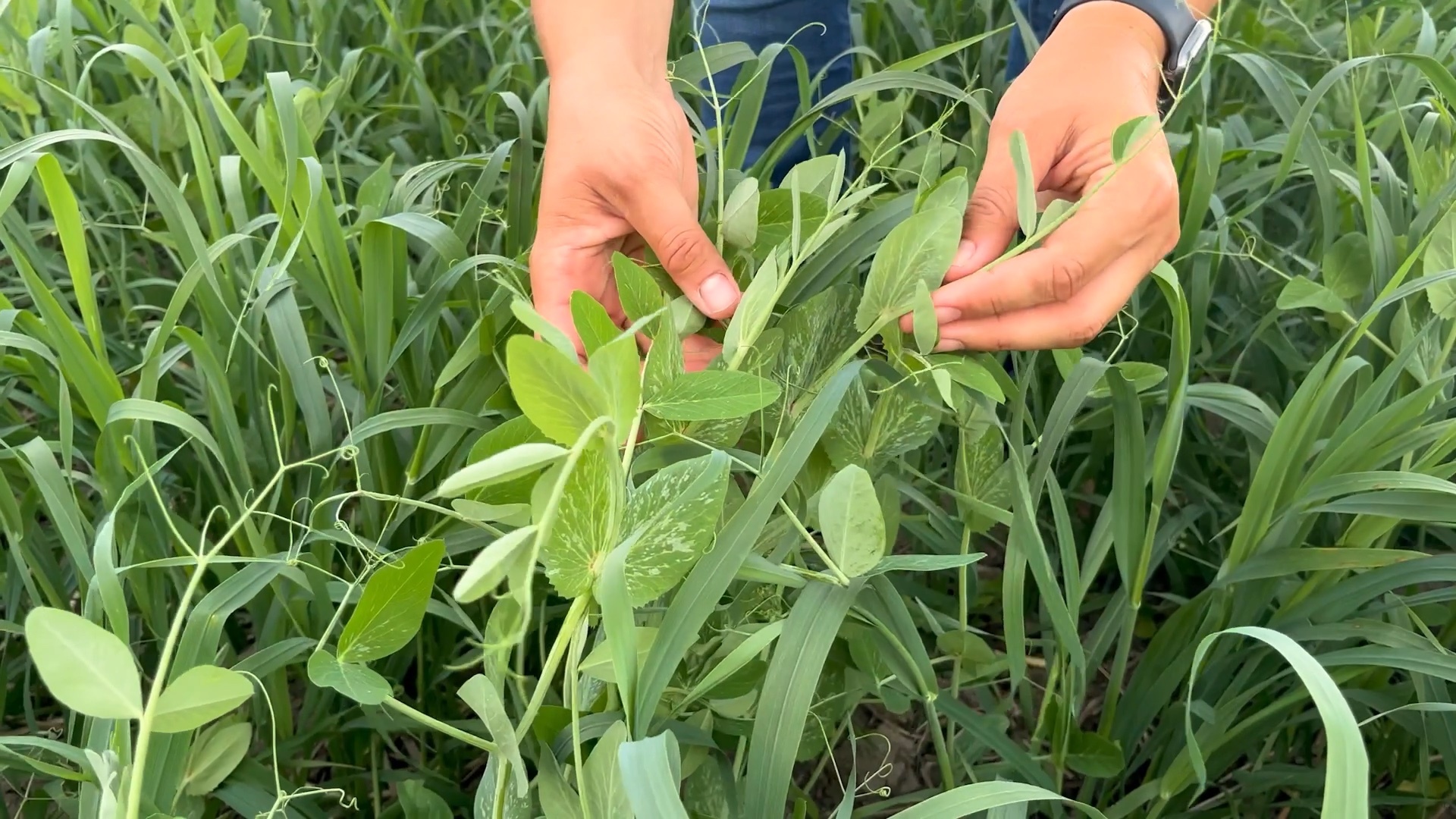
Jackknife Creek uses a custom annual cover crop mix for swath grazing, which consists of forage oats, forage peas, Italian ryegrass, hairy vetch, two brassicas (Hunter and Goliath), sunflowers, buckwheat, and millet. Hairy vetch and brassicas are the main driver, along with the cereals and peas, while sunflowers and millet add diversity and the Italian rye provides cover after its swathed into the winter.
In this nine-way mix, some of the species are in smaller proportions and not everything comes up every year. Some, like oats and peas, grow consistently tall alongside each other, while others pop up higher in the canopy as the season goes on. There’s also a variety of species, some with higher regrowth potential than others.
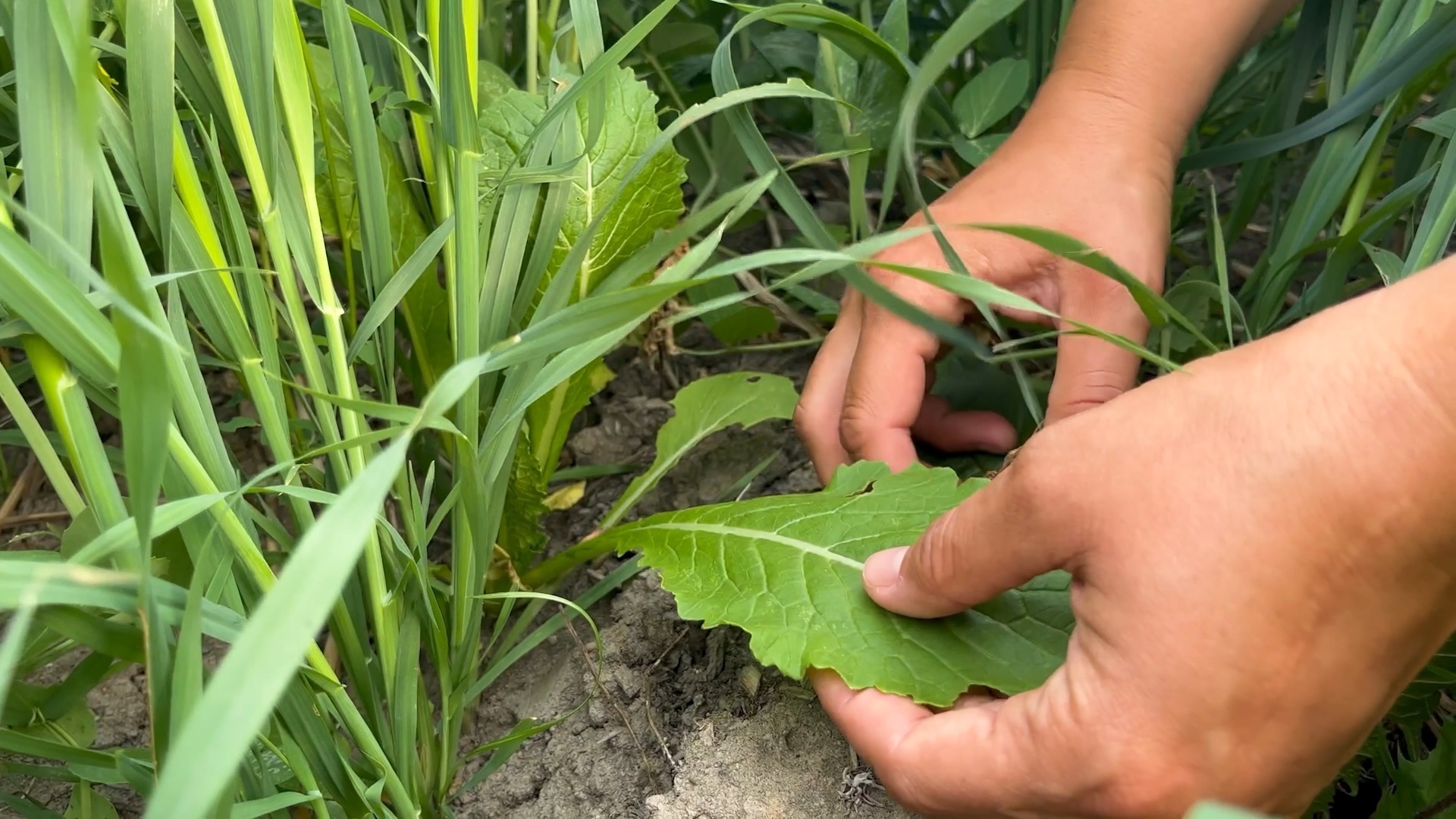
Pointing out the Hunter turnip-cross brassica, Jolene explained that while they cut at the end of August or September, there are still warm days after that.
“Even after a killing frost, these guys will come back, and with a completely basal growth habit,” she said. Gesturing at the base of the plant, she explained how there’s still enough leaf for photosynthesis and regrowth, while the tougher Goliath brassica has a thick stem and won’t regrow. And when you add in volunteer plants, such as chicory that was planted five or six years ago but keeps coming back, you have a lot of feed value.
Risk and Resilience
Another perk of swath grazing is that it boosts resiliency on the farm by spreading out risk. When a dry spell comes in May or early June, the hay crops and perennial pastures suffer. But, while the cover crops that are planted at the end of May won’t look great at first, they can take up the moisture that comes in July and August and turn into an extremely good crop.
On the other hand, if there’s early spring moisture and a dry summer, the hay crop will succeed while the cover crop may not. This spreads out the risk so at least one of the feed sources can take advantage of the moisture, no matter when that moisture comes or how long it lasts.
“We only take one hay cutting,” said Nora. “If that’s all we relied on, we would be in a really bad place for winter feed.”
While Jackknife Creek’s swath grazing program is tailored to their specific operation and local conditions, swath grazing is a viable option for many livestock producers, including organic farmers in British Columbia. For guidelines, considerations, and more details on the benefits of swath grazing, view the additional resources below.
“Cover cropping for swath grazing has been so beneficial to our operation, and we also feel it’s very beneficial to our soil too,” said Nora. “That diversity above ground is promoting diversity below ground, and we’re definitely seeing improvement in the health of our soils.”
Watch the video: youtu.be/FAIG7WdNjPU
Further reading: extension.sdstate.edu/swath-grazing
This article was funded in part by Agriculture and Agri-Food Canada through the BC Climate Agri-Solutions Fund delivered by the Investment Agriculture Foundation of BC.
Stacey Santos is the Communications Manager for Organic BC. She lives, writes, and gardens in the beautiful and traditional territories of the Lekwungen peoples, who are now known as the Esquimalt and Songhees Nations.
Featured image: Jolene Noble and Nora Paulovich overlooking their herd. Credit: Organic BC.